
Growing Your Business Through Community Involvement

As a small business owner, you have many opportunities to get involved in your community. Almost as soon as you announce that you are open for business, you may find yourself being courted by organizations asking you to join them. Generally speaking, becoming involved in these organizations can benefit your business in several ways.

By associating with local organizations and other business owners, you can:

  • Make new business acquaintances and contacts.
  • Increase awareness of your business.
  • Become part of a referral network.
  • Learn from more experienced business owners.
  • Engage in community events and service projects that benefit your community while also bringing attention to your business.

There are many positive reasons to engage in local business and civic organizations. There are also many different types of organizations to consider, including:

  • Chambers of Commerce
  • Service clubs, such as Rotary, Kiwanis, Elks, Eagles, and Lions clubs
  • Business referral groups, such as BNI

Each organization provides different benefits and requires a different level of involvement. The following chart provides a general comparison of the commitment and benefits you might expect from several common organizations.

OrganizationCommunity ServiceNetworkingReferralsLeadership
Chamber of CommerceModerateHighModerateModerate
RotaryHighHighModerateHigh
LionsHighModerateLowModerate
KiwanisHighModerateLowModerate
BNILowHighVery HighLow
ElksModerateModerateLowModerate
EaglesModerateModerateLowModerate

These are just a few of the organizations that business owners might join. Many other civic organizations and networking groups, as well as downtown merchants’ groups and industry associations, exist. Additionally, a business owner might be asked to support local schools, youth sports leagues, environmental groups, and other community causes.

Determine What You Want to Accomplish

With so many opportunities, it may be difficult to know which organizations to join. You do not have the time to join every worthwhile group, so you must decide which ones are right for you based on what you are trying to achieve.

Before joining an organization, consider your objectives. You may want to:

  • Generate sales leads.
  • Build referral relationships.
  • Meet community leaders.
  • Support community causes.
  • Recruit employees.
  • Learn business skills.
  • Gain visibility and credibility.
  • Advocate for business interests.
  • Develop leadership skills.
  • Build friendships and community connections.

Not every organization will help you accomplish every objective. For example, a referral group may be excellent for generating leads but provide fewer opportunities for community service. A service organization may offer great opportunities to serve your community and build leadership skills but may not focus on generating direct business referrals.

The key is to choose organizations that align with what you need and what you enjoy doing.

Evaluate Your Options

Once you know what you hope to accomplish, evaluate each organization you are considering based on several factors:

  1. How well will the organization help you achieve your objectives?
  2. How much time will membership require?
  3. How much enjoyment do you expect to receive from participating?
  4. Will you have access to potential clients and community leaders?
  5. Will the organization provide opportunities for professional and personal growth?

Time is an especially important consideration for a small business owner. While community involvement can help your business, becoming involved in too many organizations can take you away from the day-to-day responsibilities of running it.

Remember that membership alone is unlikely to produce significant results. Building relationships requires showing up, participating, and getting to know people. Choose organizations where you can make a meaningful commitment rather than spreading yourself too thin across too many groups.

Find the Right Combination

After you complete your evaluation, select a few organizations to explore further. Ask whether you can attend one or more meetings or events before deciding to join. This gives you a chance to see whether the organization is a good fit for you and your business.

Many business owners decide to join their local Chamber of Commerce or downtown business association, one service organization, their industry association, and one or more networking groups.

This combination can provide a balance of referrals, visibility, community impact, leadership development, and professional growth without overwhelming your schedule.

Community involvement should be more than simply putting your business name on a membership list. When you choose the right organizations and become actively involved, you can build relationships, strengthen your reputation, serve your community, and create opportunities that help your business grow.

What organizations have you joined that most benefited your business?
Expressing Employee Gratitude During the Holidays

If you are a small business owner, your employees are crucial to the success of your business. In case you need a reminder, you and your business benefit from your employees in many ways, including these:

Ability to meet the needs of more customers.
Your time is limited. Having employees extends your ability to provide goods and services to more customers. While your employees are making sales, closing deals, and answering questions, you are free to focus on other customers or handle the many administrative and marketing tasks required for your business to operate smoothly and profitably. More customers mean more revenue for your business.

Ability to take time off.
A solopreneur typically earns money only when working. Even if she operates an online store that processes sales around the clock, she must still ensure orders are fulfilled, payments are processed, and inventory is managed. However, a business owner with well-trained employees can take time away, confident that customers’ needs are being met and revenue continues to be generated.

Added skills and knowledge.
Each employee brings unique skills and talents to your business. Many will have expertise that can enhance your operations or take over tasks you don’t enjoy. For example, an employee with a flair for decorating and creativity can elevate your store windows, merchandise displays, and website in ways you might not have imagined.

Ways to Show Gratitude to Your Employees

During the Thanksgiving season, small business owners should make a special effort to recognize and reward the contributions of their employees. Here are some meaningful ways to express your appreciation:

Written or verbal expression of appreciation.
Write personal thank-you messages to each employee, mentioning a specific attitude, behavior, or achievement you particularly value.

Flexible work schedules.
Acknowledge that the holiday season can be hectic. Reward employees with four to eight hours of additional paid time off in December so they can attend school events, shop for gifts, or simply rest.

Holiday bonuses.
While many businesses give bonuses at Christmas or year-end, consider providing them at Thanksgiving instead. It’s a tangible way to express gratitude and allows your employees to use the funds to make their holidays even brighter.

Gift cards.
Help relieve holiday stress by giving gift cards for experiences your employees will enjoy—such as a massage, a spa day, a nice dinner, or tickets to a movie or play. Tailor the gift to each person’s interests when possible.

Thoughtful gifts.
A personalized gift of an employee’s favorite snacks or beverages, paired with a note of appreciation, is always meaningful. A gift basket with tea or coffee, cookies, and seasonal treats makes a warm and thoughtful gesture.

Employee appreciation meal.
Host a catered lunch or breakfast before Thanksgiving to celebrate your team. Consider closing for a few hours and posting notice ahead of time on your website and doors. Use the meal to share specific ways each employee contributes to the success of your business—and encourage team members to express gratitude for one another as well.

As we head into the busy holiday season, take time to express appreciation to your employees in ways that are meaningful to them. Doing so reinforces that you value them—and inspires them to give their best during this important season.

Please share ways you intend to express appreciation to your employees.

“I thank my God every time I remember you.”
Philippians 1:3

Strengthen Customer Loyalty Through Holiday Experiences

As a small business owner, it’s important that your customers feel connected to you—especially during the holiday season.

A genuine connection builds loyalty and encourages customers to choose your business over competitors. Two meaningful ways to build that connection are by giving back to your community and creating memorable experiences that engage your customers.

Give Back to Your Community

Sharing your blessings with those in need shows customers that your business cares about others. Many consumers today prefer to spend their money with companies that support meaningful causes. Here are some ways your business can give back this season:

Partner with local charities or food banks. Collect donations from customers and staff for organizations such as:

  • Toys for Tots—set up a collection box for toy donations.
    • Salvation Army Angel Tree—host an angel tag tree and accept gift drop-offs.
    • Samaritans Purse Operation Christmas Child—be a shoebox drop-off location.
    • Your local food bank—gather canned goods and other non-perishable items.

Donate a percentage of holiday profits.

  • Allow customers to choose which charity their purchase supports.
  • Partner with multiple nonprofits to appeal to a wider audience—such as a food bank, animal shelter, Make-a-Wish Foundation, or veterans’ organization.

Partner with nonprofits to provide hands-on service.

  • Team up with a local salon to provide free haircuts at a senior living center.
  • Partner with a disability support organization to host an accessible shopping day, with staff on hand to assist shoppers.
  • Offer free oil changes or car repairs for women living in shelters.

Volunteer together as a team.

  • Close your business for a few hours and volunteer as a group. You might host a holiday party for residents of a women’s shelter, wrap gifts for senior citizens, serve meals at a local soup kitchen, or deliver baked treats to police and fire departments. Volunteering as a team strengthens your workplace culture, boosts morale, and shows your customers that your business genuinely cares about the community.

Create Holiday Experiences

Festive events and experiences encourage customers to visit your business, linger longer, and connect on a personal level.

Host a Holiday Open House.
Many downtown districts hold open houses in November. Create an inviting, festive atmosphere with refreshments, music, and holiday décor. Offer exclusive open house deals or early-bird specials. If your business provides services, consider hosting an open house that also supports a local charity—guests could bring items or donations for a good cause.

Feature Local Artists or Makers.
Partner with local creators to showcase their work in your space.

  • A salon could host a jewelry maker or a permanent makeup artist.
  • A restaurant could feature local artisans in the lobby.
  • A retail shop could hold a trunk show with a vendor.

Host Customer Events.

  • Take photos with Santa or offer a festive photo backdrop.
  • Set up a cookie-decorating or ornament-making station.
  • Offer craft nights or centerpiece-making demonstrations.
  • Host game nights such as holiday bingo or trivia, with small prizes.

Hold Holiday Contests.

  • Run a children’s coloring contest with age-based prizes.
  • Offer daily giveaways for loyalty members.
  • Have a candy-jar guessing contest.
  • Reward customers who post reviews or engage on social media.
  • Post funny holiday photos and let followers caption them for prizes.

Wrapping Up

These ideas can help you connect with customers and strengthen relationships during the holiday season. Start planning your special events and charitable activities now, and you’ll create meaningful memories that keep your customers coming back all year long.

What are some ways your business engages with customers during the holidays? Share your ideas in the comments!

4 Workplace Trends to Embrace

The last four workplace trends from our quiz highlight positive employee behaviors. These include unbossing, job crafting, career cushioning, and acting your wage.

Each trend represents steps that employees or employers can take to foster growth, balance, and long-term satisfaction at work. As a business owner or manager, understanding these trends—and encouraging them where appropriate—can help you create a positive workplace culture and retain top talent.

Unbossing

Unbossing was popularized by the CEO of Novartis to promote servant leadership and empower employees. Today, many companies use it to replace rigid hierarchies with more flexible, collaborative structures. By removing layers of middle management, employees gain more autonomy, which often leads to higher engagement, better mental health, and increased innovation.

Key benefits of unbossing include:

  • Employees decide how and when they work, with accountability tied to outcomes and deadlines—improving work-life balance and motivation.
  • Teams self-manage workflows, goals, and performance, leading to faster decision-making and greater innovation.
  • Fewer management layers reduce payroll and overhead costs.
  • Leaders act as coaches and mentors, and employees communicate directly with leadership, reducing miscommunication.

Challenges for small businesses include:

  • Owners may struggle to let go of decision-making.
  • Without clear accountability, deadlines can be missed or productivity may drop.
  • Unclear authority may stall progress when final decisions aren’t made.
  • Small teams may lack experienced leaders who understand coaching-based leadership.

How to succeed with unbossing:
Clearly define goals, implement accountability measures, and encourage transparent communication. Tools like Teams, Trello, Slack, Zoom, or Monday.com can support collaboration and alignment.

Job Crafting

Job crafting occurs when employees reshape their roles to align with their strengths, passions, and values. This can include:

  • Task crafting – taking on projects that spark interest, using new tools to improve efficiency, or delegating less enjoyable tasks.
  • Relationship crafting – working with colleagues, mentors, or clients who inspire growth.
  • Cognitive crafting – reframing how one thinks about work to make it more meaningful.

Steps to begin job crafting:

  1. Reflect on your strengths, interests, and values.
  2. Choose one specific change to improve your role.
  3. Discuss changes with your manager if they affect tasks or clients (cognitive crafting is more personal).
  4. Test the change, measure its impact, and build from small successes.

Done well, job crafting boosts fulfillment while maintaining or even increasing productivity.

Career Cushioning

Career cushioning is the practice of preparing for your next role while still employed. Think of it as career insurance. Employees who career-cushion are proactive about growth and resilience.

Key practices include:

  • Keeping your résumé and LinkedIn profile updated.
  • Building professional relationships through networking and events.
  • Staying aware of job market trends and openings.
  • Upgrading skills and learning industry developments.
  • Developing side income streams to provide stability in case of job loss.

For employers, career cushioning shouldn’t be viewed negatively. Employees who stay sharp and connected often bring new skills and perspectives that benefit their current workplace.

Act Your Wage

“Act your wage” is a workplace trend where employees set healthy boundaries by working within the scope of their responsibilities and protecting their personal time. They push back against the expectation to constantly work overtime or take on responsibilities without fair compensation.

Why it matters:

  • For employees, it protects mental health, prevents burnout, and reinforces fair boundaries.
  • For managers, it highlights the importance of fair compensation, balanced workloads, and respect for personal time.

How employers can support this:

  • Avoid assigning tasks outside an employee’s job description.
  • Ensure workloads don’t require regular overtime, and encourage use of paid time off.
  • Provide raises or promotions when adding responsibilities.

Business benefits include:

  • Fair compensation and clear expectations.
  • Reduced burnout, turnover, and disengagement.
  • Stronger morale and job satisfaction.

Final Thoughts

In today’s competitive job market, attracting and retaining strong employees is more challenging than ever. Encouraging positive workplace behaviors—like unbossing, job crafting, career cushioning, and acting your wage—creates an environment where employees feel valued, empowered, and fulfilled. Employees who know their responsibilities, are fairly compensated, and enjoy a healthy work-life balance are far more likely to stay and thrive in your organization for years to come.

Spotting Negative Workplace Behaviors

Certain workplace behaviors signal deeper issues in the office environment. These behaviors often arise when employees feel unappreciated, overwhelmed, or pressured to keep working when they truly need a break. Business owners and managers should be aware of these behaviors so they can address root causes, create a healthier workplace, and retain valuable employees.

Presenteeism

Presenteeism occurs when employees come to work when they really shouldn’t. Most often, it happens when someone is sick, injured, mentally exhausted, or dealing with personal stress, but still shows up. It can also mean staying late until the boss leaves, even when there is no real work left to do. Employees often do this because they don’t have enough paid time off, they fear losing their job, they’re under pressure to meet deadlines, or they don’t want to miss important office conversations.

The consequences of presenteeism can be serious. An employee who is truly ill will not be able to fully concentrate, which increases the likelihood of mistakes and lowers productivity. Their lack of rest may actually prolong their illness, requiring more time away from work later. They may also spread their illness to others, which can impact the whole team. In the case of stress or burnout, presenteeism may cause poor performance, errors, or even long-term disengagement.

Employers can help reduce presenteeism by:

  • Providing sufficient paid time off so employees don’t feel forced to work while sick.
  • Establishing clear guidelines about when someone must stay home (such as with a fever or sore throat).
  • Allowing flexible work arrangements for employees who are injured but still able to work in some capacity.
  • Creating a culture of trust and support, so employees don’t fear taking needed time off.

Quiet Cracking

Quiet cracking is a subtle but harmful workplace behavior that develops when employees appear to meet expectations on the surface, but are struggling internally with stress, burnout, or discouragement. Over time, these pressures cause the employee to “crack” quietly, pulling back from engagement and beginning to detach from their role.

Quiet cracking may be triggered by an overwhelming workload, lack of training, or unclear job expectations. It can also stem from feeling unsupported, unrecognized, or uncertain about the future of the job market. The outward signs may look small at first, but they often grow into larger problems for both the employee and the business.

Warning signs of quiet cracking include:

  • Withdrawal from team interactions and social events.
  • Reluctance to volunteer for new assignments or projects.
  • Changes in mood, behavior, or productivity.
  • Missed deadlines or slow responses to communication.
  • Increased absences from work.

Employers can help prevent quiet cracking by:

  • Checking in with employees regularly and showing genuine interest in their well-being.
  • Expressing appreciation and acknowledging contributions.
  • Providing clear job descriptions and realistic expectations.
  • Offering training and career development opportunities.
  • Balancing workloads so responsibilities are spread fairly across the team.

Rage Applying

Rage applying happens when an employee, frustrated or upset with their current job, reacts by rapidly applying to multiple other positions out of anger rather than thoughtful career planning. This often follows a triggering event—such as being passed over for a raise or promotion—and is more about venting frustration than finding the right next step.

While rage applying can sometimes lead to new opportunities, it carries risks. Employees may accept a job that isn’t a good fit or feel more stressed from juggling interviews on top of an already difficult situation. They may also miss opportunities to improve their current role through open communication and problem-solving.

Employers can help reduce rage applying by:

  • Ensuring employees are paid fairly for the work they perform.
  • Offering multiple paths for career advancement within the company.
  • Providing clear expectations for promotions and the skills required to achieve them.
  • Maintaining an open-door policy for employee concerns and frustrations.
  • Avoiding excessive workloads that lead to burnout and resentment.

Proximity Bias

Proximity bias occurs when managers favor employees who are physically present in the office over those working remotely. This bias is often unintentional, as leaders naturally see and interact more with in-office employees. As a result, those working remotely may miss out on key assignments, recognition, and promotions simply because they are “out of sight, out of mind.”

If unchecked, proximity bias can damage team morale and create inequity between employees. Remote workers may feel overlooked or disconnected, while in-office workers may gain advantages that don’t necessarily reflect performance. Over time, this can erode trust and cause talented remote workers to leave.

Employers can reduce proximity bias by:

  • Including remote and hybrid workers in all staff meetings and ensuring they have equal access to tools and resources.
  • Training managers to recognize and correct unintentional bias.
  • Setting clear guidelines for remote work expectations and responsibilities.
  • Using tools like Teams or Slack to keep all employees connected and informed.
  • Evaluating performance based on outcomes, not physical presence.
  • Offering remote employees opportunities to lead projects and apply for promotions.

Final Thoughts

Workplace environments will always present challenges, but business owners can create healthier, more positive cultures by addressing these negative behaviors directly. Employees who feel valued and supported are not only more productive but also more likely to stay long-term, helping your company grow and better serve its customers.

Remote Work Trends You Should Know

The way we work has changed dramatically in recent years. Remote work, once limited to a few industries, became mainstream during the COVID-19 pandemic. What started as a necessity has now evolved into an expectation for many employees. Flexibility in work location is often used as a bargaining chip to attract and retain talent, and new workplace trends have emerged as a result.

In this blog, we’ll look at three of the most talked-about trends—coffee badging, workcations, and digital nomadism—and what they mean for small business owners and managers.

Coffee Badging

Coffee badging is when employees make a brief appearance in the office—long enough to swipe their badge, grab a coffee, and connect with colleagues—before heading home to work remotely. While not every employee literally swipes in, the term has stuck to describe this trend.

In fact, I sometimes coffee badge myself on days I work remotely. I’ll come in for a staff meeting, chat for a few minutes afterward, and then return home where I can be more productive without office distractions.

The positives of coffee badging:

  • Creates opportunities for employees to connect in person, which can spark collaboration and problem-solving.
  • Breaks the isolation of remote work.
  • Helps employees maintain visibility and presence in the workplace without being tied to the office full-time.
  • Supports work-life balance while keeping connections intact.

The drawbacks of coffee badging:

  • Brief interactions may not be enough to build strong teams.
  • Employees who live far from the office may be excluded.
  • Some workers show up only to be seen, without contributing.

How leaders can make coffee badging effective:

  • Focus in-office meetings on activities that benefit from face-to-face interaction.
  • Use these times to recognize and encourage employees.
  • Ensure fully remote employees aren’t left out of opportunities or recognition.
  • Create a welcoming environment with coffee, snacks, and comfortable spaces.

Workcations

A “workcation” happens when employees travel to a vacation spot but continue working while they’re away. The appeal is obvious—new scenery, a chance to unwind after work hours, and often a boost in creativity. But without boundaries, workcations can blur the line between work and rest.

Tips to make workcations effective:

  • Employees should communicate clearly with their manager about work hours, especially if in a different time zone.
  • Reliable internet is a must—check this before booking.
  • Take at least a few true vacation days during the trip to fully recharge.
  • Plan around mandatory meetings and let travel companions know your schedule.

Digital Nomadism

Digital nomadism goes a step further: it’s not just a week away, but a lifestyle of traveling and working from anywhere. Enabled by the internet, this trend has grown significantly in the last 15 years. Today, many digital nomads are not just freelancers but full-time employees negotiating this flexibility with their companies.

Benefits:

  • Flexibility to live and work anywhere.
  • Exposure to new cultures and lifestyles.
  • Potential for improved work-life balance.

Challenges:

  • Navigating work permits and visa requirements.
  • Understanding tax and employment laws.
  • Coordinating across time zones with colleagues.
  • Protecting sensitive company data abroad.

Final Thoughts

Remote work has created both opportunities and challenges. Coffee badging, workcations, and digital nomadism are trends that reflect employees’ desire for flexibility and balance. As a small business owner, you don’t need to embrace every trend, but it is wise to understand them.

Take time to evaluate which positions in your company can be done effectively outside the office. Develop clear guidelines for remote work, and balance flexibility with accountability. Done right, offering remote options can help you attract and retain top talent who might not otherwise consider your business.

Spotting Fake Productivity: A Guide for Small Business Leaders

Do you have employees who work through lunch, stay late, and still can’t seem to finish their tasks? They may be “clock botching.”

Or perhaps you’ve noticed employees doing the bare minimum to get by—often referred to as “quiet quitting.” Others may appear busy but aren’t producing meaningful results, a behavior called “task masking.” In the most severe cases, employees may be “ghostworking”—pretending to work while putting their time toward other activities.

While these behaviors aren’t new, the terms that describe them have gained attention in recent years. As I researched these patterns, I was surprised by just how many ways employees can appear busy while avoiding meaningful productivity.

For business owners and managers, recognizing these behaviors is critical. They don’t just reduce productivity—they often point to deeper problems in the workplace. Low morale, burnout, poor time management, or unclear expectations can all contribute. Identifying and addressing these behaviors is the first step toward creating a healthier, more effective work environment.

Clock Botching

Clock botching happens when an employee is on the clock but not truly engaged in their work. They may look dedicated—staying late or attending every meeting—but their output tells a different story.

Signs of clock botching include:

  • Working long hours with little to show for it
  • Stretching simple tasks over an entire day
  • Lack of engagement during meetings

This behavior is often unintentional. Employees may struggle with time management, feel burned out, or lack a sense of purpose in their work. As a manager, your role is to recognize the pattern and help them re-engage.

That may mean:

  • Having honest conversations about what’s behind the decline in productivity
  • Offering paid time off if burnout is an issue
  • Providing training or tools to improve time management
  • Setting aside time to prioritize and break down tasks together

Small changes—like using time management apps or weekly check-ins—can help employees regain focus and deliver stronger results.

Quiet Quitting

Unlike clock botching, quiet quitting is intentional. Employees complete only what is required of them—no more, no less. They may disengage from office activities, social events, or collaborative opportunities.

Common causes include:

  • Burnout
  • Dissatisfaction with pay or lack of career growth
  • Poor management or unclear expectations
  • Desire for better work-life balance

If you notice quiet quitting, start with self-reflection. Ask yourself:

  • Am I offering clear opportunities for growth?
  • Are employees fairly compensated?
  • Do I respect their personal time and boundaries?

If improvements are needed, acknowledge this and commit to change. If, however, your workplace provides fair pay, opportunities, and balance, and the employee still disengages, it may be time for them to move on.

Task Masking

Task masking is when employees look busy but produce little value. This can include shuffling papers, carrying laptops around, sitting silently in video meetings, or endlessly scrolling through emails.

Often, task masking thrives in organizations that reward “looking busy” rather than achieving outcomes. Pressure to appear productive—sometimes intensified by fears of being replaced by AI or being forced back into the office—can push employees toward this behavior.

To combat task masking, leaders should:

  • Set clear, meaningful goals tied to the company’s mission
  • Reward results, not just hours worked
  • Support flexible or hybrid schedules where possible
  • Build trust and enthusiasm through purposeful work

When employees know their contributions matter, they’re more likely to stay engaged and productive.

Ghostworking

Ghostworking takes task masking a step further. Employees not only appear busy but actively fake productivity—sometimes while job hunting, updating resumes, or browsing online.

Examples include:

  • Keeping a report open on-screen while doing personal tasks
  • Scheduling fake meetings to avoid accountability
  • Pretending to make calls while engaging in personal conversations

Research suggests 58% of U.S. workers admit to ghostworking regularly.

Ghostworking often arises when employees feel undervalued, insecure about job stability, or unhappy but unwilling to quit until they find another role.

Leaders can reduce ghostworking by:

  • Recognizing and rewarding real accomplishments
  • Building stronger engagement and connection with employees
  • Reducing workplace distractions
  • Ensuring fair compensation

When employees feel valued and connected, they’re less likely to disengage or fake their efforts.

Final Thoughts

Behaviors like clock botching, quiet quitting, task masking, and ghostworking may look like productivity issues on the surface—but often they point to deeper challenges in the workplace. Low morale, lack of recognition, poor management practices, and burnout are frequently at the root.

As a business owner or manager, your role isn’t just to spot these behaviors, but to ask why they are happening and address the cause. Clear goals, fair compensation, meaningful recognition, and a supportive environment go a long way in preventing these productivity killers. When you create a workplace where employees feel valued, motivated, and connected to your mission, true productivity—not just the appearance of it—will follow

Workplace Trends Quiz

I recently came across the term “clock botching,” which was new to me. Upon researching the term, I learned that it was coined earlier this month to describe a new workplace trend. That led me to explore other terms—many of which describe behaviors that have emerged in recent years.

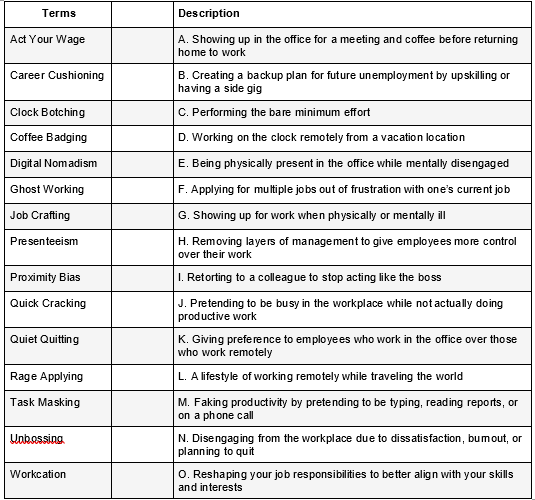
Test your knowledge! Match each workplace trend (left column) to the correct description (right column).

In the next few blogs, we will look at the factors that influenced these trends, the pros and cons of each, and how they impact your business.

Answer Key

  1. I — Act Your Wage
  2. B — Career Cushioning
  3. E — Clock Botching
  4. A — Coffee Badging
  5. L — Digital Nomadism
  6. M — Ghost Working
  7. O — Job Crafting
  8. G — Presenteeism
  9. K — Proximity Bias
  10. F — Quick Cracking
  11. C — Quiet Quitting
  12. F — Rage Applying
  13. J — Task Masking
  14. H — Unbossing
  15. D — Workcation

Leadership Mistakes: How to Turn Them Around

In recent blogs, we explored effective leadership approaches that help small business owners succeed. But many leaders still struggle to manage employees well. In fact, a study by Cake.com found that only 29% of employees trust their leaders, and just 20% believe they’re managed in a way that helps them work productively.

If you feel frustrated in your role as a leader, it may help to recognize which management styles are ineffective—and more importantly, how to correct them. Let’s look at four of the most common ineffective leadership styles and practical ways to overcome them.

Micromanagement

Micromanagers closely monitor every action their employees take. They resist delegating, and when they do, they often interfere with the work and demand constant updates. This creates an atmosphere where employees feel distrusted, fearful of mistakes, and discouraged from being creative. The result? Low morale, reduced productivity, and high turnover.

How to overcome micromanagement:

  • Acknowledge the behavior and identify the root cause. Is it fear of failure? Perfectionism? Lack of trust?
  • Start small by delegating low-risk tasks. Give clear expectations but avoid dictating every step.
  • Focus on goals and outcomes, not micromanaging the process.
  • Celebrate employee creativity and innovation.
  • Schedule regular check-ins rather than constant oversight.
  • Ask employees for feedback on how empowered they feel.
  • Invest in leadership development training—for yourself and your team.

Authoritarian Leadership

Authoritarian leaders make decisions alone, without input from their employees. While this style may feel efficient, it creates a fear-based culture, stifles creativity, and leaves employees disengaged.

How to shift away from authoritarian leadership:

  • Reflect on why you lead this way—often it’s driven by fear of failure or a need for control.
  • Invite feedback and listen to your employees’ concerns.
  • Delegate tasks and focus on results rather than process.
  • Adopt a coaching mindset: guide and encourage rather than command.
  • Encourage collaboration and shared decision-making.
  • Celebrate progress when you successfully empower employees.

Passive (Hands-Off) Leadership

At the opposite end of the spectrum, passive leaders avoid leading altogether. They focus only on their own tasks, leaving employees without direction or support. Conflicts go unresolved, decisions are delayed, and performance suffers.

How to become more engaged as a leader:

  • Acknowledge the avoidance. Remind yourself that you were chosen to lead because you are capable.
  • Ask your employees what they need from you and really listen.
  • Work with your team to set goals, priorities, and clear expectations.
  • Interact regularly and provide feedback—both praise and constructive guidance.
  • Gather information before making decisions rather than avoiding them.
  • Empower your team to make decisions and develop their skills.

Indecisive Leadership

Indecisive leaders procrastinate on decisions out of fear of mistakes. This creates confusion, frustrates employees, and causes missed opportunities for growth. Over time, employees lose confidence in their leader.

How to overcome indecisiveness:

  • Revisit why you started your business and define three priorities to guide your decisions.
  • Create a decision-making process (such as pros/cons lists or SWOT analysis).
  • Set deadlines to avoid procrastination.
  • Delegate decision-making where appropriate to reduce your burden.
  • Build confidence by making smaller, low-risk decisions first.
  • Accept that mistakes are part of leadership—learn from them and move forward.

Final Thoughts

As you can see, many of the corrective steps apply to more than one ineffective leadership style. Each plan of corrective action involves building relationships and trust with your employees. Whether you are a small business owner or a team leader within a company, your employees are your greatest assets. Treat your employees with respect and build their confidence so that they will partner with you to accomplish the goals of your company.

This blog concludes our leadership series, where we’ve explored both effective and ineffective leadership styles. Over the past several weeks, we’ve looked at transformational, servant, and coaching leadership—styles that inspire, guide, and empower employees. We’ve also examined the challenges of leading different generations in the workplace. Now, by addressing ineffective patterns such as micromanagement, authoritarianism, passivity, and indecision, you have a full picture of what to avoid and what to strive toward. Strong leadership is not about perfection—it’s about growth, self-awareness, and a commitment to creating a culture where both you and your employees can thrive.

Serve First:  The Leadership Style That Boosts Profits

In the last few blogs, we’ve explored six effective leadership styles: servant, transformational, results-driven, hands-on, adaptive, and coaching.

While no single style works best for every employee, servant leadership consistently ranked highest across most generations of workers. Beyond boosting morale and engagement, servant leadership can also improve the bottom line. A 2023 study found that business owners who shifted to a servant leadership approach saw an increase in profits.

What Makes a Servant Leader?

Servant leaders stand out by:

  • Allowing employees to share their feelings and suggestions
  • Listening to feedback from employees, customers, and stakeholders
  • Admitting mistakes and acknowledging they don’t have all the answers
  • Recognizing the contributions of others
  • Leading with authenticity
  • Committing to personal growth and improvement
  • Building a culture of trust and safety

Jesus modeled this style of leadership, reminding His disciples:

Whoever wants to become great among you must be your servant, and whoever wants to be first must be slave of all. For even the Son of Man did not come to be served, but to serve.”               — Mark 10:43–45

How Servant Leadership Benefits Businesses

Servant leadership doesn’t just feel good—it produces tangible results that can strengthen and grow a business:

1. Greater Employee Engagement

  • Employees feel valued, connected, and empowered in their roles
  • Engaged employees are more likely to stay, reducing costly turnover
  • Lower turnover = reduced hiring/training expenses = higher profits

2. Stronger Customer Relationships

  • Servant leaders prioritize customer needs and resolve issues quickly
  • Genuine care builds loyalty and trust
  • Better service and stronger relationships = repeat customers = higher revenues

3. More Innovation and Adaptability

  • Employees feel safe suggesting improvements and new ideas
  • A culture of trust encourages flexibility and openness to change
  • Increased efficiency and adaptability = happier customers = higher profits

4. Ethical Business Practices

  • Servant leaders model integrity in all dealings
  • Customers, employees, and partners are more likely to trust the business
  • Strong partnerships and customer loyalty = sustainable growth

5. Inspires Employees with a Sense of Purpose

  • Employees who believe in the mission bring passion and energy to their work
  • Purpose-driven employees are more productive and efficient
  • Greater productivity = lower costs = stronger profitability

Final Thoughts

Practicing servant leadership fosters a culture of trust, respect, and collaboration. These qualities not only make the workplace more positive but also contribute to long-term profitability.

The apostle Paul captured this spirit well:

Do nothing out of selfish ambition or vain conceit. Rather, in humility value others above yourselves, not looking to your own interests but each of you to the interests of the others.” — Philippians 2:3–4 (NIV)

When business owners choose to serve first, both people and profits thrive.