Is College a Good Investment for Your Child?

Many high school students automatically plan to attend college without genuinely considering their alternatives. The U. S. Census Bureau reports that while 59% of all Americans start college, 24% drop out without having earned a degree or a certification. Parents must convey the whole picture about the time and money required to earn a degree or a certificate in a specialized program. If God has called your child into a profession requiring college, they need to pursue the education with the knowledge of the steps it will require. Your job as a parent is to show them all the options. An opening question should be, Is college a good investment for you?

Father and daughter considering career options

Cost of Continuing Your Education

If they decide to pursue education beyond high school, you should help them count the costs and determine which path is best. Take some time to sit down with your son or daughter and add up college costs. Here are a few talking points:

  • Tuition, books, and registration fees
  • Room and board, if you live on campus
  • Fees to participate in sports, fraternities or sororities, clubs, and activities
  • Travel to and from school, if you do not live on campus
  • Foregone income from delaying full-time work while completing your education

Minimizing the Costs of Education

There are ways to make college or a certification program more affordable. Some of these are:

  • Attending a college close to home and commuting rather than living on campus
  • Attending a local community college to get your Associate’s Degree before transferring to a four-year college
  • Earning college credits while in high school through AP classes and dual-enrollment programs
  • Knowing what your goals are in attending college. Many people waste time and money by taking classes without real purpose, or they switch colleges and lose some of their credits.
  • Taking classes online from home
  • Working part-time or full-time while taking classes
  • Earning a vocational certificate rather than a two-year or four-year degree

As you pray with your child about their career path, you should consider vocational alternatives to careers that require college degrees. Many professional service provider careers are in high demand and pay well. There will always be a need for plumbers, electricians, HVAC technicians, and welders. These careers require training beyond high school, but they can learn on the job through apprenticeship programs. This is also true for heavy machine operators and some IT professions. Your son or daughter may be able to earn a cosmetology license or skilled labor certificate while in high school if the school offers those programs.

According to the Bureau of Labor Statistics, about 169 occupations require a bachelor’s degree, and another 100 require a Master’s or higher degree. On the other hand, there are about 100 occupations that require an associate’s degree or vocational certification and about 425 that do not need any formal education beyond a high school diploma  https://www.bls.gov/careeroutlook/2020/article/education-level-and-openings.htm

As you consider together whether college is in their future, they should only go if it makes wise financial sense and if it aligns with God’s plans for their life. Suppose God has called your child to be a physician, a teacher/professor, an attorney, a minister, or many other careers. In that case, he or she must spend many years gaining the necessary education. However, if God has called him or her to be a businessperson, an inventor, a writer, a hairstylist, a plumber, an electrician, or one of many other careers, they may need only to obtain vocational training or on the job training.

If you sit with your child and connect with their visions and goals, they are more likely to make an educated decision about their future. Often, kids get to college and flounder because they don’t know what major to declare. Advisors can persuade them to take all their electives and then decide. However, a community college is a smart alternative if that is the case. Students can complete their electives much cheaper and then move to a state college to declare a major. 

The Bible tells us that God has a beautiful plan for each person’s life. Ephesians 2:10 says, “For we are His workmanship, created in Christ Jesus for good works, which God prepared beforehand that we should walk in them.” God prepared your child to do the work He designed them to complete. He has empowered your child with the skills and desire to do that work. Allow Him to show you and your child His plans and then help your child prepare to fulfill those plans by obtaining the training or education needed to achieve those plans.

How to Create a Personalized Budget – “One-Size Does Not Fit All”

Do you find that you run low or out of money before the next paycheck arrives? Is your credit card full of charges that never fully get paid off, and you wish for a month with no unexpected expenses so that you can have a chance to get caught up? If you are not budgeting and planning your income, this is probably a familiar situation for you.

Budgeting Pie Chart

Many people try to create a budget a few times a year and some even stick to it, while many others find it difficult. Maybe you have even tried and found that you could not make it work. That’s because “ideal” budget percentages are based on the “average” person or family, and you are not “average.” You are a unique person, or family, with your own needs and priorities. You need to create a budget that works for you. Before we look at some tips to help you create a budget you can live with, let’s look at an ideal budget for an average household.

The median household income across America is currently $69,000. It consists of 2. 6 people—typically two adults and one child. The table below shows the “ideal” percentages that should be spent for each of the major spending categories, along with the annual and monthly amounts for each category.

Spending CategoriesPercentagesAnnual
Amount
Monthly
Amount
Housing (rent or mortgage, utilities, internet, homeowners/renters insurance, phone, cable)36%$24,840$2,070
Food (groceries and eating out)12%$8,280$690
Automobiles (car pymt, gas, insurance, maintenance and repairs12%$8,280$690
Medical (insurance and bills)5%$3,450$287.50
Clothing5%$3,450$287.50
Entertainment5%$3,450$287.50
Life Insurance5%$3,450$287.50
Savings5%$3,450$287.50
Debt Reduction5%$3,450$287.50
Miscellaneous10%$6,900$575

At first glance these numbers might look doable, and depending on where you live, maybe these are very realistic numbers.  However, where I live, it is hard to keep monthly housing costs to $2,070.  The average monthly rent for a one-bedroom apartment is $1,750.  That leaves $320 for utilities, internet, insurance, phone, and cable.  A careful consumer might be able to manage that.  However, an average family needs more than one bedroom, making it harder to stay within the budget for housing.  Automobile expenses are also challenging.  Currently, the average new car payment is $719, and the average payment for a used car is $527.  When you add in fuel, insurance, and repairs and maintenance, you will almost certainly exceed the $690 budgeted amount.

In order to create a budget that works for your household and one that you can stick with, you will have to make some difficult choices. 

Use these guidelines to help you make the decisions which are best for you and your family.

  1. Determine your needs based on the number of people in your family and your career.
    a. The more people in your family, the larger the home and vehicle you need.
    b. Each person requires food, clothing, and health care, so larger families need to allocate more money to those items.
    c. If your job requires professional or business attire, you will need to allocate more money for clothing.
    d. If you are required to drive your car for work, you will need a newer, reliable vehicle.
    e. Does your household require more than one vehicle for multiple drivers?
    f. Do you need to allocate money for childcare while you are working?
  2. Determine your priorities.
    a. Do you want each child to have their own bedroom, or can children share bedrooms?
    b. Do you want to have a short commute to work?
    c. Do you want to live in a specific community? Or a community with specific amenities?
    d. Is it important to you to have a new car every few years?
    e. Do you want your children to attend a specific school? Do you want them in a private school which will require you to pay tuition?
  3. Consider the alternatives.
    a. You may be able to afford a larger home if you are willing to commute farther to work.
    b. You may be able to live closer to work or in your preferred community, if you are willing to forgo a desired bedroom or other amenity, such as a den, garage, or extra bathroom.
    c. You may have access to safe, reliable public transportation, allowing you to forgo vehicle ownership.
    d. You may be able to continue to drive an older car by engaging in ride sharing to work and renting a car for longer trips.
    e. You can save money on food by packing lunches and cooking most meals at home.
    f. You can save money on recreation by taking advantage of free sources of entertainment and recreation.
    g. If you are single or a single parent, you could save money on housing by sharing a home or renting out a spare bedroom to a tenant.
    h. You may be able to telework full-time, or several days a week, which will reduce fuel expenses and perhaps childcare expenses.
  4. Use the “ideal” budget percentages to create a base budget. Use these budget numbers to help you see the areas in which you are overspending and underspending. Then, adjust your budget based on your current expenses and your needs.
  5. Refine your budget based on your priorities.
  6. If your expenses exceed your income, you must make additional adjustments. Consider the alternatives and make decisions based on which alternatives will best meet your needs and come closest to meeting your priorities

Creating a budget is not an easy task, but it is an important one.   It will allow you to meet the needs of your family and relieve much of the stress you are currently facing.

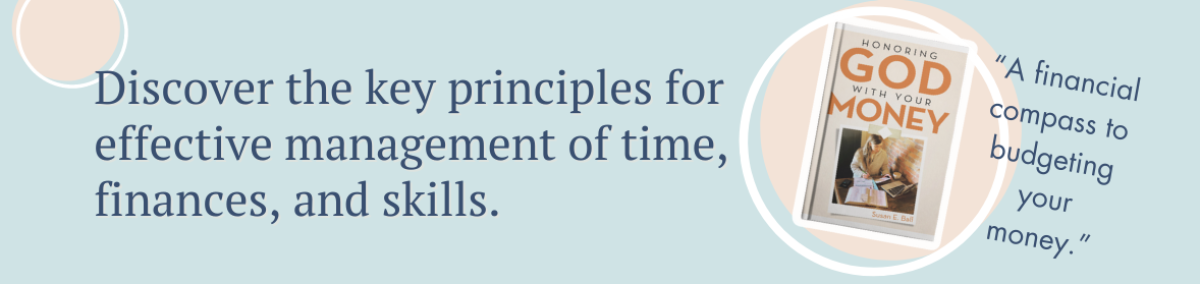
To learn more about how to honor God with your money and build treasure in Heaven, please click the Finances categories tab to find many blogs on money management, budgeting, and stewardship. My book Honoring God with Your Money is a great tool for financial money management.

Methods for Tracking Spending

Have you overdrawn your bank account recently?  Are you running up balances on your credit cards because you don’t have enough money to cover your monthly expenses? Do you find yourself wondering where all your money went? Do you want to save money for a memorable trip, yet find your savings balance decreasing rather than increasing?    If you answered yes to any of these questions, you need to create a budget and set financial goals.

Creating and sticking to a budget will allow you to stay out of debt and achieve your financial goals.  However, you need to know where your money is going before you can create a budget that will work for you. Start by tracking your spending for a few months.

Cell phone with spending app open

In times past, most people tracked their spending using a notepad and pen. I recently found a spiral notebook that my grandmother used to record her spending in 1956. She used a separate page for each month. She listed her take home income at the top of the page and carefully noted each expense. As a single woman, she brought home about $275 each month, so it was imperative that she managed her money well. This method still works well if you faithfully write down all your expenditures.

I am a big fan of spreadsheets. When my husband and I started our own home twenty-five years later, I used a pen and paper method, too. But, a few years later, when Lotus 1-2-3 (precursor of Excel) was introduced, I graduated to using a spreadsheet to track income. Today, I use Quicken to track and balance my bank accounts, and I use a spreadsheet to develop our budget. I balance my checkbook every week or two to be aware of my spending and how much money is in my accounts.

Other people use different methods. I have friends who use the envelope system. On each pay day, they cash their checks, put their budgeted savings into their savings account, and allocate the rest toward expenses. The money for each expense category goes went into a separate envelope. They pay cash for all expenses, and when the envelope is out of cash, they spend no more on that category for the remainder of the money.

Today there are many apps to help you track your spending. Some can be connected to your bank accounts and credit cards. Some apps simply track your spending, while others allow you to input spending parameters and are indeed budgeting tools. Apps benefit those who do not balance their checking accounts regularly. According to StatisticBrain.com, 79% of people rarely or never balance their checking accounts.

Some of the most popular spending apps currently are:

  1. Mint. This free app can sync to your bank accounts and credit cards. It allows you to set goals, track investments, and be reminded of when to pay bills. It will also alert you when you have exceeded your spending goals.
  2. YNAB (You Need a Budget)–This zero-based budgeting system lets users allocate all income into spending categories, debt reduction, and savings. It also lets users set goals. The downside is that after the free 34-day trial ends, you must enroll and pay a monthly or annual fee.
  3. Goodbudget. This system mimics the envelope method. The user assigns an amount to each “envelope.” This method does not connect to bank accounts or credit cards, so the amounts must be entered manually. This is a good version for those who do not want all of their accounts connected. There is a free version, but if you want to track more than a few categories, you may need to pay a fee.
  4. Every Dollar. This method is similar to my method of recording expenses in Quicken and using a spreadsheet to track totals. Like Goodbudget, it does not connect to bank accounts or credit cards. All expenses must be entered manually. It does allow the user to set reminders to pay a bill.

There are many other apps available that you might want to consider. Choose a method based on compatibility with your style and personality. Mint or YNAB might be a good choice if you want to connect all your accounts without entering expenditures manually. On the other hand, these systems may not be suitable for you if you worry about identity theft and the risks of having things too automatic. So, set aside a few hours to evaluate the options available and decide to start using one of them to track your expenditures.

If you need help to learn to manage your money and improve your credit, please check out some of my other blogs on Finances, Money Management, and Stewardship. My book Honoring God with Your Money is a great tool for financial money management.

For more money management tips, subscribe to my quarterly newsletter: newsletter signup

Letters to Mother from College

Title of book, Letters to Mother from College, and a picture of a college dorm on a southern campus

New Book—just published 

My newest book, Letters from Mother from College, is now available on Amazon. 

Will Polly discover God’s plan for her life in a small southern college?

Letters to Mother from College was inspired by the letters my mother wrote home during her first two years of college.  Mom was the only child of a single mother, and they were very close.  At 17 years of age, Mom left her home in Pennsylvania to attend a small college in a small Southern town.  Everything was new and different, and Mom wrote about her experiences in frequent, lengthy letters.  It appears that my grandmother kept every letter my mother ever wrote to her.

We discovered the letters after my grandmother passed away.  Mom wanted to toss the letters, but I took them and kept them for “safe keeping”.  Occasionally, I considered ways to share the letters with my siblings.  I began reading them in order a few years ago, after my own mother had passed,  and they were enlightening and engaging.  The letters inspired me to write at story, and I simply needed to add some details.

The letters provided the framework for the novel.  Many of the details were added from family stories that my mother told us or were fabricated from my imagination.  However, the primary elements of the story are the actual experiences my mother had as she adjusted to college life and being away from her family for the first time.

I hope that you will enjoy this look at college life in the 1950’s.  Polly discovered that God was directing her path and had a wonderful plan for her life.  God also has a wonderful plan for your life.  I pray that you will open your heart to the Lord and allow Him to direct your footsteps.

“And we know that in all things God works for the good of those who love him, whohave been called according to his purpose.”  Romans 8:28

If you have never considered that God loves you and created you for a purpose, you may not have experienced the joy of knowing Jesus Christ as your Savior and having your sins forgiven. Please click on Basics of Salvation in the tool bar above to learn how you can invite Jesus to be your Lord and Savior.


Time Management, Creativity, and REM Sleep

I have a good friend, Johnnie, who has expertise in many subjects, including time management. Time management is essential for Johnnie, as she balances family time, church service, and volunteering with SCORE with the four businesses she currently owns and manages. She also manages to include exercise, prayer, and devotional time into each day.

Earlier this week, I asked Johnnie how she plans her days and if she devoted some time each day to each business or if she focused on different businesses on different days of the week. This lead to Johnnie sharing some her time management tools. In the course of the conversation, she mentioned the importance of being quiet and still for a few minutes upon waking to continue in the creative sphere of REM sleep. I had never before considered that sleep had an impact on creativity, although I read studies that demonstrated that long period of quiet are a boost to creativity.

Coffee, note pad, and flowers
Photo by Lum3n on Pexels.com

Despite this being a new concept to me, I immediately recognized the truth of Johnnie’s statement from my own experiences and those of my husband, Steve.

Steve is a civil engineer. He deals with complex issues in designing sites for buildings and subdivisions and coming up with a good solution is often challenging. He is prone to wake up in the early hours of the morning with a solution having come to his mind. It is not uncommon for him to rise at 4 or 5 am to work on a plan. I believe that these solutions arise from the creative state the brain enters during REM sleep.

Personally, I have found that I if I can stay in bed and be still for a few minutes after waking that I will have a creative spurt. Suddenly, I am inspired with ideas for the next scene for a novel I am working on or a blog post to write.

If you want to increase your creativity, I encourage you to spend some time in the morning being quiet. Let your creative mind continue to work after sleeping, and listen for the still, small voice of the Lord speaking into your life.

Some of Johnnie’s other time management tips included (1) start the day with worship–she exercises to praise music, (2) schedule a time of prayer at the beginning of each day, (3) set aside one or two days a week to be less busy and more focused on projects that require concentration and/or creativity, (4) turn off your phone and ignore email for blocks of time each day, and (5) schedule most meetings on one or two days a week.

Woman with journal and a cup of coffee
Photo by Alina Vilchenko on Pexels.com

Johnnie is the author of Legacy Moments–Transformation that goes Beyond Change. You can learn more about Johnnie and her coaching services at JohnnieLloyd.com

To learn more about how to be a faithful steward of your financial resources, please click the Finances categories tab to find many blogs on money management, budgeting, and stewardship. My book Honoring God with Your Money is a great tool for financial money management.

The Peace that Passes Understanding

My mother used to love to tell the story of how I came home from Sunday school when I was five talking about “the peas is pass is.”  She was quite puzzled and was unable to decipher what I was trying to say.  The next Sunday she asked the teacher, who explained that I was trying to say, “the peace that passes.” We had sung the song “I’ve Got the Joy, Joy, Joy” in class.

One of the lines of the song goes link this: “I’ve got the peace that passes understanding, Down in my heart, Down in my heart to stay.”

As a five-year old, I had no clue what “the peace that passes understanding” was. It is a fun catchy song that has stuck with me through the years. Over a lifetime, I have experienced many instances of this amazing peace.

The song comes from Philippians 4: 6, 7, “Be careful for nothing; but in everything by prayer and supplication with thanksgiving let your requests be made known unto God. And the peace of God, which passes all understanding, shall keep your hearts and minds through Christ Jesus” (King James Version)

White dove. The dove represents the Holy Spirit, who brings peace into uor hearts.
Photo by M Sidharda on Pexels.com

The New King James Version begins “Be anxious for nothing.”  This exhortation was needed in the days of the early church as followers of Christ faced intense persecution.  They had much to fear, yet Paul admonished them to not live in fear, but to come to the throne of God with their needs and to trust God to meet those needs.

This directive is still pertinent today. We face threats and stress from many sides.  Some threats are applicable to every person who lives: financial stress, health challenges, political unrest, and economic pressures. Other threats are directed specifically at the Church. As Christians, we are under intense pressure to compromise our beliefs and our values in the name of being politically correct. Christianity has not been outlawed as it was in Paul’s day, but Christians are under attack daily.

And God is still the answer. When we bring our trials, challenges, and tribulations to the throne of God, the Holy Spirit fills us with God’s peace.  A peace that does not make any sense—that surpasses our understanding.  In those moments, we know that our lives are in God’s hands. He is walking beside us through each and every trial.

Whatever you are walking through today, do not be filled with anxiety.  Rather, bring your needs to God, with thanksgiving.  God will hear you, and He will walk this path with you.  Then you will experience the peace that the world cannot offer.

Bring your problems, your worries, and your cares to God.  “Humble yourself under the mighty hand of God, that He may exalt you in due time, casting all your cares upon Him, because He cares for you.”  I Peter 5: 6, 7

Grocery Shopping Amid Empty Shelves and Rising Inflation

The government announced last week that the inflation rate for December 2021 was 7%.  This is the highest rate of inflation since 1982.  Two of the hardest hit sectors were energy and food.  MarketWatch reports that prices for eggs have increased more than 20%, beef and chicken prices are up 13 – 15%, and coffee is up 10%. 

To make matters worse, grocery prices are expected to rise another 5% in 2022.  The biggest increases are expected to be for steak, chicken, mayonnaise, eggs, cereal, and vegetables.

Additionally, grocery shelves are emptier than we are used to seeing them.  Inflation and shortage combine to make feeding your family more challenging than we are used to dealing with in America.  And it is wreaking havoc on family budgets.

To keep your budget in balance, you must (1) find ways to keep your grocery spending within your means or (2) cut expenses in other areas and allocate more money for groceries.

Photo by Kevin Malik on Pexels.com

So, I am offering these ideas to help you eat well and stay within your budget.

  1. Eliminate waste. Americans waste on average one pound of food per person per day.  To reduce your food waste:
    • Plan meals and shop using a list.
    • Check the vegetable bins in your refrigerator daily to assess what needs to be eaten and plan meals accordingly.
    • Keep a food log, so you know when you cooked each dish.  Check log to see what needs to be eaten first.
  2. Make the most of leftovers—turn leftovers into soups, casseroles, and sandwich fillings.
  3. Buy cheaper cuts of meat and cook in a crockpot or instapot to tenderize.
  4. Buy store brands. You may have to try multiple stores to find the brands you like best.
  5. Shop at multiple stores to get the best buys and find items that were out of stock at your usual store.  Plan trips, though, to save gas and time.
  6. PLAN, PLAN, PLAN—but be prepared with backup plans, as shortages are expected to continue.
  7. Plant a garden and grow some of your own produce.
  8. When you find a good price for produce, stock up and freeze or can the excess.
  9. Shop at Discount stores, such as Wal-Mart, Costco, and Dollar General.
  10. Buy less than perfect or ugly produce.  Prepare immediately or process to eat later.
  11. Purchase meat that is nearing its sell-by date and has been marked down. Cook immediately or freeze.
  12. Invest in food storage dishes to keep leftovers.
  13. Invest in a vacuum sealer to freeze uncooked meats and leftovers to be eaten later.
  14. Search Pinterest and other internet sites for new recipes using ingredients that you have on hand.
  15. Challenge yourself to come up with new recipes using items you have in your pantry.
  16. Ask God for wisdom to help you make wise shopping decisions.  “If any of you lacks wisdom, let him ask of God, who gives to all liberally and without reproach, and it will be given to him.” James 1:5

I hope that you will find some of these tips to be helpful as you navigate empty grocery shelves and higher food prices.

What grocery saving tips can you add to this list?

You will find additional information on creating budgets and managing your finances in many of my other blog posts by clicking on the Finances tab on the right. If you have money questions you would like me to answer, you may email me at susan.ball5@aol.com or write your question in the Comment section.  

Those who email me will be signed up to receive my free quarterly newsletter with money management tips, encouraging stories, and Scripture inspirations.  For those desiring a better understanding of Biblical principles of money management, I have written a book Honoring God with Your Money. It is available on Amazon and from Barnes and Noble.

Last-Minute Donations

2021 is quickly drawing to a close. However, there’s still time an impact in the lives of others by making tax-deductible donations before the clock strikes midnight on December 31.  Here are some ideas.

  1. Operation Shoebox.  Shoebox collection week has come and gone.  However, you can still participate in Operation Shoebox by packing a shoebox online at https://www.samaritanspurse.org/operation-christmas-child/buildonline/   You select the items you want to include in your box, and volunteers will pack the boxes, which will be delivered in the coming months.  You can also donate $9 to deliver a box that another person has packed.
  2. Samaritan’s Purse Gift Catalog,  You can purchase gifts year-round to help those in need.  Gifts options include providing food to hungry children, purchasing chickens or honeybees to help a family start a business, providing clean water for a community, rescuing children in crisis, and assisting refugees.  Learn more at:  https://www.samaritanspurse.org/our-ministry/gift-catalog/
  3. Disaster Relief.  Every year many communities are impacted by natural disasters. Many, many families lost loved ones, homes, and belongings in the tornadoes that ravaged five states recently.  A super typhoon struck the Philippines days before Christmas. Please consider making a donation to an organization that provides disaster relief.  These organizations include:
    1. The Red Cross https://www.redcross.org/
    2. Convoy of Hope  https://convoyofhope.org/
    3. Salvation Army https://www.salvationarmyusa.org/usn/
    4. Samaritan’s Purse   https://www.samaritanspurse.org/
  4. St. Jude’s Children’s Hospital– https://www.stjude.org/  Make a donation to help a critically ill child get needed treatment at no cost to their parents.
  5. Your local food bank.  Food banks serve their communities year round to ensure that everyone has access to healthy food.
Photo by RODNAE Productions on Pexels.com

There are many, many other charitable organizations that are fulfilling Christ’s command to care for those in need. Pray earnestly about which organizations God would have you support.

“Then the King will say to those on His right hand, ‘Come, you blessed of My Father, inherit the kingdom prepared for you from the foundation of the world: for I was hungry and you gave Me food; I was thirsty and you gave Me drink; I was a stranger and you took Me in; I was naked and you clothed Me; I was sick and you visited Me; I was in prison and you came to Me.’”

“Then the righteous will answer Him, saying, ‘Lord, when did we see You hungry and feed You, or thirsty and give You drink? When did we see You a stranger and take You in, or naked and clothe You? Or when did we see You sick, or in prison, and come to You?’  And the King will answer and say to them, ‘Assuredly, I say to you, inasmuch as you did it to one of the least of these My brethren, you did it to Me.’ ” Matthew 25:34-40

NOTE:  Donations sent by mail and postmarked by December 31 are considered as 2021 donations, regardless of when they are received. 

Photo by Liza Summer on Pexels.com

Thankful for Blessings

“Enter into His gates with thanksgiving and into His courts with praise.”  Psalm 100:4

As our nation celebrates Thanksgiving, I encourage each of you to pause for a few moments today to reflect on the many blessings God has bestowed upon you in the past year. Certainly, 2021 has more than its share of challenges. It would be easy to focus on the interruptions in our lives caused by covid and rising prices for food and gas. However, we all still have much for which to be thankful.

Grateful Thankful Blesses

The Bible is replete with the command to thank God for His goodness, as we read in Psalm 95: 1- 7:

Oh come, let us sing to the Lord!
Let us shout joyfully to the Rock of our salvation.
Let us come before His presence with thanksgiving;
Let us shout joyfully to Him with psalms.
For the Lord is the great God,
And the great King above all gods.
In His hand are the deep places of the earth;
The heights of the hills are His also.
The sea is His, for He made it;
And His hands formed the dry land.

God is our creator.  He made us, and He is worth of our praise and our outpourings of thanksgiving.  “Know ye that the Lord he is God: it is he that hath made us, and not we ourselves; we are his people, and the sheep of his pasture.” Psalm 100:3

Today and every day, we need to express our gratitude to God for giving us life, for providing a beautiful home for us to reside in this life, and for sending His Son to redeem us and make provision for us to live eternally with God in heaven.

May your heart overflow with gratitude for our wonderful Lord.

Cornucopia and Happy Thanksgiving

Thanking Those Who Provide Service


My life was made much easier during the past year and a half by those who did not have the option of working from home and social distancing.  Grocery clerks, postal workers, delivery people, truck drivers, and many other were out in the public every day so that the rest of us had access to the things we needed.  Thanksgiving is a great opportunity to thank those who sacrificed for the rest of us. 

Here’s some ideas to show appreciation:
1) Hand-written note.  Do you know that is takes only about 3 minutes to write a thoughtful, sincere thank you note?  Set aside time each week between now and Thanksgiving to write a couple of thank you notes to those who have most impacted your life during covid. If you will mail your cards, allow extra time as postal deliveries are taking longer than in the past.

2) Gift cards.  Consider purchasing gift cards for those who provide services to you regularly. Gift cards can be included with thank you notes, or you can write a quick “thank you for your service” message on the card. Of course, budget for the gift cards and stick to your budget. A sincere thank you is more important than the amount of the card.

3) Holiday tipping. Many of us tip those who provide service to us more at Christmas than at other times. This year, consider giving tips at Thanksgiving instead of, or in addition to, your Christmas tip. 

Thank you note and flowers
Photo by Giftpundits.com on Pexels.com

As you take time this Thanksgiving to meditate on God’s blessings, ask Him to bring to your mind those who have made your covid-experience more comfortable. He will guide you to remember those who will be truly blessed by your heartfelt and sincere message that you have been blessed by their hard work and sacrifice.