Plan for Christmas Charity Now

It’s 135 days until Christmas. You may be wondering why I am writing about Christmas in the middle of August. The summer days are hot, and school children are preparing to start back to school. Christmas is 4 ½ months away. So, why am I talking about Christmas charity now? There are several goods reason to plan for Christmas giving this month.

Now is the time to decide how much your budget will allow you to give and spread your donations over the next several months. Planning for your charity is much easier on your wallet than making all your donations in December. If you plan to pack Christmas boxes for Operation Christmas Child (https://www.samaritanspurse.org/what-we-do/operation-christmas-child/), decide now how many boxes you will fill and the gender and age of the children for whom you will pack boxes. Keep an eye out for items and purchase them when on sale and as your budget allows. When school supplies go on sale this month, grab extra to add to the packages going overseas for the children. It’s not too early to buy new toys to donate to Toys for Tots (https://www.toysfortots.org/default.aspx) or save money to contribute to the Salvation Army’s Angel Tree program (https://salvationarmynca.org/angeltree/.

Pray thoughtfully about how you can participate in supporting these organizations. Can your business place a collection bin for Toys for Tots? Can you promote Operation Christmas Child to your church and organize the shoebox collection? Can you share information about Prison Fellowship’s Angel Tree program with others in your church and your network of friends? (https://www.prisonfellowship.org/about/angel-tree/angel-tree-christmas/) These activities do not cost money but require an investment of time. Now is the time to register as a collection site and order resources to promote the programs you wish to support this year.

Volunteer time at one of these charitable organizations. It takes many volunteers to sort presents, check shoeboxes, and deliver gifts. If God puts a burden on your heart to get more actively involved, be obedient. Most of these organizations are actively soliciting volunteers year-round. Application forms are available online now so that they can make plans and train volunteers.

Actions you can take right now:

  1. Order shoeboxes and promotional materials for Operation Christmas Child from Samaritan’s Purse.
  2. Register to be a Salvation Army Angel.
  3. Donate money to Prison Fellowship’s Angel Tree program.
  4. Shop for new toys to donate to Toys for Tots.
  5. Volunteer to help an organization and begin any training required.

Remember that Christian charity should be year-round, not just during the holiday season. Our schedules stay full, and adding charity to our time requires planning ahead. As you are able, make donations to local food pantry ministries to feed the hungry, give to One Simple Wish (https://www.onesimplewish.org/) to make wishes come true for kids in foster care, write letters to soldiers to let them know you appreciate their service and send them through We Are Here (https://www.operationwearehere.com/ideasforsoldierscardsletters.html), and send children to summer camp through Prison Fellow or the Salvation Army.

As you bless those in need in tangible ways, God will use your donations of money and time to be His hands extended. Your kindness might be the key to letting someone know they are not forgotten, and God loves them. There is no greater gift you can give someone than helping them to open their heart to God and accepting His free offer of forgiveness of sins and eternal life

My book Honoring God with Your Money provide more information about how to decide which charities to support and how much you can afford to donate.

Do You Have What It Takes to Be A Business Owner?

Are you among the millions of Americans who dream of owning a business? People want to own their own business for many reasons, and the most common one I encounter is: “I want to be my own boss.”  

Factors to Consider in Business Ownership

Business ownership has many advantages, including running the business how you want to run it and calling the shots. If you are a successful business owner, you will likely earn much more than you could as an employee. Many people, however, do not succeed as business owners. My job as a small business consultant is to equip people with the tools to help them succeed.

Here are some factors to consider when evaluating whether business ownership suits you.

  1. It is hard work. After many years, you may achieve a level of success that allows you to depend on your employees to run the business when you take a vacation. However, your work situation will likely differ significantly in the early years. You may work 40 – 60 hours in your business and then another 20 or more hours to pay the bills, make the work schedule, invoice clients, complete the payroll, promote the business through marketing and networking, and plan for the company’s future.
  2. It requires good organizational skills. Business owners typically wear all the “hats” in the first few years of the business. You will be the manager, salesman, accountant, and marketer. You will take inventory, order supplies and merchandise, stock the shelves, write proposals, take out the garbage, and clean the bathrooms. You must be well organized to accomplish all these tasks and not let things fall through the cracks.
  3. Family support is essential. Whether your spouse works with you in the business or has an outside job to generate a steady income, you need to work as a team. If your spouse disagrees that starting a business is a good idea, they may resent you and the business. It would be best if you were honest with your family about the commitment of time and financial resources that will be involved. If your family does not support your decision, you should seriously reconsider business ownership at this time.
  4. Establish good credit before you take the business ownership plunge. Good credit will be required if you need financing from a commercial lender or an investor. Suppliers will also want you to have good credit before they sell to you. If your credit is poor, you may be able to purchase inventory and supplies; however, you will have to pay for orders in full before they are shipped. If you seek to be a government contractor, you should know that government buyers will only buy goods and services from businesses with a history of good credit or whose owners have excellent credit.
  5. Save money to invest and work in the industry before you start a business. A lender will consider you a reasonable risk if (1) you have a variety of experience in the industry, (2) if you have a significant amount of your own money to invest—typically 20 percent of the start-up costs, and (3) if they believe you will be successful.
  6. Pray diligently and seek God’s will. You should not start a business without praying and seeking God’s will. If the company you are considering is God’s will for your life, He will give you peace and open doors of opportunity. For instance, the perfect retail space may become available for rent at an affordable rate, or a colleague who knows your skills may offer you an opportunity to work on a government contract. God has a perfect plan for you, and He will reveal it to you if you ask Him.  “For I know the thoughts that I think toward you, says the Lord, thoughts of peace and not of evil, to give you a future and a hope.” Jeremiah 29:11. God loves you more than you can comprehend and wants to give you good things.

Business ownership can be a tremendous financial and emotional blessing if you are cut out for business ownership and choose a business that is right for you.

God’s word has much to say about employers, finances, and managing money in ways that reduce stress and honor God. To learn more, my Bible study Honoring God with Your Money is a great resource.

How to Manage Your Budget During Inflation

Do you feel like your money is not stretching as far as it did a few years ago? When you come home from the grocery store, do you feel like you have fewer bags of groceries, but your bill is the same or higher? At this stage in our lives, my husband shops for our groceries. Last week, he came home without some items I had written on our list. A few products were out of stock since the supply chain continues to struggle, and other items were priced higher than we felt was reasonable to pay. For example, my favorite salad dressing had doubled in price to $6 a bottle, and the sirloin I needed for pepper steak was more than $12 a pound. So, we found the salad dressing at a lower price at a different store and chose a recipe that used cheaper meat.

Despite the good news of a recent slowdown in the inflation rate, grocery prices continue to rise faster than the paycheck of the average American. Last week, the Bureau of Labor Statistics reported the inflation rate for June was 3.0%, the lowest rate in more than two years. Unfortunately, this 3% price increase since June 2022 is on top of the 9.1% increase from the previous twelve months, so most consumers are paying 12% more for the same goods than they were two years ago, while salaries have risen only about 9.5%.

Woman reviewing her shopping list

Grocery prices have risen more than the average consumer product. In fact, over the past two years, groceries have increased nearly 20%, requiring a more significant chunk of your budget.   Here’s an example:

  • In 2021, if you were making an “average” income of $57,000, you were taking home an average monthly check of $3,700.
  • The ideal food budget is 12% of your monthly take-home pay or $444.
  • If your income has increased only by an average of 9.5% to $62,415 and your take-home pay is now $4,051, then to buy the same “basket” of groceries today that you did in 2021, you would pay $533 per month.
  • Groceries are now consuming $533/$4051 = 13.2% of your budget.
  • A 1.2% increase might not seem like a big deal, but it will require you to cut $49 from other areas of your budget. It would be best to be mindful when shopping for the best deals on your non-food purchases.

Rent and fuel have also increased significantly. Rent has increased an average of about 15% over the past two years, and gasoline prices where I live have increased by about 17%. These increases are reducing the purchasing power of most Americans. Consumers are adjusting their spending and shopping habits to combat the impact of inflation.

Here are some tips to help you manage your budget as inflation grows faster than wages.

  • Check grocery ads to determine what is on sale and where to get the best prices before you plan your meals. Plan meals around what is available and affordable.Go to multiple grocery stores to get the best deals on the food you want.
  • Stick to your lists, and don’t be distracted by great deals on items you won’t use before they expire. Avoid extreme loyalty to particular brands. Be willing to try other brands and generic items to get better prices.
  • Combine grocery store trips with other errands to minimize gas consumption.
  • Use credit cards wisely if you use them for grocery and gasoline purchases. Always pay your balance in full each month. Use a card that gives you cash back. Sign up for monthly or quarterly “extra” cash-back bonuses. Make a grocery list and stick to it to avoid overspending often associated with using credit cards.
  • Research before making a purchase.  Use the Internet and digital tools to help you find the best prices for items you need. Google Shopping, Price.com, and other online portals will compare prices on various items to help you find the best deals. For an evaluation of some of these tools, see https://www.moneycrashers.com/best-price-comparison-shopping-engine-sites/ or https://influencermarketinghub.com/best-price-comparison-sites/
  • Shop through portals that give you cash back for shopping. Sign into a shopping portal and purchase from the companies they have relationships with. Receive a portion of the sale as cash back. The percentages are typically less than 10%. This option is similar to a discount, except you must wait for the cash back. These sites can be beneficial as they also search out the best prices. They are most helpful if you are not loyal to a particular brand and if you will buy the best deal rather than the brand-name item.

It seems as if the rapid inflation of the past two years is behind us, at least for the time being. However, it will take years for wages and salaries to catch up. Take this time to review your budget and make adjustments based on your current spending for food and other necessities. You may need to reduce discretionary spending until your earnings match the new price levels.

For other guidance on balancing your budget and managing your money, my book Honoring God with Your Money is an excellent resource. If you would like a free budget worksheet incorporating ideal spending guidelines, please email me at Susan.ball5@aol.com, and I will happily email them to you.

A Secret Method for Motivation to Save Money

Where are the holes in your budget? When people start to get serious about saving money, they will begin reigning in the expensive ticket items and carefully research the best price for those purchases. Watching a large amount of money leave your bank account can be painful, so an obvious way to save money is to compare the price of your options before committing to spending a large sum. If you need new furniture, you may research and find that new inventory hits the floor biannually, and stores discount last season’s items to make room in the showcase area. The research will result in hundreds of dollars in savings. 

However, an often overlooked part of a budget is the accumulated sum spent on your smaller ticket items. Shoppers tend to buy less expensive items on impulse without giving them much thought. Since a product is not expensive, you can justify tossing it in the cart and checking out. Over time, these purchases can be a hidden drain on your budget. They can also lead to regret when you realize the product is not worth as much as the money you spent on it.

Perspective: Let’s look at an example involving shoes. 

Suppose you are shopping for a new pair of shoes. Do you stop to take the time to consider if you need the shoes? The average price of shoes for women is $49. Regarding your budget, that might not seem like a bad price for a pair of shoes. But what if we put it in terms of how many hours you had to work to earn the shoes? 

According to the Bureau of Labor Statistics, the median wage for an American worker is currently about $57,000. A salaried worker with two weeks of paid vacation works 2,000 hours a year. Their hourly rate can be quickly estimated by dividing the yearly salary earned by 2. Therefore, we can calculate the average hourly wage rate at $28.50. (57,000/2=28.50) Of course, this is their gross salary. After deductions for tax withholdings, social security, and Medicare, the take-home pay would be about $22 per hour.

Therefore, an average person will work 2.2 hours to pay for an average-priced pair of shoes. A pair of heels could easily cost $150, which will require 6.8 hours of labor; a pair of Jimmy Choo’s can run $800 or more, consuming nearly a whole week’s work. 

Coffee is another possible area of your budget that you might not scrutinize. A woman spends, on average, $2,327 a year on coffee from a coffee shop. She will spend 105 hours working to pay for her coffee. When your daily habit is to drive-thru and grab a coffee without considering the cost, it can affect your budget’s bottom line. Even changing your order to a less expensive coffee can make a difference.  

A simple method to reduce impulse purchases is to ask yourself two questions:

1. Do I truly need this item?

2. Am I willing to trade ______ hour(s) of my labor to obtain this item?

So before purchasing something like the shoes mentioned in the example, you should ask yourself, “Am I willing to trade more than 2 hours (or 7 hours or 36 hours) of my time to own these shoes?”

The higher your wages, the fewer hours of labor it will take to make the same purchase. Conversely, if you make less than the median wage, you must work longer to buy a pair of shoes or whatever item you consider. A woman whose take-home income is $40 per hour will have to work a little more than an hour to buy an average pair of shoes, and she can buy a pair of Jimmy Choo’s for 20 hours of labor. A woman earning $15 an hour will take home about $11. She will have to work more than 4 hours for an average-priced pair of shoes and almost 14 hours for a dressy pair.

One pair of shoes will not break the budget but consider all the little purchases you might throw in the shopping cart, and it adds up. Use this new method of motivation to curtail your smaller impulse spending. 

Knowing your estimated hourly take-home pay lets you quickly calculate the hours you must work to make any purchase. It is a wise idea to take a few minutes to figure out the investment in labor to make the purchase and evaluate if this makes sense. It will save you from making many regrettable purchases. 

My book Honoring God with Your Money can provide you with more ideas on how to manage your money and achieve financial peace. My free quarterly newsletter is another great resource; click here to subscribe: newsletter

Is College a Good Investment for Your Child?

Many high school students automatically plan to attend college without genuinely considering their alternatives. The U. S. Census Bureau reports that while 59% of all Americans start college, 24% drop out without having earned a degree or a certification. Parents must convey the whole picture about the time and money required to earn a degree or a certificate in a specialized program. If God has called your child into a profession requiring college, they need to pursue the education with the knowledge of the steps it will require. Your job as a parent is to show them all the options. An opening question should be, Is college a good investment for you?

Father and daughter considering career options

Cost of Continuing Your Education

If they decide to pursue education beyond high school, you should help them count the costs and determine which path is best. Take some time to sit down with your son or daughter and add up college costs. Here are a few talking points:

  • Tuition, books, and registration fees
  • Room and board, if you live on campus
  • Fees to participate in sports, fraternities or sororities, clubs, and activities
  • Travel to and from school, if you do not live on campus
  • Foregone income from delaying full-time work while completing your education

Minimizing the Costs of Education

There are ways to make college or a certification program more affordable. Some of these are:

  • Attending a college close to home and commuting rather than living on campus
  • Attending a local community college to get your Associate’s Degree before transferring to a four-year college
  • Earning college credits while in high school through AP classes and dual-enrollment programs
  • Knowing what your goals are in attending college. Many people waste time and money by taking classes without real purpose, or they switch colleges and lose some of their credits.
  • Taking classes online from home
  • Working part-time or full-time while taking classes
  • Earning a vocational certificate rather than a two-year or four-year degree

As you pray with your child about their career path, you should consider vocational alternatives to careers that require college degrees. Many professional service provider careers are in high demand and pay well. There will always be a need for plumbers, electricians, HVAC technicians, and welders. These careers require training beyond high school, but they can learn on the job through apprenticeship programs. This is also true for heavy machine operators and some IT professions. Your son or daughter may be able to earn a cosmetology license or skilled labor certificate while in high school if the school offers those programs.

According to the Bureau of Labor Statistics, about 169 occupations require a bachelor’s degree, and another 100 require a Master’s or higher degree. On the other hand, there are about 100 occupations that require an associate’s degree or vocational certification and about 425 that do not need any formal education beyond a high school diploma  https://www.bls.gov/careeroutlook/2020/article/education-level-and-openings.htm

As you consider together whether college is in their future, they should only go if it makes wise financial sense and if it aligns with God’s plans for their life. Suppose God has called your child to be a physician, a teacher/professor, an attorney, a minister, or many other careers. In that case, he or she must spend many years gaining the necessary education. However, if God has called him or her to be a businessperson, an inventor, a writer, a hairstylist, a plumber, an electrician, or one of many other careers, they may need only to obtain vocational training or on the job training.

If you sit with your child and connect with their visions and goals, they are more likely to make an educated decision about their future. Often, kids get to college and flounder because they don’t know what major to declare. Advisors can persuade them to take all their electives and then decide. However, a community college is a smart alternative if that is the case. Students can complete their electives much cheaper and then move to a state college to declare a major. 

The Bible tells us that God has a beautiful plan for each person’s life. Ephesians 2:10 says, “For we are His workmanship, created in Christ Jesus for good works, which God prepared beforehand that we should walk in them.” God prepared your child to do the work He designed them to complete. He has empowered your child with the skills and desire to do that work. Allow Him to show you and your child His plans and then help your child prepare to fulfill those plans by obtaining the training or education needed to achieve those plans.

Trusting God for Your Finances

Are your resistant to the concept of tithing? Do you consider it a suggestion rather than a command from the Lord? Some people rationalize withholding their tithe because their bank accounts are empty at the end of the month. Others justify not tithing because they see it as God taking money away from them. Perhaps others plan to tithe when the company gives them a bonus or a raise, but those times arrive, and they still do not tithe.

Coins and the heading, The Truth about Tithing.

It is normal to be fearful when you have difficulty paying your bills and making ends meet, especially in this slower economy. Even if you typically can pay all your bills, you might worry you will not have enough extra cash to meet an unexpected expense for circumstances like extended sickness. Wishing for more money is not the solution. 

The solution is to put your trust in God and follow His command to tithe. It may sound counterintuitive that tithing can be the solution to financial difficulty. However, tithing, combined with sound financial management, is the solution.  

Tithing is an act of obedience. In Malachi 3:8, God chastised His people for failing to pay tithes. “Will a man rob God? Yet you have robbed Me! But you say, ‘In what way have we robbed You?’ In tithes and offerings.”  God expected the Israelites to bring in one-tenth of all their crops and livestock to support the priest. He still expects Christians to give one-tenth of their income to support the work of their local churches. The apostles and other early Christians demonstrated this by supporting the ministry of Paul and other teachers and apostles.

Tithing and giving when prompted by the Holy Spirit demonstrates trust in God. In the Sermon on the Mount, Jesus promised His followers that they did not need to worry about their needs because God would always be faithful to meet them (Matthew 6:25-35). In the Bible, God gives us many examples of people who gave sacrificially in obedience, and God met their needs. Two examples are Elijah and the widow in 1 Kings 17 and Elisha and the widow’s oil in 2 Kings 4.

God promises to bless those who are obedient in tithing. In Malachi 3:10, God promises to richly bless those who tithe. God challenges us to trust Him fully and allow Him to demonstrate that He will always give back to us more than we gave to Him.

“Bring all the tithes into the storehouse,

That there may be food in My house,

And try Me now in this,”

Says the Lord of hosts,

“If I will not open for you the windows of heaven

And pour out for you such blessing

That there will not be room enough to receive it.”

God does not want you to live in fear of being unable to care for your family and meet your basic needs. He has promised to care for those who place their trust in Him. He has also promised that you shall not be in need. One of the most famous passages of Scripture is Psalm 23:1, “The Lord is my shepherd, I shall not want.”

If the Lord is truly your shepherd, you are under His protection, and He will meet your needs. If He is not your shepherd, He desires to be. He loves you and wants to offer you the forgiveness of your sins, eternal life, and His care and provisions while you are on Earth.

In Psalm 34:8, David wrote, “Oh, taste and see that the Lord is good; blessed is the man that trusts in Him.” David was in the midst of a trial, yet he recognized that the Lord is always good. He trusted God in all circumstances, and God blessed David in very many ways. I challenge you to trust God with your finances and to demonstrate that trust by paying your tithes and giving as led by the Lord.

To learn how to accept God’s free gift of salvation, please click “Basics of Salvation” from the menu bar. If you want to learn more about managing your money in ways that honor God and reduce your stress, my book Honoring God with Your Money is a great resource.

Honoring God with Your Money

When you sit down to pay bills, does it create stress and anxiety for you? Do you feel guilty for not tithing, but you barely make ends meet? Is your first thought, if only I could make more money? If so, you are not alone. For most people, a lack of money does not cause their financial pressure. They do not budget their current salary or live within a budget, allowing their wants and desires to dictate their spending. However, when you see your earnings as a blessing from God, most of your stress turns into financial peace. The first step is recognizing that God has entrusted you with your income. Next is embracing the principles that He laid out in His word. If you consistently live outside of your means, you live in debt. God does not want us to live as debtors. 

Bible study on stewarding financial resources
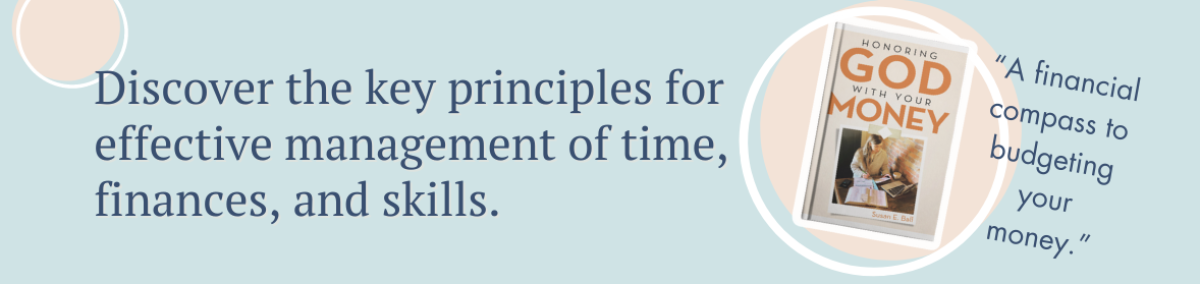
Honoring God with Your Money

I read Dwight L. Moody’s book Pleasure and Profit in Bible Study several years ago. It inspired me to do a word search on what the Bible says about money which led to searches on riches, wealth, poverty, giving, charity, tithing, and greed. I realized that the Bible has much to say about money and finances and began to create teachings based on those guidelines so others could live in financial freedom.   

From these teachings, I created a Bible study, Honoring God with Your Money. Part One of this book is an in-depth study of what God’s word says to us on the subject of:

  • The role of money in our lives
  • Appropriate attitudes toward money
  • The foolishness of trusting in money
  • Tithing, offerings, and charitable donations
  • Business practices

Part Two applies the biblical teachings and budgeting principles and helps you create a budget for your family to achieve your financial goals. 

This Bible study is an excellent tool for young people about to graduate from high school or college, newly married couples, and anyone who struggles to manage their finances. Individuals, couples, or small groups can work through it. Also, I have developed teaching materials for instructors to use in small group settings. If you would like these materials, please email me at susan.ball5@aol.com, and I will happily email them to you. I do not charge for these materials. 

Recently, Deborah Morrison interviewed me for her YouTube channel, Greater is Jesus in Me. In the interview, we went through all the sections in the book and discussed the blessings of managing money according to godly principles. Deborah split the interview into two parts.

Part 1 of interview:  https://youtu.be/_3QFxywuzqo

Part 2 of interview:  https://youtu.be/euThkOk0Kr0

God intends for money to be a tool to help make your life easier. He does not intend for money to be a source of stress. As you go through this study, I pray that you will allow God to bless you with financial peace and empower you to use the financial resources that He entrusts to you to care for your family, help others, and honor God.

Financial Success Can Help You Realize Your Dreams

One of my favorite songs is “If I Were a Rich Man” from the musical “Fiddler on the Roof.” The family patriarch, Tevye, sings the song, and it begins like this,
“Oh, Lord, you made many, many poor people
I realize, of course, it’s no shame to be poor
But it’s no great honor either!
So, what would have been so terrible if I had a small fortune?”

And it ends with,
“Lord, who made the lion and the lamb
You decreed I should be what I am
Would it spoil some vast eternal plan
If I were a wealthy man?”

In the middle, Tevye shares with God all the ways his life would be easier if he were wealthy. It is a humorous but self-centered rendition of the life of ease Tevye dreams of for his family. He would have multiple staircases—one going up, one going down, and one going nowhere. His wife would have ‘a proper double chin’, and he could sit around having religious discussions with the learned men. Poor Tevye always works hard and provides for his family but never achieves financial success.

Two people climbing an incline with a third person helping them up.

Like Tevye, many of us dream of the lifestyle wealth would allow us to have. Then we read Scriptures that speak against being wealthy, and we may rethink our desire for financial success. Matthew 19:24, “And again I say to you, it is easier for a camel to go through the eye of a needle than for a rich man to enter the kingdom of God.”

Of course, Christ was not saying that a wealthy man or woman could not go to Heaven. Instead, He was speaking against making riches a priority in your life. If you wish to be rich, so you can be treated as a VIP and live a life of ease, then your focus is likely not on the things of God. On the other hand, if you wish to provide for your family and use your excess money to bless others, then God may be able to trust you with wealth.

Sharing your wealth with others is one of the blessings of achieving financial success. You can go beyond tithing and generously giving to missionaries, food banks, homeless shelters, and other causes that God lays on your heart. You will be a blessing to others and be blessed in return.

Financial success has other benefits as well. It can provide you with the freedom to try new endeavors. As a business consultant, I meet people weekly who want to start their own business. They are more likely to be equipped to launch their business if they have achieved enough financial success to have savings to invest in their business and see them through the start-up phase.

Financial success can allow you to retire at a relatively young age. Of course, retirement can be pretty dull if you do not have meaningful endeavors to keep you active and help you feel worthwhile. However, retirement can be quite rewarding if you use your time to engage in hobbies, travel, volunteer in schools and hospitals, go on mission trips, or care for aging loved ones or grandchildren.

An alternative to early retirement is taking a sabbatical from work. They can last a few weeks, months, or even years. Sabbaticals can allow you to try a new vocation temporarily, take an extended vacation, or engage in short-term volunteer projects. College professors often use them to teach in a different country, whereas some lifelong learners immerse themselves in a different culture during their sabbaticals. The break from the mundane schedule of life can rejuvenate your motivation at work and help you refocus on personal goals. 

What is your dream? It likely requires money. By managing your money well and working hard to gain financial success, you will be more likely to achieve your goals.

God has designed you for a purpose, instilling unique dreams and visions in your heart. Managing your finances well can allow you to pursue your dreams. My blogs on money management and stewardship are great resources for learning how to manage your money and accomplish God’s plan for your life. My book, Honoring God with Your Money, is another resource to help you learn money management principles.

Save Money and Develop a New Mindset with a Financial Fast

If you’ve ever had surgery or bloodwork for your cholesterol levels, the test required you to fast for 8 hours or more. Many people also endeavor to fast for its health benefits to promote better digestion, weight loss, lowering cholesterol, and resetting appetite. Others may fast for spiritual reasons, like drawing closer to God for spiritual direction or increasing discipline.

Sack with bundles of cash falling out

However, eating is not the only item you can limit when fasting. I have “fasted” activities, such as crossword puzzles, computer games, and television, to gain more time to accomplish a goal or project. My time management fasts typically lasted until I achieved my goal or task.

A financial fast might be in order if you need to control your spending better. Whether you are just beginning to set up your budget or years into managing your money and want to reach a new goal, this plan might be the catalyst for your success. A total financial fast eliminates all unnecessary expenditures for a set period, whereas a partial fast eliminates specific spending categories. After you review your budget, decide which option works for you. During the period of the financial fast, you cut your spending. Fasting should increase your bank balance. However, you will likely experience other benefits.

Benefits of a Financial Fast:

One benefit is an increased awareness of how often you spend money on non-essentials. The ease of your purchases can hinder your realization of how much you spend. While shopping, a store offers multiple ways to pay for items. Pulling out a credit card or clicking the online “order button” distances the shopper from feeling their loss of money. Consider if you paid cash for every transaction. As the stack of bills shrinks in your hand, you connect the loss with the purchase. If you habitually charge $5 for breakfast and $10 for lunch every workday, you may not realize that those purchases add up to $330 each month (based on 22 workdays per month). The individual transactions are hardly worth noting when you examine your credit card bill, but the total makes a big dent in your bank balance. You will be surprised when you implement your fast. Those quick habits of taping your phone or swiping your credit card will lessen, and your bank account will grow.

A second benefit will be breaking bad habits and creating good ones. If you have been going through a drive-up for a coffee and breakfast sandwich, and now you skip that, you may begin to make coffee and breakfast at home. After a few weeks of this, making breakfast at home should be a regular habit, and going through the drive-up might become a once-in-while treat.

A third benefit is saving time. It takes time to get from your office to your car, drive to a restaurant, eat, and return to your office.   Packing a lunch takes much less time, and you can use that time savings to do something else, such as taking a walk, writing a letter, or engaging in a friendly conversation with a co-worker.

Finally, you are developing a new mindset of finding ways to enjoy life that do not require spending money. If you decide to fast spending money on recreation, you will work harder to seek free entertainment options. You will likely find many available to you and your family.

Action Plan for a Financial Fast:

  1. Decide on a goal for your financial fast. Possible goals might include:
    a. Paying off some debts
    b. Saving for a vacation
    c. Developing an appreciation of “free” activities and habits
    d. Demonstrating to your children that you have the self-control to delay a purchase until you have ended your spending fast.
  2. Set a time frame. Many financial experts recommend a 21-day fast, which is based on estimates that it takes 21 days to make or break a habit. Other experts recommend a period of intermittent financial fasting, such as fasting financially for one week out of every month. Your time period could be shorter or longer, depending on your goal and what spending category you will fast.
  3. Decide what you will fast. One option is to go on a strict fast, where you only pay bills and purchase groceries and medicine. Another option is a partial fast in which you forego spending for specific categories of items. For example, if buying shoes is a personal weakness, you might fast shoe purchases for an extended period. If you are saving to go on a cruise, you might give up dining out and recreational spending to have more money going toward your cruise budget.
  4. Plan for success. If you give up eating fast food for breakfast and lunch, ensure you have groceries to prepare those meals at home. Have motivational phrases and Scripture verses in your wallet, car, and computer to help you stay motivated. Celebrate your success without breaking your fast.
  5. Avoid temptations. If you are fasting clothing expenditures, avoid visiting your favorite apparel sites and stores. Throw away catalogs and delete marketing emails without reading them.

Recently, I participated in a 24-hour dietary fast at the request of a friend with a terminally-ill child. The purpose of the fast was to spend time in prayer for the child. I had no other motivation. Although I have been working to lose weight for a while, I did not fast with the expectation of losing weight. When the fast ended, however, I found that my appetite had been “reset.”  I have been able to eat less and feel satisfied, which has led to weight loss. A financial fast can provide the benefit of resetting your spending mindset, which will reap economic benefits for you long after you have ended your financial fast.

My Bible study, Honoring God with Your Money, is a great resource to help you understand how to manage your money better and achieve your financial goals. It is available on Amazon. If you would like to receive my quarterly newsletter with tips on managing your money, please complete this short form: Honoring God with Your Money (list-manage.com)

Why More Money Is Not the Solution to Your Anxieties

Are you struggling with financial stress, low self-esteem, depression, or marital discord? People often believe the solution to their stress and unhappiness is more money. Do you often think, “If I only had more money, I would be happier?” Perhaps you imagine winning the lottery and believe all your burdens and financial problems would melt away. Would all your troubles disappear and your attitude permanently change? 

Are extremely wealthy people happier? The rich and famous may have more earthly treasures, but this does not lead them to greater happiness or satisfaction. Many studies have shown that extreme wealth is a hindrance to happiness. American author, Graeme Wood, wrote an article in The Atlantic entitled “Secret Fears of the Super-Rich.” The piece included a behind-the-scenes look at a project that asked wealthy individuals, those with a net worth above $25 million, to write freely about their deepest concerns. The stunning revelation to most readers was that the participants faced many anxieties, including isolation, worries about work and their families, and insecurities about their wealth. Graeme Wood concluded, “The respondents turned out to be a generally despondent lot, whose money had contributed to deep anxieties involving love, work, and family). (The Atlantic, April 2011 issue). Since the release of the landmark project on wealth and happiness, more recent studies have verified these conclusions.

Let us not overlook the idea that some may be in a desperate position and struggle daily to provide the basic necessities of life for themselves. They will likely have some anxieties that money or access to the essentials could resolve. Otherwise, money is not your answer to your worries. 

Life is full of many challenges, and Jesus himself said, “In this world you will have trouble.” John 16:33. A personal relationship with Jesus Christ is the solution to reducing and managing your anxieties. However, the Bible does not suggest that all your troubles disappear once you have a relationship with Jesus. The scriptures offer a solution to managing our anxiety and lifting the burden of worry. 

Abie Kulynych, a pastor and author, believes one way we can reduce our anxieties is by actively remembering God’s provisions in the past. In his devotional “Thou Art with Me, Volume 2,” he discussed how the nation of Israel became anxious about their needs being met, despite God supplying them with manna daily.  “For Israel, there came a point where gathering manna was simply what they did rather than what God had done for them. They were so accustomed to the miracle that they forgot it was miraculous. What if the key to quieting the voice of anxiety is constantly reminding ourselves of God’s goodness? What if Israel, every morning, when they walked out into the open places to gather their manna, had stopped and said, “Look what God has done for us today?” What if we did more than count our blessings? What if we recounted them? I’m not talking about telling our story to someone else, but telling it to ourselves, regularly, daily, constantly. I think that if we told our testimony to ourselves more often, we’d have more opportunities to share it with others.” (Page 317, Commentary on Psalm 149)

God blesses each of us daily. If we reflect on God’s blessings and His past provisions, we will be more likely to trust Him to meet our future needs. God wants us to trust Him. He does not want us to be anxious but to come to Him with our needs.  

God instructed the Israelites to record their blessings and to remind their children of God’s faithfulness in the past. We need to incorporate that command in our lives and with our children. 

Here are a few suggestions to start recording God’s faithfulness in your life: 

  1. Create a blessings journal.
  2. Read your journal regularly to remind yourself of God’s faithfulness.
  3. Share stories of God’s provisions with your children to increase their faith and trust in God to meet their needs.
  4. Place notes around the house to remind you to take all your needs to God in prayer. He wants you to ask for His help and is delighted to answer your prayers and meet your needs.

“Be anxious for nothing, but in everything by prayer and supplication, with thanksgiving, let your requests be made known to God; and the peace of God, which surpasses all understanding, will guard your hearts and minds through Christ Jesus.” Philippians 4: 6-7

If you have not yet accepted Jesus Christ as your Savior, you have not yet experienced the peace of God. I urge you to accept Jesus’s free gift of salvation and experience the true peace that can only come by knowing that your sins are forgiven, and you will spend eternity in Heaven. Guidance on how to take this life-changing step is in the link “Basics of Salvation.”

My Bible study, Honoring God with Your Money, is a great resource to help you understand how to manage your money better and achieve your financial goals. It is available on Amazon. If you would like to receive my quarterly newsletter with tips on managing your money, please complete this short form: Honoring God with Your Money (list-manage.com)