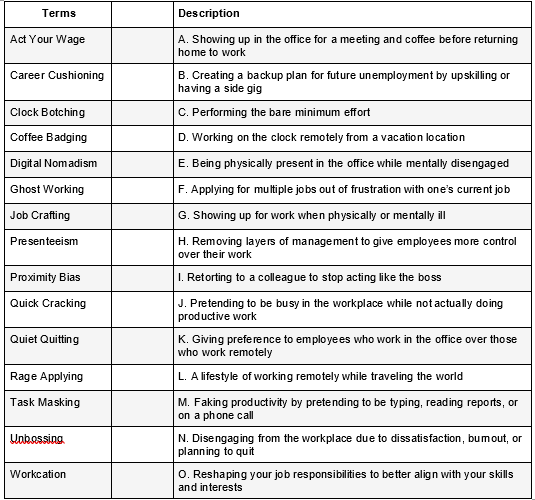
I recently came across the term “clock botching,” which was new to me. Upon researching the term, I learned that it was coined earlier this month to describe a new workplace trend. That led me to explore other terms—many of which describe behaviors that have emerged in recent years.
Test your knowledge! Match each workplace trend (left column) to the correct description (right column).
In the next few blogs, we will look at the factors that influenced these trends, the pros and cons of each, and how they impact your business.
The demands of running a business are endless. As a small business owner, you’re responsible for overseeing daily operations, managing employees, handling financials, filing taxes, networking, planning marketing campaigns, making growth decisions—and that’s just the start.
It’s no surprise that many entrepreneurs experience stress and overwhelm.
One proven way to lighten the load is by outsourcing tasks that either fall outside your comfort zone or don’t require your direct decision-making. A virtual assistant (VA) can be an affordable, flexible solution to help you manage your workload while allowing you to focus on growing your business.
Tasks Commonly Outsourced to Virtual Assistants
Start by identifying which responsibilities you’re comfortable handing off. Many small business owners delegate tasks in the following areas:
Marketing Tasks
Creating ads and promotions for traditional marketing outlets
Developing content for social media platforms
Responding to comments and messages on social media
Creating and maintaining a marketing calendar
Graphic design and video editing
Administrative & Back-Office Tasks
Data entry
Scheduling appointments and meetings
Replying to customer inquiries and messages
Invoicing and recording payments
Paying bills
Bookkeeping Tasks
Recording daily transactions
Payroll processing
Reconciling bank statements
Maintaining ledgers
Filing insurance claims
Financial Reporting Tasks
Filing quarterly and annual payroll reports
Filing monthly sales tax reports
Running monthly profit and loss statements
Developing cash flow analyses
Technical & Web Support Tasks
Developing and maintaining your website
Updating site links and plugins
Providing IT support
Overseeing cybersecurity
How to Hire a Virtual Assistant
If you’ve decided a virtual assistant might be right for you, follow these steps to get started:
1. Identify Tasks to Outsource Make a list of the duties you’d like a virtual assistant to handle.
2. Estimate Time Requirements Determine how many hours per week these tasks will require.
3. Research Pay Rates Check the going rates for the type of work you need in both the U.S. and international markets.
4. Evaluate Your Budget Decide what you can afford. If needed, prioritize only your most time-consuming or uncomfortable tasks.
5. Create a Job Description Be clear about responsibilities and required skills—such as bookkeeping certification, social media experience, or website management. If hiring internationally, specify proficiency in English.
6. Search for Candidates You can find virtual assistants through:
Freelance platforms (Fiverr, Freelancer, Upwork)
Virtual assistant services (Zirtual, Time etc., Belay)
Referrals from your professional network
7. Screen and Interview Applicants Look for:
Relevant work experience
Strong communication skills
Proven reliability and time management
Positive references
Optional: assign a short test task
8. Onboard Your VA
Set clear expectations for tasks and deadlines
Use affordable project management tools like Monday.com, ClickUp, or Teamwork.com
Provide regular feedback and encouragement
Final Thoughts
If you find the right virtual assistant and outsource the tasks that take the most time or cause the most stress, your workload — and stress level — can be reduced significantly. More importantly, you’ll free up valuable time to focus on the aspects of your business that only you can do.
While hiring a virtual assistant does require an investment, it can pay for itself in several ways. For example:
A skilled virtual assistant managing your social media accounts can increase engagement and attract new clients.
Delegating routine administrative or bookkeeping tasks frees you to spend more time meeting with clients, networking, or developing new services.
An assistant handling website updates or email responses ensures customers receive timely attention, which can improve customer satisfaction and lead to repeat business.
When you use your reclaimed time to focus on revenue-generating activities, your business can become more profitable — turning your virtual assistant from an expense into an investment.
If you’ve ever hired a virtual assistant, I’d love to hear your insights and advice in the comments!
The eighth fruit of the Spirit is gentleness. When I think of gentleness, I picture a mother lovingly cradling her baby in her arms. She carefully supports her infant’s head, providing the nourishment and love the child needs. Paul describes this in his first letter to the Thessalonians: “We were gentle among you, just as a nursing mother cherishes her own children” (1 Thessalonians 2:7).
It’s natural to be gentle with an infant or an elderly person who is frail and in need of assistance. But it’s not always easy to be gentle when you’re bailing someone out of trouble or when they’ve wronged you.
How do you respond to the person who has failed to repay the money they borrowed from you?
How do you react to the person who just caused significant damage to your vehicle?
How do you assist a relative who has gotten himself into a financial mess—again?
Hopefully, you respond with gentleness and the love of Christ.
True gentleness can be defined as “treating others as you want to be treated; showing mercy and forgiveness without judgment.” In terms of money, gentleness can be applied to helping someone in need in a way that maintains their dignity and self-esteem. This means offering financial assistance without judgment. If I am showing gentleness, I cannot berate someone for their financial difficulties. In fact, gentleness may even require me to forgive the debt they owe me, just as Christ forgave my much larger debt.
Gentleness in Helping Others
If the Lord has provided for your needs, He expects you to help others: “But whoever has this world’s goods, and sees his brother in need, and shuts up his heart from him, how does the love of God abide in him?” (1 John 3:17).
It’s easy to feel compassion and gently help someone who has faced financial setbacks due to illness, an accident, a job layoff, or a national economic downturn. But it can be more difficult to extend compassion to someone who has mismanaged their money, lived beyond their means, or made reckless investments in hopes of getting rich quickly. You might even feel that their difficulties are the result of sin and find yourself reluctant to help. However, gentleness compels us to help others without making them feel ashamed. Galatians 6:1 reminds us, “If someone is caught in a sin, you who live by the Spirit should restore that person gently.”
If you struggle with gentleness, remember that fortunes can change quickly. Today, you might be in a position to give, but tomorrow, you might need help yourself: “Cast but a glance at riches, and they are gone, for they will surely sprout wings and fly off to the sky like an eagle” (Proverbs 23:5).
Offering Assistance with Gentleness
Seek God’s direction before offering help: “But the wisdom that is from above is first pure, then peaceable, gentle, willing to yield, full of mercy and good fruits, without partiality and without hypocrisy” (James 3:17).
Consider how you would want to be approached for assistance and follow the Golden Rule: “Do to others as you would have them do to you” (Luke 6:31).
Offer assistance discreetly and with humility: “Be careful not to practice your righteousness in front of others to be seen by them. If you do, you will have no reward from your Father in heaven. So, when you give to the needy, do not announce it with trumpets, as the hypocrites do in the synagogues and on the streets, to be honored by others. Truly I tell you, they have received their reward in full. But when you give to the needy, do not let your left hand know what your right hand is doing” (Matthew 6:1–3).
Offer help not to seek praise from others, but as an opportunity to share the gospel: “Nor did we seek glory from men, either from you or from others, when we might have made demands as apostles of Christ. But we were gentle among you, just as a nursing mother cherishes her own children. So, affectionately longing for you, we were well pleased to impart to you not only the gospel of God, but also our own lives, because you had become dear to us” (1 Thessalonians 2:6–8).
Practical Ways to Assist Someone Financially with Gentleness
Pay a bill anonymously.
Send a check with a note that says, “The Lord instructed me to give this to you.”
Drop off a bag of groceries or a gift card to a grocery store.
Pay attention to their needs and purchase specific items to meet those needs.
Offer them an opportunity to do paid work for you, such as:
Yard work
Home repairs and maintenance
Errands and/or shopping
Housecleaning
Temporary work at your business (e.g., seasonal sales or extra labor for large jobs)
Contract work for your business (e.g., website design, bookkeeping, marketing, or janitorial services)
Conclusion:
Gentleness is more than just a soft-spoken demeanor; it is an intentional choice to treat others with dignity, compassion, and humility, especially when it comes to our financial dealings. Whether helping someone in need, forgiving a debt, or practicing patience in difficult financial situations, gentleness reflects Christ’s love and grace in practical ways. As we cultivate this fruit of the Spirit, we not only honor God, but we also create an environment of peace, trust, and healing in our relationships with others.
Ask God to open your eyes to those in need around you and pray for wisdom to meet those needs, as led by the Holy Spirit, with gentleness and a heart that reflects His love. Let gentleness guide you in your financial decisions and interactions, and watch how it transforms not only your heart but the lives of those around you. May we continue to be faithful stewards of the resources God has entrusted to us, using gentleness as a reflection of His love in all things.
Discussion Questions:
How can you apply gentleness when helping someone with a financial need, especially if their situation is a result of poor financial decisions? How can you balance compassion and wisdom in such situations?
What are some ways gentleness can influence how you manage your own finances? For example, how might gentleness affect your approach to budgeting, saving, or giving?
In what areas of your life do you struggle to show gentleness in your financial interactions, whether it’s forgiving a debt, giving to others, or paying your bills on time? How can you ask God for help in those areas?
Think about a time when you needed financial help or guidance. How did the gentleness or lack thereof from others impact your relationship with them? How can you practice gentleness in your own financial dealings to build trust and understanding?
As we celebrate Thanksgiving, let’s take a moment to appreciate the heart of our communities—small businesses. On Small Business Saturday, and throughout the holiday season, it’s important to recognize the significant role small businesses play in shaping our local economies and supporting community growth.
Small Businesses: The Backbone of the Economy
With over 34.8 million small businesses in the U.S. employing nearly 59 million people, small businesses make up 99.9% of all businesses and account for almost 46% of all jobs. While many small businesses are owned and operated by just one or two people, their economic impact cannot be overstated. Some of today’s small businesses will grow into large employers in the future, further strengthening the economy.
How Small Businesses Strengthen Local Communities
Small businesses are not just job creators; they are vital to the social and economic fabric of their communities. Here’s how:
Money stays in the local economy: When you spend money at a small business, it stays within your community. The business owner and employees spend that money locally, creating a ripple effect of local job creation and economic activity.
Ability to meet the unique needs of their community: Small business owners have the flexibility to pivot quickly and meet the specific needs of their customers. Without the need for top-down approval, they can respond swiftly to new opportunities, ensuring their businesses are relevant and adaptable.
Creates a community identity: Many small businesses have been a cornerstone of their communities for decades. For example, one of the best-known small businesses in our area is about to celebrate its 100th anniversary! These businesses become synonymous with local identity, embodying the history and culture of the area.
Involvement in local civic life: Small business owners often participate in community organizations like the Chamber of Commerce, Rotary clubs, and local initiatives. This active involvement helps address local challenges while creating a sense of shared purpose in the community.
Innovation and supporting other small businesses: A local restaurant might source ingredients from nearby farms, or a boutique could sell locally made products. Small businesses frequently collaborate with each other, creating unique shopping experiences and boosting one another’s success.
Show Your Appreciation on Small Business Saturday
As we reflect on the many blessings we have this Thanksgiving, I encourage you to show your gratitude by supporting small businesses this holiday season, especially on Small Business Saturday. Visit local shops, dine at locally owned restaurants, and think about allocating some of your Christmas shopping budget to support your favorite small businesses. When you shop local, you’re investing directly in the future of your community.
If you’ve heard about any small business owners giving back to the community or supporting charitable causes, take a moment to recognize their contributions. A simple “thank you” can go a long way.
A Special Note to Small Business Owners
If you’re a small business owner, remember to be grateful for your customers—they don’t have to shop with you, they choose to. Showing appreciation can take many forms, from offering special perks like gift wrapping or loyalty programs, to simply offering a friendly smile or a kind word. It’s a great time to strengthen the relationship with your customers and show them you value their support.
The Power of Kind Words
In this busy season, both customers and business owners can benefit from a kind word of thanks. After all, as the old saying goes: “Kind words are like honey—sweet to the soul and healthy for the body.” (Proverbs 16:24)
Happy Thanksgiving and Happy Small Business Saturday!
May you experience joy and blessings this season, and may your small business continue to thrive in the coming year!
“It’s my pleasure.” When I hear this phrase, I immediately think of Chick-fil-A. This simple, polite response is just one of the many ways the company creates an exceptional customer experience. By focusing on customer service, Chick-fil-A has become the number one fast-food restaurant in America. On average, a Chick-fil-A location generates 50% more revenue than a McDonald’s, despite being closed on Sundays.
As a small business owner, delivering a great customer experience should be at the heart of your strategy. A positive experience not only encourages repeat visits but also drives sales and increases profitability. Whether you’re just starting your business or looking to grow, it’s essential to create a customer-centric environment. The key to success lies in setting clear customer service policies, training your staff, and making sure everyone is on the same page. While customer service may look different depending on your industry, certain principles apply across the board.
1. Be Polite and Show Respect
Politeness and respect should be at the core of your interactions with customers. The way you address your clients—whether formally (e.g., Mr. Smith or Mrs. Jones) or informally—sets the tone for your business. Timely responses to emails and phone calls are also a sign of respect. It’s also vital to train your employees to handle complaints professionally by listening actively and taking steps to resolve issues quickly.
2. Timeliness Matters
Time is valuable to your customers, and respecting that time can set you apart. If you’re in a service-based business or doing contract work, meeting deadlines is crucial. If you operate a retail store or restaurant, greeting customers promptly and serving their orders as soon as they’re ready shows that you value their time and business.
3. Give Your Full Attention
When interacting with customers, it’s important to be fully present. This means putting away distractions like cell phones and focusing on their needs. In a busy environment, consider systems like queues or numbered tickets to ensure that no customer is left waiting too long and that service remains consistent.
4. Apologize for Mistakes and Make It Right
No business is perfect, and occasionally you will make mistakes. When this happens, apologize sincerely and avoid making excuses. A genuine apology can go a long way, but in some cases, you may need to offer a refund, replacement product, or discount to make up for the mistake. Empower your team to handle customer issues effectively, ensuring that the solution is fair and quick.
5. Respect Your Customers’ Timelines and Budgets
This is especially important in contract or service-based businesses. If a client needs a job done by a certain deadline, don’t take on the job if you can’t meet it. Similarly, if a client has a strict budget, be transparent about costs upfront and do your best to stay within their limits. Trust is built when customers know you’ll respect both their time and money.
6. Establish a Dress Code
Your customer service policies should include clear guidelines for employee appearance. Whether you require uniforms, name tags, or business attire, make sure your team looks professional and approachable. A dress code that aligns with your industry standards shows customers that you take your business seriously and care about their experience.
7. Create a Welcoming Environment
First impressions matter. How customers feel when they enter your business can set the tone for their entire experience. Some businesses greet customers immediately upon entry, while others offer complimentary refreshments like coffee, bottled water, or mints. Small touches—like comfortable seating or soft background music—can make a big difference. Think about how you can enhance the atmosphere to make your customers feel welcome and valued.
8. Meet or Exceed Customer Expectations
The ultimate goal of customer service is to exceed expectations. When customers experience something better than they anticipated—whether it’s a friendly interaction, faster service, or a surprise bonus—they’ll be more likely to return. Continuously seek feedback from your customers and look for ways to improve.
Conclusion
The customer experience you offer is one of the most powerful tools you have for growing your business. By focusing on politeness, timeliness, respect, and attention to detail, you can create an environment where your customers feel valued and appreciated. Remember, small touches can leave a big impression. When your customers feel good about their experience, they’ll keep coming back—and they’ll bring others with them.
Need help creating a customer service strategy that works for your business? Whether you’re just starting out or looking to refine your existing approach, I’m here to guide you. Reach out today for a personalized consultation and let’s build a customer experience that will keep your clients coming back for more!
Are you among the 73 million Americans who work in the gig economy? If you drive for Uber, deliver meals for DoorDash, shop for others through Instacart, design websites on Fiverr, pet sit for friends and neighbors for a fee, take on side jobs through Upwork, or engage in any other type of side hustle work, then you are part of the gig economy. If you are one of these workers, you may wonder (1) if you have to claim these earnings and (2) how you claim these earnings.
Many individuals who work in the gig economy also have a conventional job that provides them with a steady salary or wages. They obtain a W-2 form from their employer and must file a tax return. They may overlook the smaller amounts earned from their side jobs, but this would be a mistake.
Gig workers are considered independent contractors or freelancers by those who hire them rather than employees. As such, they do not receive W-2s at the end of the year. No taxes are withheld from their income, and the companies they work for do not pay a portion of their required Medicare and Social Security contributions.
The IRS considers earnings from side hustles or freelance work as self-employment income. For this income, you will file a Schedule C, Profit or Loss from Business. This form will be part of your income tax return, and the Net Profit or Loss will transfer to your 1040.
Each employer you worked for as an independent contractor should provide you with a 1099-NEC form. If you have earnings of $400 or more reported on these forms, you must file a Schedule C. This form requires you to sum up your total income and write it in Line 1. You can add up your income on Schedule C if you have worked multiple freelance jobs.
In Part II, you will need to list all the legitimate expenses for your business. This is crucial to ensure that you pay the correct amount of taxes and do not overpay.
Your expenses may include the costs incurred while driving your car to transport passengers or make deliveries. You should keep track of the miles you have driven and use the standard mileage rate of 65.5 cents per mile set by the IRS. You can enter the total miles driven on Page 2, Part IV, and then multiply the total mileage by .655 to get the exact value, which you can then enter on Line 9.
Advertising and marketing expenses, such as creating business cards, fliers, a magnetic sign for your vehicle, or a website, are entered on Line 8.
Contract labor comes from hiring someone to assist you with jobs. If you are a freelance web designer, you might subcontract the creation of a logo for your client to a graphic designer or artist. If you had those expenses, enter the total on Line 11.
Insurance for your business is entered on Line 15. Typical insurance charges are surcharges added to your vehicle insurance due to making deliveries; errors and omissions insurance if you provide a professional service such as tax preparation; property insurance to cover a loss of tools or equipment for fire or theft; and general liability insurance.
Commissions and fees paid to Fiverr, Uber, Upwork, or another job matching service are entered on Line 10.
Payment processing fees. If you use PayPal, Venmo, or another service to process payments, you are paying them a percentage of the charges for their service. If your clients pay by credit card, then your credit card provider will deduct a service fee. These fees are counted as Other Expenses entered on Line 27a. You can detail these expenses in Section V.
Cellphone and internet service charges are deductible if used primarily for business. These expenses are typically included on Line 27a and in Section V.
Supplies used to operate your business are deductible. Office supplies are standard for most companies. A food delivery driver might also invest in insulated bags to keep food warm or cold, a pet sitter might purchase pet treats and toys, and a handyman would buy tools and hardware. Keep track of these and deduct them from Line 22 on your Schedule C form.
When you have entered all your expenses, total them on Line 28. Subtract the total from your income to determine your Tentative Profit. For most independent contractors, tentative profit is the same as Net Profit. However, those working from a home office may elect to deduct some home office expenses, lowering your taxable profit but requiring additional work.
Cost of Goods Sold is calculated in Section III, but as gig economy workers do not commonly incur it, we will not include it in this post.
Your Net Profit on Line 31 should be transferred to Line 3 of your 1040 and also to Line 2 of your Schedule SE. Schedule SE is used to calculate your self-employment tax. Your tax software or your tax preparer will do this automatically. Your role is to accurately track your income and deductible expenses from your side hustles so that your tax liability will be accurate.
Do you feel like your money is not stretching as far as it did a few years ago? When you come home from the grocery store, do you feel like you have fewer bags of groceries, but your bill is the same or higher? At this stage in our lives, my husband shops for our groceries. Last week, he came home without some items I had written on our list. A few products were out of stock since the supply chain continues to struggle, and other items were priced higher than we felt was reasonable to pay. For example, my favorite salad dressing had doubled in price to $6 a bottle, and the sirloin I needed for pepper steak was more than $12 a pound. So, we found the salad dressing at a lower price at a different store and chose a recipe that used cheaper meat.
Despite the good news of a recent slowdown in the inflation rate, grocery prices continue to rise faster than the paycheck of the average American. Last week, the Bureau of Labor Statistics reported the inflation rate for June was 3.0%, the lowest rate in more than two years. Unfortunately, this 3% price increase since June 2022 is on top of the 9.1% increase from the previous twelve months, so most consumers are paying 12% more for the same goods than they were two years ago, while salaries have risen only about 9.5%.
Woman reviewing her shopping list
Grocery prices have risen more than the average consumer product. In fact, over the past two years, groceries have increased nearly 20%, requiring a more significant chunk of your budget. Here’s an example:
In 2021, if you were making an “average” income of $57,000, you were taking home an average monthly check of $3,700.
The ideal food budget is 12% of your monthly take-home pay or $444.
If your income has increased only by an average of 9.5% to $62,415 and your take-home pay is now $4,051, then to buy the same “basket” of groceries today that you did in 2021, you would pay $533 per month.
Groceries are now consuming $533/$4051 = 13.2% of your budget.
A 1.2% increase might not seem like a big deal, but it will require you to cut $49 from other areas of your budget. It would be best to be mindful when shopping for the best deals on your non-food purchases.
Rent and fuel have also increased significantly. Rent has increased an average of about 15% over the past two years, and gasoline prices where I live have increased by about 17%. These increases are reducing the purchasing power of most Americans. Consumers are adjusting their spending and shopping habits to combat the impact of inflation.
Here are some tips to help you manage your budget as inflation grows faster than wages.
Check grocery ads to determine what is on sale and where to get the best prices before you plan your meals. Plan meals around what is available and affordable.Go to multiple grocery stores to get the best deals on the food you want.
Stick to your lists, and don’t be distracted by great deals on items you won’t use before they expire. Avoid extreme loyalty to particular brands. Be willing to try other brands and generic items to get better prices.
Combine grocery store trips with other errands to minimize gas consumption.
Use credit cards wisely if you use them for grocery and gasoline purchases. Always pay your balance in full each month. Use a card that gives you cash back. Sign up for monthly or quarterly “extra” cash-back bonuses. Make a grocery list and stick to it to avoid overspending often associated with using credit cards.
Shop through portals that give you cash back for shopping. Sign into a shopping portal and purchase from the companies they have relationships with. Receive a portion of the sale as cash back. The percentages are typically less than 10%. This option is similar to a discount, except you must wait for the cash back. These sites can be beneficial as they also search out the best prices. They are most helpful if you are not loyal to a particular brand and if you will buy the best deal rather than the brand-name item.
It seems as if the rapid inflation of the past two years is behind us, at least for the time being. However, it will take years for wages and salaries to catch up. Take this time to review your budget and make adjustments based on your current spending for food and other necessities. You may need to reduce discretionary spending until your earnings match the new price levels.
For other guidance on balancing your budget and managing your money, my book Honoring God with Your Money is an excellent resource. If you would like a free budget worksheet incorporating ideal spending guidelines, please email me at Susan.ball5@aol.com, and I will happily email them to you.
Many high school students automatically plan to attend college without genuinely considering their alternatives. The U. S. Census Bureau reports that while 59% of all Americans start college, 24% drop out without having earned a degree or a certification. Parents must convey the whole picture about the time and money required to earn a degree or a certificate in a specialized program. If God has called your child into a profession requiring college, they need to pursue the education with the knowledge of the steps it will require. Your job as a parent is to show them all the options. An opening question should be, Is college a good investment for you?
Cost of Continuing Your Education
If they decide to pursue education beyond high school, you should help them count the costs and determine which path is best. Take some time to sit down with your son or daughter and add up college costs. Here are a few talking points:
Tuition, books, and registration fees
Room and board, if you live on campus
Fees to participate in sports, fraternities or sororities, clubs, and activities
Travel to and from school, if you do not live on campus
Foregone income from delaying full-time work while completing your education
Minimizing the Costs of Education
There are ways to make college or a certification program more affordable. Some of these are:
Attending a college close to home and commuting rather than living on campus
Attending a local community college to get your Associate’s Degree before transferring to a four-year college
Earning college credits while in high school through AP classes and dual-enrollment programs
Knowing what your goals are in attending college. Many people waste time and money by taking classes without real purpose, or they switch colleges and lose some of their credits.
Taking classes online from home
Working part-time or full-time while taking classes
Earning a vocational certificate rather than a two-year or four-year degree
As you pray with your child about their career path, you should consider vocational alternatives to careers that require college degrees. Many professional service provider careers are in high demand and pay well. There will always be a need for plumbers, electricians, HVAC technicians, and welders. These careers require training beyond high school, but they can learn on the job through apprenticeship programs. This is also true for heavy machine operators and some IT professions. Your son or daughter may be able to earn a cosmetology license or skilled labor certificate while in high school if the school offers those programs.
According to the Bureau of Labor Statistics, about 169 occupations require a bachelor’s degree, and another 100 require a Master’s or higher degree. On the other hand, there are about 100 occupations that require an associate’s degree or vocational certification and about 425 that do not need any formal education beyond a high school diploma https://www.bls.gov/careeroutlook/2020/article/education-level-and-openings.htm
As you consider together whether college is in their future, they should only go if it makes wise financial sense and if it aligns with God’s plans for their life. Suppose God has called your child to be a physician, a teacher/professor, an attorney, a minister, or many other careers. In that case, he or she must spend many years gaining the necessary education. However, if God has called him or her to be a businessperson, an inventor, a writer, a hairstylist, a plumber, an electrician, or one of many other careers, they may need only to obtain vocational training or on the job training.
If you sit with your child and connect with their visions and goals, they are more likely to make an educated decision about their future. Often, kids get to college and flounder because they don’t know what major to declare. Advisors can persuade them to take all their electives and then decide. However, a community college is a smart alternative if that is the case. Students can complete their electives much cheaper and then move to a state college to declare a major.
The Bible tells us that God has a beautiful plan for each person’s life. Ephesians 2:10 says, “For we are His workmanship, created in Christ Jesus for good works, which God prepared beforehand that we should walk in them.” God prepared your child to do the work He designed them to complete. He has empowered your child with the skills and desire to do that work. Allow Him to show you and your child His plans and then help your child prepare to fulfill those plans by obtaining the training or education needed to achieve those plans.
Do you find that you run low or out of money before the next paycheck arrives? Is your credit card full of charges that never fully get paid off, and you wish for a month with no unexpected expenses so that you can have a chance to get caught up? If you are not budgeting and planning your income, this is probably a familiar situation for you.
Budgeting Pie Chart
Many people try to create a budget a few times a year and some even stick to it, while many others find it difficult. Maybe you have even tried and found that you could not make it work. That’s because “ideal” budget percentages are based on the “average” person or family, and you are not “average.” You are a unique person, or family, with your own needs and priorities. You need to create a budget that works for you. Before we look at some tips to help you create a budget you can live with, let’s look at an ideal budget for an average household.
The median household income across America is currently $69,000. It consists of 2. 6 people—typically two adults and one child. The table below shows the “ideal” percentages that should be spent for each of the major spending categories, along with the annual and monthly amounts for each category.
Spending Categories
Percentages
Annual Amount
Monthly Amount
Housing (rent or mortgage, utilities, internet, homeowners/renters insurance, phone, cable)
36%
$24,840
$2,070
Food (groceries and eating out)
12%
$8,280
$690
Automobiles (car pymt, gas, insurance, maintenance and repairs
12%
$8,280
$690
Medical (insurance and bills)
5%
$3,450
$287.50
Clothing
5%
$3,450
$287.50
Entertainment
5%
$3,450
$287.50
Life Insurance
5%
$3,450
$287.50
Savings
5%
$3,450
$287.50
Debt Reduction
5%
$3,450
$287.50
Miscellaneous
10%
$6,900
$575
At first glance these numbers might look doable, and depending on where you live, maybe these are very realistic numbers. However, where I live, it is hard to keep monthly housing costs to $2,070. The average monthly rent for a one-bedroom apartment is $1,750. That leaves $320 for utilities, internet, insurance, phone, and cable. A careful consumer might be able to manage that. However, an average family needs more than one bedroom, making it harder to stay within the budget for housing. Automobile expenses are also challenging. Currently, the average new car payment is $719, and the average payment for a used car is $527. When you add in fuel, insurance, and repairs and maintenance, you will almost certainly exceed the $690 budgeted amount.
In order to create a budget that works for your household and one that you can stick with, you will have to make some difficult choices.
Use these guidelines to help you make the decisions which are best for you and your family.
Determine your needs based on the number of people in your family and your career. a. The more people in your family, the larger the home and vehicle you need. b. Each person requires food, clothing, and health care, so larger families need to allocate more money to those items. c. If your job requires professional or business attire, you will need to allocate more money for clothing. d. If you are required to drive your car for work, you will need a newer, reliable vehicle. e. Does your household require more than one vehicle for multiple drivers? f. Do you need to allocate money for childcare while you are working?
Determine your priorities. a. Do you want each child to have their own bedroom, or can children share bedrooms? b. Do you want to have a short commute to work? c. Do you want to live in a specific community? Or a community with specific amenities? d. Is it important to you to have a new car every few years? e. Do you want your children to attend a specific school? Do you want them in a private school which will require you to pay tuition?
Consider the alternatives. a. You may be able to afford a larger home if you are willing to commute farther to work. b. You may be able to live closer to work or in your preferred community, if you are willing to forgo a desired bedroom or other amenity, such as a den, garage, or extra bathroom. c. You may have access to safe, reliable public transportation, allowing you to forgo vehicle ownership. d. You may be able to continue to drive an older car by engaging in ride sharing to work and renting a car for longer trips. e. You can save money on food by packing lunches and cooking most meals at home. f. You can save money on recreation by taking advantage of free sources of entertainment and recreation. g. If you are single or a single parent, you could save money on housing by sharing a home or renting out a spare bedroom to a tenant. h. You may be able to telework full-time, or several days a week, which will reduce fuel expenses and perhaps childcare expenses.
Use the “ideal” budget percentages to create a base budget. Use these budget numbers to help you see the areas in which you are overspending and underspending. Then, adjust your budget based on your current expenses and your needs.
Refine your budget based on your priorities.
If your expenses exceed your income, you must make additional adjustments. Consider the alternatives and make decisions based on which alternatives will best meet your needs and come closest to meeting your priorities
Creating a budget is not an easy task, but it is an important one. It will allow you to meet the needs of your family and relieve much of the stress you are currently facing.
To learn more about how to honor God with your money and build treasure in Heaven, please click the Finances categories tab to find many blogs on money management, budgeting, and stewardship. My book Honoring God with Your Money is a great tool for financial money management.
Have you overdrawn your bank account recently? Are you running up balances on your credit cards because you don’t have enough money to cover your monthly expenses? Do you find yourself wondering where all your money went? Do you want to save money for a memorable trip, yet find your savings balance decreasing rather than increasing? If you answered yes to any of these questions, you need to create a budget and set financial goals.
Creating and sticking to a budget will allow you to stay out of debt and achieve your financial goals. However, you need to know where your money is going before you can create a budget that will work for you. Start by tracking your spending for a few months.
In times past, most people tracked their spending using a notepad and pen. I recently found a spiral notebook that my grandmother used to record her spending in 1956. She used a separate page for each month. She listed her take home income at the top of the page and carefully noted each expense. As a single woman, she brought home about $275 each month, so it was imperative that she managed her money well. This method still works well if you faithfully write down all your expenditures.
I am a big fan of spreadsheets. When my husband and I started our own home twenty-five years later, I used a pen and paper method, too. But, a few years later, when Lotus 1-2-3 (precursor of Excel) was introduced, I graduated to using a spreadsheet to track income. Today, I use Quicken to track and balance my bank accounts, and I use a spreadsheet to develop our budget. I balance my checkbook every week or two to be aware of my spending and how much money is in my accounts.
Other people use different methods. I have friends who use the envelope system. On each pay day, they cash their checks, put their budgeted savings into their savings account, and allocate the rest toward expenses. The money for each expense category goes went into a separate envelope. They pay cash for all expenses, and when the envelope is out of cash, they spend no more on that category for the remainder of the money.
Today there are many apps to help you track your spending. Some can be connected to your bank accounts and credit cards. Some apps simply track your spending, while others allow you to input spending parameters and are indeed budgeting tools. Apps benefit those who do not balance their checking accounts regularly. According to StatisticBrain.com, 79% of people rarely or never balance their checking accounts.
Some of the most popular spending apps currently are:
Mint. This free app can sync to your bank accounts and credit cards. It allows you to set goals, track investments, and be reminded of when to pay bills. It will also alert you when you have exceeded your spending goals.
YNAB (You Need a Budget)–This zero-based budgeting system lets users allocate all income into spending categories, debt reduction, and savings. It also lets users set goals. The downside is that after the free 34-day trial ends, you must enroll and pay a monthly or annual fee.
Goodbudget. This system mimics the envelope method. The user assigns an amount to each “envelope.” This method does not connect to bank accounts or credit cards, so the amounts must be entered manually. This is a good version for those who do not want all of their accounts connected. There is a free version, but if you want to track more than a few categories, you may need to pay a fee.
Every Dollar. This method is similar to my method of recording expenses in Quicken and using a spreadsheet to track totals. Like Goodbudget, it does not connect to bank accounts or credit cards. All expenses must be entered manually. It does allow the user to set reminders to pay a bill.
There are many other apps available that you might want to consider. Choose a method based on compatibility with your style and personality. Mint or YNAB might be a good choice if you want to connect all your accounts without entering expenditures manually. On the other hand, these systems may not be suitable for you if you worry about identity theft and the risks of having things too automatic. So, set aside a few hours to evaluate the options available and decide to start using one of them to track your expenditures.
If you need help to learn to manage your money and improve your credit, please check out some of my other blogs on Finances, Money Management, and Stewardship. My book Honoring God with Your Money is a great tool for financial money management.
For more money management tips, subscribe to my quarterly newsletter: newsletter signup










 Susan's Reflections
You must be logged in to post a comment.