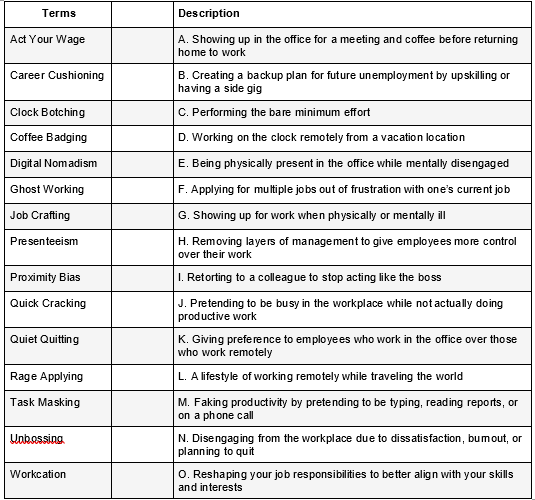
I recently came across the term “clock botching,” which was new to me. Upon researching the term, I learned that it was coined earlier this month to describe a new workplace trend. That led me to explore other terms—many of which describe behaviors that have emerged in recent years.
Test your knowledge! Match each workplace trend (left column) to the correct description (right column).
In the next few blogs, we will look at the factors that influenced these trends, the pros and cons of each, and how they impact your business.
The demands of running a business are endless. As a small business owner, you’re responsible for overseeing daily operations, managing employees, handling financials, filing taxes, networking, planning marketing campaigns, making growth decisions—and that’s just the start.
It’s no surprise that many entrepreneurs experience stress and overwhelm.
One proven way to lighten the load is by outsourcing tasks that either fall outside your comfort zone or don’t require your direct decision-making. A virtual assistant (VA) can be an affordable, flexible solution to help you manage your workload while allowing you to focus on growing your business.
Tasks Commonly Outsourced to Virtual Assistants
Start by identifying which responsibilities you’re comfortable handing off. Many small business owners delegate tasks in the following areas:
Marketing Tasks
Creating ads and promotions for traditional marketing outlets
Developing content for social media platforms
Responding to comments and messages on social media
Creating and maintaining a marketing calendar
Graphic design and video editing
Administrative & Back-Office Tasks
Data entry
Scheduling appointments and meetings
Replying to customer inquiries and messages
Invoicing and recording payments
Paying bills
Bookkeeping Tasks
Recording daily transactions
Payroll processing
Reconciling bank statements
Maintaining ledgers
Filing insurance claims
Financial Reporting Tasks
Filing quarterly and annual payroll reports
Filing monthly sales tax reports
Running monthly profit and loss statements
Developing cash flow analyses
Technical & Web Support Tasks
Developing and maintaining your website
Updating site links and plugins
Providing IT support
Overseeing cybersecurity
How to Hire a Virtual Assistant
If you’ve decided a virtual assistant might be right for you, follow these steps to get started:
1. Identify Tasks to Outsource Make a list of the duties you’d like a virtual assistant to handle.
2. Estimate Time Requirements Determine how many hours per week these tasks will require.
3. Research Pay Rates Check the going rates for the type of work you need in both the U.S. and international markets.
4. Evaluate Your Budget Decide what you can afford. If needed, prioritize only your most time-consuming or uncomfortable tasks.
5. Create a Job Description Be clear about responsibilities and required skills—such as bookkeeping certification, social media experience, or website management. If hiring internationally, specify proficiency in English.
6. Search for Candidates You can find virtual assistants through:
Freelance platforms (Fiverr, Freelancer, Upwork)
Virtual assistant services (Zirtual, Time etc., Belay)
Referrals from your professional network
7. Screen and Interview Applicants Look for:
Relevant work experience
Strong communication skills
Proven reliability and time management
Positive references
Optional: assign a short test task
8. Onboard Your VA
Set clear expectations for tasks and deadlines
Use affordable project management tools like Monday.com, ClickUp, or Teamwork.com
Provide regular feedback and encouragement
Final Thoughts
If you find the right virtual assistant and outsource the tasks that take the most time or cause the most stress, your workload — and stress level — can be reduced significantly. More importantly, you’ll free up valuable time to focus on the aspects of your business that only you can do.
While hiring a virtual assistant does require an investment, it can pay for itself in several ways. For example:
A skilled virtual assistant managing your social media accounts can increase engagement and attract new clients.
Delegating routine administrative or bookkeeping tasks frees you to spend more time meeting with clients, networking, or developing new services.
An assistant handling website updates or email responses ensures customers receive timely attention, which can improve customer satisfaction and lead to repeat business.
When you use your reclaimed time to focus on revenue-generating activities, your business can become more profitable — turning your virtual assistant from an expense into an investment.
If you’ve ever hired a virtual assistant, I’d love to hear your insights and advice in the comments!
As we celebrate Thanksgiving, let’s take a moment to appreciate the heart of our communities—small businesses. On Small Business Saturday, and throughout the holiday season, it’s important to recognize the significant role small businesses play in shaping our local economies and supporting community growth.
Small Businesses: The Backbone of the Economy
With over 34.8 million small businesses in the U.S. employing nearly 59 million people, small businesses make up 99.9% of all businesses and account for almost 46% of all jobs. While many small businesses are owned and operated by just one or two people, their economic impact cannot be overstated. Some of today’s small businesses will grow into large employers in the future, further strengthening the economy.
How Small Businesses Strengthen Local Communities
Small businesses are not just job creators; they are vital to the social and economic fabric of their communities. Here’s how:
Money stays in the local economy: When you spend money at a small business, it stays within your community. The business owner and employees spend that money locally, creating a ripple effect of local job creation and economic activity.
Ability to meet the unique needs of their community: Small business owners have the flexibility to pivot quickly and meet the specific needs of their customers. Without the need for top-down approval, they can respond swiftly to new opportunities, ensuring their businesses are relevant and adaptable.
Creates a community identity: Many small businesses have been a cornerstone of their communities for decades. For example, one of the best-known small businesses in our area is about to celebrate its 100th anniversary! These businesses become synonymous with local identity, embodying the history and culture of the area.
Involvement in local civic life: Small business owners often participate in community organizations like the Chamber of Commerce, Rotary clubs, and local initiatives. This active involvement helps address local challenges while creating a sense of shared purpose in the community.
Innovation and supporting other small businesses: A local restaurant might source ingredients from nearby farms, or a boutique could sell locally made products. Small businesses frequently collaborate with each other, creating unique shopping experiences and boosting one another’s success.
Show Your Appreciation on Small Business Saturday
As we reflect on the many blessings we have this Thanksgiving, I encourage you to show your gratitude by supporting small businesses this holiday season, especially on Small Business Saturday. Visit local shops, dine at locally owned restaurants, and think about allocating some of your Christmas shopping budget to support your favorite small businesses. When you shop local, you’re investing directly in the future of your community.
If you’ve heard about any small business owners giving back to the community or supporting charitable causes, take a moment to recognize their contributions. A simple “thank you” can go a long way.
A Special Note to Small Business Owners
If you’re a small business owner, remember to be grateful for your customers—they don’t have to shop with you, they choose to. Showing appreciation can take many forms, from offering special perks like gift wrapping or loyalty programs, to simply offering a friendly smile or a kind word. It’s a great time to strengthen the relationship with your customers and show them you value their support.
The Power of Kind Words
In this busy season, both customers and business owners can benefit from a kind word of thanks. After all, as the old saying goes: “Kind words are like honey—sweet to the soul and healthy for the body.” (Proverbs 16:24)
Happy Thanksgiving and Happy Small Business Saturday!
May you experience joy and blessings this season, and may your small business continue to thrive in the coming year!
“It’s my pleasure.” When I hear this phrase, I immediately think of Chick-fil-A. This simple, polite response is just one of the many ways the company creates an exceptional customer experience. By focusing on customer service, Chick-fil-A has become the number one fast-food restaurant in America. On average, a Chick-fil-A location generates 50% more revenue than a McDonald’s, despite being closed on Sundays.
As a small business owner, delivering a great customer experience should be at the heart of your strategy. A positive experience not only encourages repeat visits but also drives sales and increases profitability. Whether you’re just starting your business or looking to grow, it’s essential to create a customer-centric environment. The key to success lies in setting clear customer service policies, training your staff, and making sure everyone is on the same page. While customer service may look different depending on your industry, certain principles apply across the board.
1. Be Polite and Show Respect
Politeness and respect should be at the core of your interactions with customers. The way you address your clients—whether formally (e.g., Mr. Smith or Mrs. Jones) or informally—sets the tone for your business. Timely responses to emails and phone calls are also a sign of respect. It’s also vital to train your employees to handle complaints professionally by listening actively and taking steps to resolve issues quickly.
2. Timeliness Matters
Time is valuable to your customers, and respecting that time can set you apart. If you’re in a service-based business or doing contract work, meeting deadlines is crucial. If you operate a retail store or restaurant, greeting customers promptly and serving their orders as soon as they’re ready shows that you value their time and business.
3. Give Your Full Attention
When interacting with customers, it’s important to be fully present. This means putting away distractions like cell phones and focusing on their needs. In a busy environment, consider systems like queues or numbered tickets to ensure that no customer is left waiting too long and that service remains consistent.
4. Apologize for Mistakes and Make It Right
No business is perfect, and occasionally you will make mistakes. When this happens, apologize sincerely and avoid making excuses. A genuine apology can go a long way, but in some cases, you may need to offer a refund, replacement product, or discount to make up for the mistake. Empower your team to handle customer issues effectively, ensuring that the solution is fair and quick.
5. Respect Your Customers’ Timelines and Budgets
This is especially important in contract or service-based businesses. If a client needs a job done by a certain deadline, don’t take on the job if you can’t meet it. Similarly, if a client has a strict budget, be transparent about costs upfront and do your best to stay within their limits. Trust is built when customers know you’ll respect both their time and money.
6. Establish a Dress Code
Your customer service policies should include clear guidelines for employee appearance. Whether you require uniforms, name tags, or business attire, make sure your team looks professional and approachable. A dress code that aligns with your industry standards shows customers that you take your business seriously and care about their experience.
7. Create a Welcoming Environment
First impressions matter. How customers feel when they enter your business can set the tone for their entire experience. Some businesses greet customers immediately upon entry, while others offer complimentary refreshments like coffee, bottled water, or mints. Small touches—like comfortable seating or soft background music—can make a big difference. Think about how you can enhance the atmosphere to make your customers feel welcome and valued.
8. Meet or Exceed Customer Expectations
The ultimate goal of customer service is to exceed expectations. When customers experience something better than they anticipated—whether it’s a friendly interaction, faster service, or a surprise bonus—they’ll be more likely to return. Continuously seek feedback from your customers and look for ways to improve.
Conclusion
The customer experience you offer is one of the most powerful tools you have for growing your business. By focusing on politeness, timeliness, respect, and attention to detail, you can create an environment where your customers feel valued and appreciated. Remember, small touches can leave a big impression. When your customers feel good about their experience, they’ll keep coming back—and they’ll bring others with them.
Need help creating a customer service strategy that works for your business? Whether you’re just starting out or looking to refine your existing approach, I’m here to guide you. Reach out today for a personalized consultation and let’s build a customer experience that will keep your clients coming back for more!
Are you among the 73 million Americans who work in the gig economy? If you drive for Uber, deliver meals for DoorDash, shop for others through Instacart, design websites on Fiverr, pet sit for friends and neighbors for a fee, take on side jobs through Upwork, or engage in any other type of side hustle work, then you are part of the gig economy. If you are one of these workers, you may wonder (1) if you have to claim these earnings and (2) how you claim these earnings.
Many individuals who work in the gig economy also have a conventional job that provides them with a steady salary or wages. They obtain a W-2 form from their employer and must file a tax return. They may overlook the smaller amounts earned from their side jobs, but this would be a mistake.
Gig workers are considered independent contractors or freelancers by those who hire them rather than employees. As such, they do not receive W-2s at the end of the year. No taxes are withheld from their income, and the companies they work for do not pay a portion of their required Medicare and Social Security contributions.
The IRS considers earnings from side hustles or freelance work as self-employment income. For this income, you will file a Schedule C, Profit or Loss from Business. This form will be part of your income tax return, and the Net Profit or Loss will transfer to your 1040.
Each employer you worked for as an independent contractor should provide you with a 1099-NEC form. If you have earnings of $400 or more reported on these forms, you must file a Schedule C. This form requires you to sum up your total income and write it in Line 1. You can add up your income on Schedule C if you have worked multiple freelance jobs.
In Part II, you will need to list all the legitimate expenses for your business. This is crucial to ensure that you pay the correct amount of taxes and do not overpay.
Your expenses may include the costs incurred while driving your car to transport passengers or make deliveries. You should keep track of the miles you have driven and use the standard mileage rate of 65.5 cents per mile set by the IRS. You can enter the total miles driven on Page 2, Part IV, and then multiply the total mileage by .655 to get the exact value, which you can then enter on Line 9.
Advertising and marketing expenses, such as creating business cards, fliers, a magnetic sign for your vehicle, or a website, are entered on Line 8.
Contract labor comes from hiring someone to assist you with jobs. If you are a freelance web designer, you might subcontract the creation of a logo for your client to a graphic designer or artist. If you had those expenses, enter the total on Line 11.
Insurance for your business is entered on Line 15. Typical insurance charges are surcharges added to your vehicle insurance due to making deliveries; errors and omissions insurance if you provide a professional service such as tax preparation; property insurance to cover a loss of tools or equipment for fire or theft; and general liability insurance.
Commissions and fees paid to Fiverr, Uber, Upwork, or another job matching service are entered on Line 10.
Payment processing fees. If you use PayPal, Venmo, or another service to process payments, you are paying them a percentage of the charges for their service. If your clients pay by credit card, then your credit card provider will deduct a service fee. These fees are counted as Other Expenses entered on Line 27a. You can detail these expenses in Section V.
Cellphone and internet service charges are deductible if used primarily for business. These expenses are typically included on Line 27a and in Section V.
Supplies used to operate your business are deductible. Office supplies are standard for most companies. A food delivery driver might also invest in insulated bags to keep food warm or cold, a pet sitter might purchase pet treats and toys, and a handyman would buy tools and hardware. Keep track of these and deduct them from Line 22 on your Schedule C form.
When you have entered all your expenses, total them on Line 28. Subtract the total from your income to determine your Tentative Profit. For most independent contractors, tentative profit is the same as Net Profit. However, those working from a home office may elect to deduct some home office expenses, lowering your taxable profit but requiring additional work.
Cost of Goods Sold is calculated in Section III, but as gig economy workers do not commonly incur it, we will not include it in this post.
Your Net Profit on Line 31 should be transferred to Line 3 of your 1040 and also to Line 2 of your Schedule SE. Schedule SE is used to calculate your self-employment tax. Your tax software or your tax preparer will do this automatically. Your role is to accurately track your income and deductible expenses from your side hustles so that your tax liability will be accurate.
Do you feel like your money is not stretching as far as it did a few years ago? When you come home from the grocery store, do you feel like you have fewer bags of groceries, but your bill is the same or higher? At this stage in our lives, my husband shops for our groceries. Last week, he came home without some items I had written on our list. A few products were out of stock since the supply chain continues to struggle, and other items were priced higher than we felt was reasonable to pay. For example, my favorite salad dressing had doubled in price to $6 a bottle, and the sirloin I needed for pepper steak was more than $12 a pound. So, we found the salad dressing at a lower price at a different store and chose a recipe that used cheaper meat.
Despite the good news of a recent slowdown in the inflation rate, grocery prices continue to rise faster than the paycheck of the average American. Last week, the Bureau of Labor Statistics reported the inflation rate for June was 3.0%, the lowest rate in more than two years. Unfortunately, this 3% price increase since June 2022 is on top of the 9.1% increase from the previous twelve months, so most consumers are paying 12% more for the same goods than they were two years ago, while salaries have risen only about 9.5%.
Woman reviewing her shopping list
Grocery prices have risen more than the average consumer product. In fact, over the past two years, groceries have increased nearly 20%, requiring a more significant chunk of your budget. Here’s an example:
In 2021, if you were making an “average” income of $57,000, you were taking home an average monthly check of $3,700.
The ideal food budget is 12% of your monthly take-home pay or $444.
If your income has increased only by an average of 9.5% to $62,415 and your take-home pay is now $4,051, then to buy the same “basket” of groceries today that you did in 2021, you would pay $533 per month.
Groceries are now consuming $533/$4051 = 13.2% of your budget.
A 1.2% increase might not seem like a big deal, but it will require you to cut $49 from other areas of your budget. It would be best to be mindful when shopping for the best deals on your non-food purchases.
Rent and fuel have also increased significantly. Rent has increased an average of about 15% over the past two years, and gasoline prices where I live have increased by about 17%. These increases are reducing the purchasing power of most Americans. Consumers are adjusting their spending and shopping habits to combat the impact of inflation.
Here are some tips to help you manage your budget as inflation grows faster than wages.
Check grocery ads to determine what is on sale and where to get the best prices before you plan your meals. Plan meals around what is available and affordable.Go to multiple grocery stores to get the best deals on the food you want.
Stick to your lists, and don’t be distracted by great deals on items you won’t use before they expire. Avoid extreme loyalty to particular brands. Be willing to try other brands and generic items to get better prices.
Combine grocery store trips with other errands to minimize gas consumption.
Use credit cards wisely if you use them for grocery and gasoline purchases. Always pay your balance in full each month. Use a card that gives you cash back. Sign up for monthly or quarterly “extra” cash-back bonuses. Make a grocery list and stick to it to avoid overspending often associated with using credit cards.
Shop through portals that give you cash back for shopping. Sign into a shopping portal and purchase from the companies they have relationships with. Receive a portion of the sale as cash back. The percentages are typically less than 10%. This option is similar to a discount, except you must wait for the cash back. These sites can be beneficial as they also search out the best prices. They are most helpful if you are not loyal to a particular brand and if you will buy the best deal rather than the brand-name item.
It seems as if the rapid inflation of the past two years is behind us, at least for the time being. However, it will take years for wages and salaries to catch up. Take this time to review your budget and make adjustments based on your current spending for food and other necessities. You may need to reduce discretionary spending until your earnings match the new price levels.
For other guidance on balancing your budget and managing your money, my book Honoring God with Your Money is an excellent resource. If you would like a free budget worksheet incorporating ideal spending guidelines, please email me at Susan.ball5@aol.com, and I will happily email them to you.
When you sit down to pay bills, does it create stress and anxiety for you? Do you feel guilty for not tithing, but you barely make ends meet? Is your first thought, if only I could make more money? If so, you are not alone. For most people, a lack of money does not cause their financial pressure. They do not budget their current salary or live within a budget, allowing their wants and desires to dictate their spending. However, when you see your earnings as a blessing from God, most of your stress turns into financial peace. The first step is recognizing that God has entrusted you with your income. Next is embracing the principles that He laid out in His word. If you consistently live outside of your means, you live in debt. God does not want us to live as debtors.
Honoring God with Your Money
I read Dwight L. Moody’s book Pleasure and Profit in Bible Study several years ago. It inspired me to do a word search on what the Bible says about money which led to searches on riches, wealth, poverty, giving, charity, tithing, and greed. I realized that the Bible has much to say about money and finances and began to create teachings based on those guidelines so others could live in financial freedom.
From these teachings, I created a Bible study, Honoring God with Your Money. Part One of this book is an in-depth study of what God’s word says to us on the subject of:
The role of money in our lives
Appropriate attitudes toward money
The foolishness of trusting in money
Tithing, offerings, and charitable donations
Business practices
Part Two applies the biblical teachings and budgeting principles and helps you create a budget for your family to achieve your financial goals.
This Bible study is an excellent tool for young people about to graduate from high school or college, newly married couples, and anyone who struggles to manage their finances. Individuals, couples, or small groups can work through it. Also, I have developed teaching materials for instructors to use in small group settings. If you would like these materials, please email me at susan.ball5@aol.com, and I will happily email them to you. I do not charge for these materials.
Recently, Deborah Morrison interviewed me for her YouTube channel, Greater is Jesus in Me. In the interview, we went through all the sections in the book and discussed the blessings of managing money according to godly principles. Deborah split the interview into two parts.
God intends for money to be a tool to help make your life easier. He does not intend for money to be a source of stress. As you go through this study, I pray that you will allow God to bless you with financial peace and empower you to use the financial resources that He entrusts to you to care for your family, help others, and honor God.
Have you overdrawn your bank account recently? Are you running up balances on your credit cards because you don’t have enough money to cover your monthly expenses? Do you find yourself wondering where all your money went? Do you want to save money for a memorable trip, yet find your savings balance decreasing rather than increasing? If you answered yes to any of these questions, you need to create a budget and set financial goals.
Creating and sticking to a budget will allow you to stay out of debt and achieve your financial goals. However, you need to know where your money is going before you can create a budget that will work for you. Start by tracking your spending for a few months.
In times past, most people tracked their spending using a notepad and pen. I recently found a spiral notebook that my grandmother used to record her spending in 1956. She used a separate page for each month. She listed her take home income at the top of the page and carefully noted each expense. As a single woman, she brought home about $275 each month, so it was imperative that she managed her money well. This method still works well if you faithfully write down all your expenditures.
I am a big fan of spreadsheets. When my husband and I started our own home twenty-five years later, I used a pen and paper method, too. But, a few years later, when Lotus 1-2-3 (precursor of Excel) was introduced, I graduated to using a spreadsheet to track income. Today, I use Quicken to track and balance my bank accounts, and I use a spreadsheet to develop our budget. I balance my checkbook every week or two to be aware of my spending and how much money is in my accounts.
Other people use different methods. I have friends who use the envelope system. On each pay day, they cash their checks, put their budgeted savings into their savings account, and allocate the rest toward expenses. The money for each expense category goes went into a separate envelope. They pay cash for all expenses, and when the envelope is out of cash, they spend no more on that category for the remainder of the money.
Today there are many apps to help you track your spending. Some can be connected to your bank accounts and credit cards. Some apps simply track your spending, while others allow you to input spending parameters and are indeed budgeting tools. Apps benefit those who do not balance their checking accounts regularly. According to StatisticBrain.com, 79% of people rarely or never balance their checking accounts.
Some of the most popular spending apps currently are:
Mint. This free app can sync to your bank accounts and credit cards. It allows you to set goals, track investments, and be reminded of when to pay bills. It will also alert you when you have exceeded your spending goals.
YNAB (You Need a Budget)–This zero-based budgeting system lets users allocate all income into spending categories, debt reduction, and savings. It also lets users set goals. The downside is that after the free 34-day trial ends, you must enroll and pay a monthly or annual fee.
Goodbudget. This system mimics the envelope method. The user assigns an amount to each “envelope.” This method does not connect to bank accounts or credit cards, so the amounts must be entered manually. This is a good version for those who do not want all of their accounts connected. There is a free version, but if you want to track more than a few categories, you may need to pay a fee.
Every Dollar. This method is similar to my method of recording expenses in Quicken and using a spreadsheet to track totals. Like Goodbudget, it does not connect to bank accounts or credit cards. All expenses must be entered manually. It does allow the user to set reminders to pay a bill.
There are many other apps available that you might want to consider. Choose a method based on compatibility with your style and personality. Mint or YNAB might be a good choice if you want to connect all your accounts without entering expenditures manually. On the other hand, these systems may not be suitable for you if you worry about identity theft and the risks of having things too automatic. So, set aside a few hours to evaluate the options available and decide to start using one of them to track your expenditures.
If you need help to learn to manage your money and improve your credit, please check out some of my other blogs on Finances, Money Management, and Stewardship. My book Honoring God with Your Money is a great tool for financial money management.
For more money management tips, subscribe to my quarterly newsletter: newsletter signup
Inflation has slowed to 7.1%. Still, Moody’s Analytics estimates that the average family spent $396 more per month this fall than they did in 2021 for the same goods and services. The Census Bureau calculated the median household income at the end of 2021 as $69,021. The average worker received a raise of 4.8% in 2022. For a family earning $69,021, the raise was $3,313 for the year, or $276 a month. That translates to a take-home increase of about $201. After paying $28 tithe on the extra salary, they have an extra $173 per month. That’s a nice sum, but it falls $223 short of the average increase in monthly costs.
If you are in this situation, now is the time to rework your budget and try to cut $223 from your normally re-occurring expenses. If you manage your money well and live below your means, you likely have some room in your budget. However, it is still important to examine your expenses and make cuts where you can.
Here is a plan to cut on spending without feeling deprived.
Cut back on technology expenses. Most home today have an internet and cable television plan, in addition to a cell phone plan, and perhaps a landline telephone. The average household spends $116 on internet and cable and another $114 on cell phones, and many spend much more than that. This is a good time to research your options and see if you can find a more economical plan. Tom’s Guide offers an analysis of the best cell phone plans for 2023 to help you make a wise decision (https://www.tomsguide.com/best-picks/best-family-cell-phone-plan, and cabletv.com has analyzed the best home internet plans (https://www.cabletv.com/blog/best-cheap-internet-packages). Let’s assume for this example that you are able to reduce your technology expenses to $170 per month, saving $60.
Reduce streaming services. Two-thirds of all American households subscribe to Netflix, sixty percent to Amazon Prime, and nearly half to Hulu and Disney+. The cost of these plans is about $42 per month, plus the costs of any movie rentals that are not covered by a plan. When you are researching cable television packages, try to find one that includes free movies that you enjoy. If you do so, you can cancel these subscriptions and save $42 per month. Even if you don’t find a plan with free movies, you can cancel two or three of these subscriptions and save up to $27 a month.
Reduce food waste. RTS (Recycle Track System) estimates that the average household wastes $1,866 in food each year. That’s more than $155 per month. The biggest culprit is produce which goes bad. Meat and dairy products are also highly perishable. Reduce food waste by planning meals before you shop and making a point to use perishable food items in a timely manner. We will assume, that with some effort, you can reduce food waste by $80 per month.
Unplug appliances and electronics when not in use. Estimates are that the average household could save $15 per month by unplugging the coffee pot and other kitchen appliances when not in use.
Reduce money spent eating out. Fast food prices jumped about 15% in 2022. The average lunch out now cost more than $11 for one person, while a sit-down lunch will run closer to $20 with tip. If you cut out two fast-food lunches and one sit-down lunch per month, you will save $42 per month.
These five changes will save you enough money to make up for the loss of purchasing power from inflation. If you find that you need, or want, to reduce your spending more, coffee and beverages on the go are another source of potential savings. A large soda or a cup of regular coffee at a drive-up restaurant will cost you $2 or more, while a specialty beverage could cost you $4 – $6. If you buy one beverage each workday, you are spending between $44 and $132 per month. This amount could be significantly reduced by brewing coffee at home and buying other beverages at the grocery store.
God expects us to be faithful stewards of the financial resources He entrusts to us. Money allows us to meet the needs of our families and bless others. However, it can be a cause of great stress if it is not managed properly. Prayerfully ask God to help you budget and manage your money, and rely on Him to meet all your needs.
To learn more about how to honor God with your money and build treasure in Heaven, please click the Finances categories tab to find many blogs on money management, budgeting, and stewardship. My book Honoring God with Your Money is a great tool for financial money management. Click here to sign up for my quarterly newsletter on managing your money: newsletter signup
If you have never accepted Jesus Christ as your Savior, you may not understand what it means to rely on God to meet your needs. Please click on Basics of Salvation in the tool bar above to learn how you can accept the wonderful free gift of salvation.
In our church, we often use the phrase “God’s arms extended.” We use this when speaking about reaching out into our community and sharing God’s love through service, ministry, and prayer.
To my knowledge, the phrase “God’s arms extended” does not appear in the Bible. However, Jesus expressed the importance of doing this in Matthew 25: 31- 46. He was teaching His disciples about things that will happen when He returns to rule over the earth.
“When the Son of Man comes in his glory, and all the angels with him, he will sit on his glorious throne. All the nations will be gathered before him, and he will separate the people one from another as a shepherd separates the sheep from the goats. He will put the sheep on his right and the goats on his left.” Matthew 25: 31 – 34
Jesus explains that those who offered food and drink to the hungry and thirsty, extended hospitality to the stranger, clothed those in need, cared for the sick, and visited the imprisoned are the sheep. Those who failed to extend assistance and compassion are the goats. Those who cared for others will receive eternal life, and those who did not will receive eternal damnation.
We had a missionary, Mark, speak in our church on Sunday. He shared that early in his ministry in Africa, he had not learned enough of the language to preach and teach. For a time, Mark was limited to embracing children and engaging them in sports. He began to get discouraged that he could not do more. As he prayed, Mark said something along the lines of, “All I can do is hug the children.” In his spirit, Mark clearly heard the Lord say, “Thank you.”
Mark realized that when we, as God’s people, show love to others, we allow God to show love through us. As Mark hugged the children, he was allowing God to wrap His arms around these precious little ones. Mark was literally being God’s arms extended.
What a beautiful picture! God wants to provide for the hungry, thirsty, needy, sick, and imprisoned. And, He does provide through us.
The next time you see someone in need, afraid, or discouraged, I pray that this illustration will come to mind and that you will take the opportunity to be God’s arms extended.
Please feel free to share an instance in which you knew that God was using you to be His hands extended.











 Susan's Reflections
You must be logged in to post a comment.