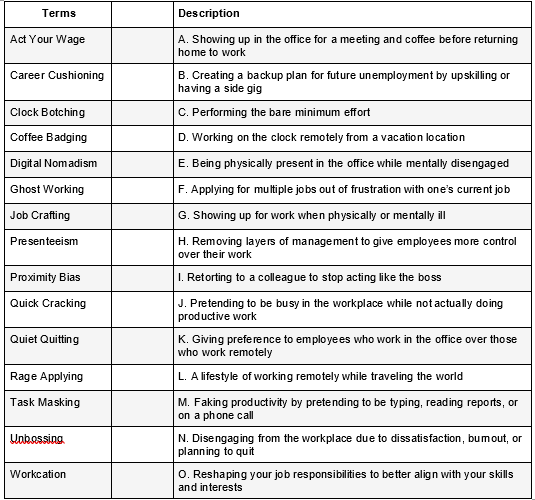
I recently came across the term “clock botching,” which was new to me. Upon researching the term, I learned that it was coined earlier this month to describe a new workplace trend. That led me to explore other terms—many of which describe behaviors that have emerged in recent years.
Test your knowledge! Match each workplace trend (left column) to the correct description (right column).
In the next few blogs, we will look at the factors that influenced these trends, the pros and cons of each, and how they impact your business.
A friend commented recently that one of his children had been so content as a young man, he worried it might keep him from achieving all that God intended for him in life.
Contentment—being at peace and satisfied with one’s station—is a valuable quality. People who are content tend to experience lower stress levels and a deeper appreciation for daily life. The apostle Paul modeled this beautifully, writing:
“I have learned in whatever state I am, to be content.” — Philippians 4:11 (KJV)
But while contentment is healthy, it can become a drawback if it leads to complacency. A person who is too content may neglect personal development, avoid pursuing opportunities, or settle for less than their best. For a small business owner, this might mean missing out on ways to better serve customers, grow the business, or create jobs.
Conversely, unchecked ambition can be equally harmful. The Bible warns against selfish ambition:
“For where you have envy and selfish ambition, there you find disorder and every evil practice.” — James 3:16 (NIV)
The key is finding a healthy balance—striving to improve your business while maintaining contentment in the journey and integrity in your methods.
How to Balance Contentment and Ambition in Your Business
If you’re a small business owner, it’s important to regularly evaluate your goals, values, and ambitions to ensure they align with your faith, lifestyle, and vision. Here’s a practical process to help you balance ambition with contentment:
1. Reflect on Your Personal and Business Goals
Before you can decide how much to grow your business, be clear about what you want from it. Consider:
Do you want to work as a solopreneur, generating income through your own skills without managing employees?
Does your business idea require more labor than you can handle alone?
Do you want to create jobs and provide reliable income for others?
How many hours per week are you willing to work?
What type of schedule would you like to maintain?
Example: If you value evenings and weekends off, a manufacturing or professional service business might suit you better than a restaurant, retail shop, or entertainment business.
2. Define Your Financial Needs
Understand how much income you need to meet your personal and family obligations. Your financial goals will shape your business structure:
As a solopreneur, your income depends solely on your labor and the rates you charge.
As an employer, your income potential grows with employee productivity and overall business revenue.
3. Develop a Business Plan That Reflects Your Priorities
Once your goals are clear, develop a plan that honors those objectives.
Choose your legal structure.
Launch your marketing strategy.
Build your customer base through personal connections and word-of-mouth.
Remember: The startup phase is typically slow—be patient as customers become aware of your business.
4. Regularly Assess Your Growth and Contentment
Periodically evaluate whether you’re satisfied with your business’s size, revenue, and operations.
Questions to consider:
Are you content with your current workload and income?
Has demand exceeded your capacity? If so, would you prefer to turn away work or hire help and grow your business?
Would expanding your hours, services, or product lines serve your goals—or cause unnecessary stress?
Is maintaining your current size better aligned with your personal and family priorities?
There’s no wrong answer—what matters is that your decisions reflect thoughtful, prayerful discernment.
5. Avoid Complacency While Maintaining Contentment
Even if you’re satisfied with your business size, remain proactive:
Monitor industry trends and customer preferences.
Stay current with new technologies that improve efficiency.
Review your offerings to meet evolving customer needs.
Keep your physical space welcoming and well-maintained.
Stay compliant with legal and regulatory changes.
Invest in employee development through training and advancement opportunities.
Final Thoughts
Business ownership can bring both financial rewards and personal fulfillment when managed wisely. But it can also lead to stress and dissatisfaction if you chase goals that don’t align with your values or allow others to pressure you into expanding beyond your comfort zone.
Strive to operate a business that honors your definition of success, serves others well, and allows you to live with contentment and integrity. In doing so, you’ll find a healthy, God-honoring balance between ambition and peace.
📢 I’d love to hear from you!
How have you balanced contentment and ambition in your business? What decisions helped you stay true to your values while pursuing growth? Share your thoughts in the comments!
Over the past few weeks, we’ve discussed how to create and understand your financial statements. Now it’s time to turn our attention to reviewing and assessing those statements.
Regularly analyzing your financial data is essential to:
Determine if your business plans are working
Identify problems such as theft or fraud
Evaluate how your business compares to others in your industry
Spot trends that may positively or negatively affect your revenue
Are Your Plans Working?
Your cash flow worksheet was based on projected monthly sales over two years. You made critical business decisions—such as hiring staff, leasing space, and applying for financing—based on those projections.
If your actual revenue is falling short of projections, you may be burning through cash faster than expected. Identifying that early allows you to make adjustments, cut expenses, or secure additional funding.
On the flip side, if your revenue is exceeding expectations, you might be struggling to meet demand or maintain excellent customer service. In that case, you may need to hire more staff or set clearer expectations with customers regarding delivery times.
Identifying Problems
When I owned a restaurant, we were required to complete a weekly profit and loss statement and submit it to headquarters along with our royalty payment. Two numbers I always paid close attention to were payroll and cost of goods sold (COGS).
Our goal was to keep payroll under 22% of revenue and COGS under 35%. If either number was too high, it triggered an investigation. Here are some examples:
Payroll Red Flags
Overstaffing during slow periods: I reviewed scheduling during off-peak hours and made necessary adjustments.
Employees clocking in early or out late: I compared timecards to the schedule. One student used to come in early to do homework, but I didn’t realize he was on the clock!
Overtime pay: This often happened when a nearly full-time employee picked up extra shifts. We learned to ask part-time staff to cover instead.
Inventory Red Flags
Improper food preparation: Mistakes led to waste. We retrained employees or reminded them to follow special instructions more carefully.
Excess food on the buffet: Supervisors learned to reduce what was put out in the last 30 minutes of service.
Ordering errors: Overstocked perishables spoiled; running out meant buying from local stores at higher prices.
Theft: This included employees eating food without paying, giving away food, or failing to ring up sales and pocketing the cash.
Even if you’re not in the food service business, these examples illustrate how to track down the causes of higher-than-expected costs.
Comparing to Industry Standards
Analyzing your financial statements also helps you understand how your business stacks up against others in your industry. Industry benchmarks are available through association data, IBISWorld reports, and other sources.
Declining sales volume is a major red flag. A brief dip might be seasonal or due to temporary competition. But if the trend continues, take a closer look:
Customer service issues: Even one rude or careless employee can cost you business. Many customers won’t complain—they’ll just leave.
Product quality issues: Poor-quality goods can lead to returns and dissatisfied customers.
Missed deadlines: Late deliveries frustrate clients. Evaluate every step in your supply chain to find and fix delays.
Rising accounts receivable can signal that your customers are struggling to pay. This slows your collections, reduces cash flow, and makes it harder to pay your own suppliers. If your receivables are growing:
Identify which customers are paying late and ask why.
Consider adjusting their credit limits or payment terms.
Project your cash flow for the next few months.
Talk to your banker about a line of credit, and ask suppliers for more favorable terms if needed.
Declining profit margins are another warning sign. Investigate the root cause. It could be:
Rising supply costs: Due to inflation, fuel prices, or shortages. Consider discontinuing low-margin items or sourcing more affordable alternatives.
Increased wages: If labor costs have risen, look for ways to improve productivity or automate processes.
Higher operating expenses: These might include utilities, insurance, or telecom services. Shop around for better rates, reduce waste (like leaking pipes or lights left on), and review whether you’re paying for services you don’t need.
Final Thoughts
Every business is different, but all must control costs and protect profit margins. Assessing your financial ratios regularly helps you identify problems early—before they impact your bottom line. Use the examples above as a guide to evaluate your own financials, make informed decisions, and position your business for long-term success.
If you’d like help reviewing your financial statements or identifying potential issues, don’t hesitate to reach out. I’m here to support you! You can email me at susan.ball5@aol.com.
“It’s my pleasure.” When I hear this phrase, I immediately think of Chick-fil-A. This simple, polite response is just one of the many ways the company creates an exceptional customer experience. By focusing on customer service, Chick-fil-A has become the number one fast-food restaurant in America. On average, a Chick-fil-A location generates 50% more revenue than a McDonald’s, despite being closed on Sundays.
As a small business owner, delivering a great customer experience should be at the heart of your strategy. A positive experience not only encourages repeat visits but also drives sales and increases profitability. Whether you’re just starting your business or looking to grow, it’s essential to create a customer-centric environment. The key to success lies in setting clear customer service policies, training your staff, and making sure everyone is on the same page. While customer service may look different depending on your industry, certain principles apply across the board.
1. Be Polite and Show Respect
Politeness and respect should be at the core of your interactions with customers. The way you address your clients—whether formally (e.g., Mr. Smith or Mrs. Jones) or informally—sets the tone for your business. Timely responses to emails and phone calls are also a sign of respect. It’s also vital to train your employees to handle complaints professionally by listening actively and taking steps to resolve issues quickly.
2. Timeliness Matters
Time is valuable to your customers, and respecting that time can set you apart. If you’re in a service-based business or doing contract work, meeting deadlines is crucial. If you operate a retail store or restaurant, greeting customers promptly and serving their orders as soon as they’re ready shows that you value their time and business.
3. Give Your Full Attention
When interacting with customers, it’s important to be fully present. This means putting away distractions like cell phones and focusing on their needs. In a busy environment, consider systems like queues or numbered tickets to ensure that no customer is left waiting too long and that service remains consistent.
4. Apologize for Mistakes and Make It Right
No business is perfect, and occasionally you will make mistakes. When this happens, apologize sincerely and avoid making excuses. A genuine apology can go a long way, but in some cases, you may need to offer a refund, replacement product, or discount to make up for the mistake. Empower your team to handle customer issues effectively, ensuring that the solution is fair and quick.
5. Respect Your Customers’ Timelines and Budgets
This is especially important in contract or service-based businesses. If a client needs a job done by a certain deadline, don’t take on the job if you can’t meet it. Similarly, if a client has a strict budget, be transparent about costs upfront and do your best to stay within their limits. Trust is built when customers know you’ll respect both their time and money.
6. Establish a Dress Code
Your customer service policies should include clear guidelines for employee appearance. Whether you require uniforms, name tags, or business attire, make sure your team looks professional and approachable. A dress code that aligns with your industry standards shows customers that you take your business seriously and care about their experience.
7. Create a Welcoming Environment
First impressions matter. How customers feel when they enter your business can set the tone for their entire experience. Some businesses greet customers immediately upon entry, while others offer complimentary refreshments like coffee, bottled water, or mints. Small touches—like comfortable seating or soft background music—can make a big difference. Think about how you can enhance the atmosphere to make your customers feel welcome and valued.
8. Meet or Exceed Customer Expectations
The ultimate goal of customer service is to exceed expectations. When customers experience something better than they anticipated—whether it’s a friendly interaction, faster service, or a surprise bonus—they’ll be more likely to return. Continuously seek feedback from your customers and look for ways to improve.
Conclusion
The customer experience you offer is one of the most powerful tools you have for growing your business. By focusing on politeness, timeliness, respect, and attention to detail, you can create an environment where your customers feel valued and appreciated. Remember, small touches can leave a big impression. When your customers feel good about their experience, they’ll keep coming back—and they’ll bring others with them.
Need help creating a customer service strategy that works for your business? Whether you’re just starting out or looking to refine your existing approach, I’m here to guide you. Reach out today for a personalized consultation and let’s build a customer experience that will keep your clients coming back for more!
In the world of small business ownership, assembling the right team is crucial for success. Whether you’re launching a startup or expanding an existing venture, a core support team is indispensable. Enter your BAIL team – Banker, Accountant, Insurance Agent, and Lawyer.
These professionals form the cornerstone of your business’s foundation, offering essential guidance, resources, and connections to steer you toward success. Forming a relationship with a professional from each category before you start your business can also help you avoid costly mistakes.
Banker: Establishing a business checking account is pivotal from the outset, safeguarding your personal assets from business liabilities. Cultivating a rapport with a banker early on is key, positioning you favorably for future financial needs and potential loans. Their insights can prove invaluable in assessing financial health and preempting any looming threats.
Accountant: While some small business owners possess financial literacy, most benefit from the expertise of a dedicated accountant. From navigating tax complexities to optimizing financial structures, their role is pivotal in ensuring fiscal compliance and maximizing savings. Moreover, they can offer strategic advice on transitioning business entities for enhanced benefits. Remember, skimping on professional financial advice can lead to costly errors down the line.
Insurance Agent: Shielding your small business from unforeseen risks is imperative, and an adept insurance agent is your ally in this endeavor. Whether it’s safeguarding physical assets against disasters or mitigating liabilities arising from accidents, their counsel is indispensable in crafting comprehensive coverage plans tailored to your needs.
Lawyer: Legal intricacies are an inevitable part of small business ownership, underscoring the need for proficient legal guidance. Before embarking on your entrepreneurial journey, engaging an attorney to vet contractual agreements is prudent. Their expertise becomes instrumental in navigating complex contracts and resolving disputes as your business evolves. Remember, legal missteps can prove far costlier than retaining a skilled attorney from the outset.
In addition to your BAIL team, assembling a group of business professionals tailored to your specific needs is essential. From web designers to marketing experts, their collective expertise bolsters your small business’s online presence and outreach efforts. Moreover, outsourcing tasks like payroll management and administrative services can streamline operations and enhance efficiency.
Most business owners can benefit from creating a networking team. This team will consist of non-competitive businesses serving a similar clientele to yours. Those on your team will be business owners whose work you trust so that you are comfortable referring them to your customers; hopefully, they will return the favor and recommend you to their customers. Here are some examples of teams that might be useful for different types of businesses.
If you are a wedding and events planner, you will want to form relationships with event venues, limo drivers, caterers, florists, bands, DJs, and photographers.
General Contractors need the services of skilled laborers (HVAC, plumbers, electricians, painters, roofers, etc), real estate agents, home stagers, lawyers, and interior decorators.
If you own a handyman service, you will want to form a referral network with carpet cleaners, power washers, landscapers, painters, and residential cleaning companies.
Retail store owners want to form relationships with other store owners in their proximity. These partnerships can attract customers to your shopping area. A florist might partner with a chocolate store and a tea shop to offer gift baskets for Mother’s Day; a restaurant might partner with a massage therapist and a carriage tour to create “date night” packages.
Irrespective of your small business niche, leveraging the expertise and networks of fellow small business owners is instrumental in fostering growth and long-term success. By cultivating strong relationships with your BAIL team and strategic collaborators, you’re prepared to navigate the world of small business ownership with confidence and resilience. Don’t forget to save this blog and create your own checklist using these four cornerstone professionals – they’re non-negotiable for your small business’s success.
When my husband and I decided to purchase a pizza franchise, we had little knowledge about the Small Business Development Center (SBDC) program and its free assistance. When I later became an SBDC consultant, I realized how much we could have benefited from meeting with an SBDC advisor during the planning stage of our small business venture.
If you are contemplating launching a small business, consider seeking free and confidential consulting services from your local Small Business Development Center (SBDC). They can provide invaluable assistance and support tailored to your specific needs.
Business Ownership Considerations
An SBDC consultant can assist you in understanding the demands, risks, and rewards of owning your own business. It is crucial to consider how running your business will impact your family and lifestyle. For example, restaurant owners should be prepared to be present during the busiest periods, which typically occur in the evenings and on weekends. Similarly, accountants should expect to work long hours from January to mid-April. In addition to being directly involved in their businesses, business owners must also oversee employees, manage finances, handle inventory, create work schedules, promote their business, and handle numerous other responsibilities. The hours can be long and may infringe on personal and family time.
Realistic Business Loan Preparation
Just like many of our clients, Steve and I were unaware of the differences between a business loan and a personal loan. We prepared for it similarly to a personal loan but added a business plan. We should have realized that lenders needed more assurances beyond a good credit score and the ability to repay the loan. We had to convince the lender that (1) there was a demand for our products and services, (2) we knew our target clients and how to reach them, and (3) we could generate enough sales to comfortably make the loan payments. The SBDC consultant would have coached us on those 3 points and assisted us in creating 24 months of cash flow projections and validating our revenue projections.
Bank Selection
We chose a bank to apply for a loan because it was the bank used by our franchise corporation, one of the country’s largest national banks. However, we didn’t understand that each region operated independently. The bankers we spoke with knew nothing about our franchise and didn’t seem interested in a loan for a “small” business like ours. The whole process was frustrating, and in the end, the denial letter wasn’t even for our business. We should have applied to a local or regional bank. Even then, it would have been difficult to find a bank willing to lend to a start-up restaurant on our own. Today, after being a consultant for 17 years, I know how to direct clients to the banks most likely to assist them.
Research
Business planning includes defining your target customer and researching whether your local demographics include your target customer group. It also involves research into the industry you will enter. Is the industry growing? What are the trends? What are the primary products and services in your industry? You also need to know who your competitors are. Your local SBDC can provide industry reports and request local research from the national research center.
Business Plan Development and Cash Flow Forecast
Your SBDC consultant can assist you in developing your business plan, reviewing your draft, and providing feedback. Your plan will encompass an introduction to your company and ownership, a description of your products and services, an analysis of your competitors’ strengths and weaknesses, and details on how you will market your company to attract your target customers. Additionally, an SBDC consultant can help you prepare your 24-month cash flow forecast. The research they provide can aid you in writing your business plan and in estimating projected revenues.
When you decide to embark on the journey of starting your own business, it’s important to remember that you don’t have to navigate this path by yourself. Make sure to tap into the valuable resources your local small business development center provides to get the support and guidance you need.
Owning a small business is a challenging task, yet it is the dream of millions of people. As someone who works with over a hundred potential small business owners each year, I can attest to their passion for entrepreneurship.
They all have different motivations for pursuing business ownership. Some of them possess the necessary qualities to be successful business owners, while others lack realistic expectations of what owning a business entails and how to prepare themselves to start and operate one.
Twenty-five years ago, my husband and I were in the same position as many of my clients when we decided to invest in a pizza franchise. Fortunately, we had close friends who were already part of the same franchise, and they mentored and guided us. They were honest and open with us, but there were still many lessons we had to learn on our own. These are some lessons we wish we had known before starting our business.
Help is available. I was previously aware of SBA and SBA-guaranteed loans, but I did not know the support provided by Small Business Development Centers (SBDC). If we had approached an SBDC for help, we would have been better equipped, avoided some complications, and saved money.
Obtaining a business loan is vastly different from obtaining a personal loan. Despite our excellent credit scores and references, my husband and I were surprised to be rejected for a business loan. We had sufficient funds to invest in our business, and obtaining personal loans for various purposes, like buying a house or car or making home improvements, had been easy. I never imagined we would be turned down for a business loan, but we were.
When applying for a business loan, it is essential to choose the right bank. As a small business owner, there might be better options than a large national bank for you. Instead, local or regional banks are better suited for small businesses. A local banker is more likely to invest in your community and work with you if things do not go as planned.
Getting established in a business takes longer than most people plan. You need adequate financial resources to support yourself during the startup and growth phases. You should have enough savings to cover your personal expenses for several months. This will allow you to reinvest your business revenue back into the business and promote its growth.
Managing employees can be challenging, especially if you struggle with assertiveness or find it difficult to correct them when they make mistakes. However, your employees play a vital role in your business’s success. Excellent employees can help you grow your business, while poor employees can harm your business’s reputation. Therefore, it is crucial to assess employee performance accurately and take corrective action when necessary.
For the past 17 years, I have been working as a business consultant, helping clients achieve their business goals. Over the years, I have gathered a wealth of knowledge and expertise, not just from my own experiences as a business owner but also from the valuable insights I have gained from individuals who want to start their own businesses.
In the upcoming months, I plan to share some of these insights in my blog, which will give you a unique perspective on the challenges and opportunities involved in starting and running a small business. So, if you want to turn your dream of starting a business into a reality, I highly recommend checking out my blog for valuable tips and tricks to help you succeed.
Many Americans have a dream of owning a business. According to a survey conducted in 2022, more than 40% of Americans aspire to start or purchase their own businesses. This is a positive thing since small businesses are the backbone of the American economy. In fact, 99.9% of all US businesses are small. More than 33 million small businesses employ over 61.7 million workers, per the SBA’s Office of Advocacy. Yet less than 7% of Americans are small business owners.
If you are considering starting or buying a small business, you need to ask yourself if you have what it takes to become a small business owner. Several vital attributes are common to successful small business owners. Read through the following list and score yourself one point for each attribute that applies to you. The higher the score, the more prepared you are to be a business owner.
Attributes of Successful Business Owners:
Is your spouse supportive of your plan? If you’re married, it’s crucial that your spouse is supportive of your decision to start a business. In the beginning, starting a business will consume a significant amount of your time and energy. Having a spouse who feels neglected or unheard can add unnecessary stress to an already challenging situation.
Are you willing to put in long hours to get your business up and running? During the initial stages of your business, it is essential to focus on raising awareness about your company’s existence while catering to the needs of your early customers. In the beginning, you may be the sole member of your company and will need to work long hours both within and on the business.
Do you have money to invest in starting your business? It’s important to remember that no lender will provide the entire amount required to start a new business. You need to save up a substantial amount of money to invest in yourself and your company. Generally, 15-25% of the total start-up costs are required.
Is there other household income to support your family while you launch your business? Some business owners can start their business on a small scale while maintaining their full-time jobs. This is ideal, but it is only realistic for some people. You may have to give up your secure paycheck to start. It is helpful to have other sources of income to pay the bills until your business begins to generate sufficient revenues to make a profit. Other sources of income might include your spouse’s wages or salary, retirement, disability, investments, and rental income.
Did you operate a lemon stand or paper route as a child? Having experience owning a business before can prove highly beneficial when taking on bigger and more complex ventures. The lessons learned from prior business ownership can help you better understand the importance of strategic planning, financial management, and effective communication with stakeholders. Additionally, you have gained valuable insights into building and maintaining successful relationships with clients, employees, and other partners in the business world. Overall, prior business ownership provides a wealth of knowledge and experience that can help you navigate the challenges of entrepreneurship with greater confidence and success.
Do you have close relatives or friends who are business owners? Experienced business owners are typically happy to share their keys to success and the lessons learned from their mistakes.
Have you worked for and been in close contact with the owner of a small business? If so, you may have witnessed their decision-making processes and experienced times when you disagreed with their decisions.
Have you had management experience in any business? The responsibility of making decisions and guiding employees helps prepare you for owning and running your own business.
Have you had various functional work experiences, such as accounting, finance, or marketing? In your own business, you will have the ultimate decision-making authority for every aspect. Having some experience in many different areas will help you be better prepared.
Have you been frustrated by having your work-improvement suggestions rejected by those in management above you? Those who note inefficiencies and problems in the workplace are naturally inclined to want to run their own businesses and test their solutions.
Are you a person of action rather than a dreamer? While the idea of owning a business appeals to many, it takes a great deal of hard work and determination to turn that dream into a reality. Unfortunately, only a small fraction of those who dream of business ownership are willing to put in the necessary effort and dedication to make it happen.
Are you a risk taker? Starting a business is risky. It requires you to leave the comfort of a reliable, steady paycheck for the uncertain possibility of great success and satisfaction. But it also involves the possibility of failure.
Do you enjoy working with other people? Owning your own business will force you to interact with many different groups of people, including employees, networking partners, lenders, business development leaders, and competitors.
Are you able to delegate effectively? Running your own business will require you to let go of many tasks so that you can focus on the tasks that only you can do. You will have to train your employees and then trust them to do the tasks assigned without constantly looking over their shoulders.
Do the employees you supervise in your current job respect you and work hard for you? It is important that your employees see you as the leader and take direction from you. This does not mean that you become a dictator. Listen to your employees and let them share their ideas. Ultimately, however, you will make the final decisions, and your employees have to respect that and follow your directives.
Are you someone who can adapt to new situations easily and is comfortable with change? As soon as you start to feel relaxed, things will change. Change comes from many sources outside of your control, such as new competition, inflation, and new regulations. You must be flexible and adapt to changes you cannot control.
If you are seriously considering taking the plunge into business ownership, join me over the next few months as I continue to share what I learned as a business owner and a full-time small business consultant.
During my initial meeting with a new client, I generally ask about their motivation behind starting a business. In my experience of 17 years, I have come across various answers, ranging from “I have extensive knowledge about this industry and can perform better than my previous employers” to “My boss is reaping all the benefits of my hard work, and I feel it’s unjust.”
LivePlan conducted a survey in 2022 to explore why people start their own businesses. The survey results revealed the seven most common motivations behind entrepreneurship, shedding light on the factors driving individuals to take the leap into self-employment.
To pursue their passion. Starting a business to pursue your passion is often cited as a top reason. Mark Twain reportedly said, “Find a job you love, and you will never have to work a day in your life.” If you can earn a livelihood by following your passion, then you will likely find your work fulfilling. However, there are a few things you should keep in mind: A. Your passion may be a better side hustle than a full-time business, particularly in the beginning. B. You may find less joy in doing the hobby or skill you loved when you have to do it to pay the bills.
To create generational wealth. Creating generational wealth has become a popular term nowadays as people understand that successful business owners can pass down a thriving business to their children. However, it’s essential to keep in mind that this is a rare occurrence. Many children do not wish to follow in their parents’ footsteps, and only 20% of the time do children take over the family business. Furthermore, most family businesses rarely survive to the third or fourth generation due to the younger generations’ lack of preparation or passion.
To support the community and help others. Supporting your community can be achieved by creating job opportunities and earning a significant profit, which then can be shared with those in need. Starting a business can be a great way to achieve this noble goal. However, success is crucial to fulfill this mission. Therefore, running your business according to best business practices is essential.
To turn a side gig into a full-fledged business. This reason is similar to the first one, but it is different in that your side gig may not necessarily be your passion. Your side project may have started because you noticed a need that you could meet. For example, you may have realized that many houses in your neighborhood, including your own, desperately needed power washing. So, you bought a power washer and started washing houses for a fee when you weren’t working your regular job. Over time, your side hustle may grow to the point where you could do it full-time. Many of my clients are starting a side job with the goal of developing it into their full-time businesses.
To challenge the status quo. Some of my clients are frustrated with their bosses who keep doing things “the same old way.” They have observed that certain tasks could be accomplished more efficiently, employees could be given more authority, and customer support policies could be improved. However, they do not feel there is an atmosphere at the workplace to challenge their bosses to change. As a result, they are considering starting their own businesses to put their ideas into practice.
To achieve better family life balance and flexibility. In my area, many people travel long distances to work in either the nation’s capital or my state’s capital. They spend several hours commuting on highways, in addition to the time they put in at their jobs. However, they often believe that their quality of life would improve if they could work locally and have more control over their schedules. Whether this balance is achievable depends on the type of business they choose. A. Starting and growing a business requires a lot of hard work and dedication, and many business owners put in long hours to establish their businesses. For government contractors, consultants, marketers, and salespeople, networking and building professional relationships are especially important during the early stages of their businesses. B. Retail shops, restaurants, and hospitality businesses are typically busiest on weekends, evenings, and holidays. However, these businesses do offer owners the opportunity to take time off during the weekdays. This option can be a good choice if you would like to travel during the off-season or have a few days off mid-week.
To be the boss. According to a recent survey, almost half of the participants (47%) expressed their desire to become entrepreneurs and be their own boss. For some people, the idea of being in charge of one’s own business also comes with a sense that other people respect you. However, it also entails the crucial responsibility of effectively managing and developing the enterprise.
While there are many compelling reasons to start a business, such as being your own boss, pursuing your passion, or achieving financial independence, these reasons alone are not enough to ensure success. To set yourself up for success, you will need to do your due diligence, develop a comprehensive business plan, and gain a deep understanding of your target market and industry trends. You must also be equipped with the necessary skills to manage business operations effectively and lead and motivate employees. Only with a combination of these factors can you increase your chances of building a thriving and sustainable business.
Are you one of the millions of Americans considering opening a business? Before taking the plunge into business ownership, ask yourself these questions and answer them as honestly as possible.
Am I comfortable taking risks? Risk is an inherent part of starting a business. If you’re considering leaving your current job to start your business, you’ll be giving up a steady income. There’s also the risk of depending on your business to provide for your family’s needs. If you’re uncomfortable with risk, starting a business may not be the right choice for you.
Do I have money to invest in starting a business? Financial planning is a crucial aspect of starting a business. We often meet with people who don’t have any cash to invest in starting a business and expect to be able to borrow 100% of the startup costs. This is not a realistic expectation. A lender will expect the business owner to have 10- 20% of the startup funding needed. If you don’t have the capital to invest but you really desire to start a business, consider options that require little or no investment. Such enterprises include consulting services or virtual services you can do from home using only your computer.
Do I have time to devote to running a business? All businesses require time to work both in and on the business. Many business owners tell us that they work 40 or more hours in their businesses each week and work another 10 – 20 hours on the business. Working on the business includes marketing and networking efforts to find customers, invoicing, bill paying, scheduling, and many other necessary tasks that do not generate revenue.
Am I comfortable making decisions? A business owner makes many important decisions every day. These decisions include which jobs you want to bid on, the proper price to charge for your services, how you will market your services, and whether you should hire (or fire) an employee. If you are hesitant to make these decisions, business ownership may not fit your personality.
Do I have the expertise to do the work and run the business? We often encounter individuals lacking the skills to perform the tasks required to start their desired company. They plan to hire the appropriate individuals to complete the job. For instance, a non-chef may open a restaurant with the intention of employing a talented chef. This approach may prove successful until the hired chef departs for another position. Prospective business owners need to have some training and experience in the services they will offer so they can do the work themselves when necessary. They also need to be capable of recognizing when an employee is not doing the job properly or well.
Does my family support my decision? Running a business is hard work. It requires working long hours and committing family financial resources to succeed. You need the support of those in your immediate family. You should reconsider if those closest to you do not support your decision.
If you answered yes to these six questions, you may be ready to move forward with starting your own business. This series of blogs will give you more valuable information that you need to be well-prepared for success.









 Susan's Reflections
You must be logged in to post a comment.