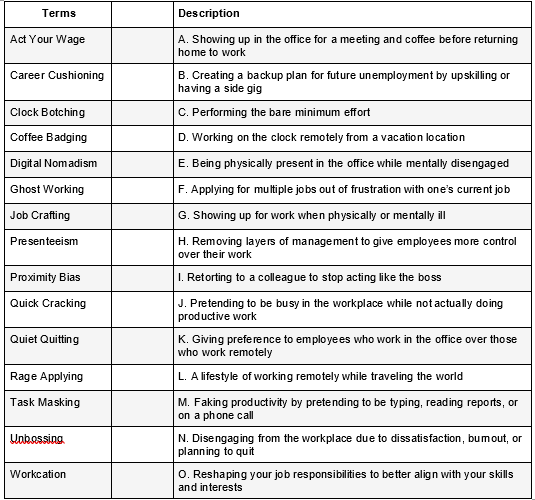
I recently came across the term “clock botching,” which was new to me. Upon researching the term, I learned that it was coined earlier this month to describe a new workplace trend. That led me to explore other terms—many of which describe behaviors that have emerged in recent years.
Test your knowledge! Match each workplace trend (left column) to the correct description (right column).
In the next few blogs, we will look at the factors that influenced these trends, the pros and cons of each, and how they impact your business.
A friend commented recently that one of his children had been so content as a young man, he worried it might keep him from achieving all that God intended for him in life.
Contentment—being at peace and satisfied with one’s station—is a valuable quality. People who are content tend to experience lower stress levels and a deeper appreciation for daily life. The apostle Paul modeled this beautifully, writing:
“I have learned in whatever state I am, to be content.” — Philippians 4:11 (KJV)
But while contentment is healthy, it can become a drawback if it leads to complacency. A person who is too content may neglect personal development, avoid pursuing opportunities, or settle for less than their best. For a small business owner, this might mean missing out on ways to better serve customers, grow the business, or create jobs.
Conversely, unchecked ambition can be equally harmful. The Bible warns against selfish ambition:
“For where you have envy and selfish ambition, there you find disorder and every evil practice.” — James 3:16 (NIV)
The key is finding a healthy balance—striving to improve your business while maintaining contentment in the journey and integrity in your methods.
How to Balance Contentment and Ambition in Your Business
If you’re a small business owner, it’s important to regularly evaluate your goals, values, and ambitions to ensure they align with your faith, lifestyle, and vision. Here’s a practical process to help you balance ambition with contentment:
1. Reflect on Your Personal and Business Goals
Before you can decide how much to grow your business, be clear about what you want from it. Consider:
Do you want to work as a solopreneur, generating income through your own skills without managing employees?
Does your business idea require more labor than you can handle alone?
Do you want to create jobs and provide reliable income for others?
How many hours per week are you willing to work?
What type of schedule would you like to maintain?
Example: If you value evenings and weekends off, a manufacturing or professional service business might suit you better than a restaurant, retail shop, or entertainment business.
2. Define Your Financial Needs
Understand how much income you need to meet your personal and family obligations. Your financial goals will shape your business structure:
As a solopreneur, your income depends solely on your labor and the rates you charge.
As an employer, your income potential grows with employee productivity and overall business revenue.
3. Develop a Business Plan That Reflects Your Priorities
Once your goals are clear, develop a plan that honors those objectives.
Choose your legal structure.
Launch your marketing strategy.
Build your customer base through personal connections and word-of-mouth.
Remember: The startup phase is typically slow—be patient as customers become aware of your business.
4. Regularly Assess Your Growth and Contentment
Periodically evaluate whether you’re satisfied with your business’s size, revenue, and operations.
Questions to consider:
Are you content with your current workload and income?
Has demand exceeded your capacity? If so, would you prefer to turn away work or hire help and grow your business?
Would expanding your hours, services, or product lines serve your goals—or cause unnecessary stress?
Is maintaining your current size better aligned with your personal and family priorities?
There’s no wrong answer—what matters is that your decisions reflect thoughtful, prayerful discernment.
5. Avoid Complacency While Maintaining Contentment
Even if you’re satisfied with your business size, remain proactive:
Monitor industry trends and customer preferences.
Stay current with new technologies that improve efficiency.
Review your offerings to meet evolving customer needs.
Keep your physical space welcoming and well-maintained.
Stay compliant with legal and regulatory changes.
Invest in employee development through training and advancement opportunities.
Final Thoughts
Business ownership can bring both financial rewards and personal fulfillment when managed wisely. But it can also lead to stress and dissatisfaction if you chase goals that don’t align with your values or allow others to pressure you into expanding beyond your comfort zone.
Strive to operate a business that honors your definition of success, serves others well, and allows you to live with contentment and integrity. In doing so, you’ll find a healthy, God-honoring balance between ambition and peace.
📢 I’d love to hear from you!
How have you balanced contentment and ambition in your business? What decisions helped you stay true to your values while pursuing growth? Share your thoughts in the comments!
Many small business owners find financial statements intimidating, but they don’t have to be. Understanding your financial statements is key to managing your business’s health and growth. In this blog post, we’ll break down the balance sheet—one of the most essential financial statements you need to know.
By the end, you’ll have a clearer understanding of how your business’s assets, liabilities, and equity come together to tell the story of your company’s financial health.
What Is a Balance Sheet?
A balance sheet provides a snapshot of your business’s financial position at a specific point in time. It outlines three core components:
Assets: What your business owns
Liabilities: What your business owes
Equity: The owner’s stake in the business
The fundamental equation behind a balance sheet is:
Assets = Liabilities + Equity
This equation shows that all assets are financed either by the owner’s investment, debt (liabilities), or retained earnings (profits that remain in the business).
Assets: What Your Business Owns
Assets are the resources your business owns or is owed. They can be divided into two main categories: Current Assets and Fixed Assets.
Current Assets
These are assets that can be converted into cash or used within one year. They include:
Cash: Money in bank accounts and on-hand
Accounts Receivable: Money owed to the business, typically due within a year (e.g., unpaid customer invoices, credit card balances)
Inventory: Goods held for sale or used in production
Inventory Valuation Tip: Inventory can fluctuate in value over time. A common method is the FIFO (First In, First Out) method, where older inventory is sold first. This helps ensure the most recent purchases are valued accurately.
Fixed Assets
Fixed assets are long-term investments that have a stable value and are expected to last for more than one year. These include:
Furniture, fixtures, and equipment
Property and real estate
Vehicles
Depreciation: Fixed assets lose value over time due to wear and tear. Your accountant will help determine the most beneficial depreciation method for your business, as set by the IRS.
Liabilities: What Your Business Owes
Liabilities represent debts your business is obligated to pay. These are also categorized into two types: Current Liabilities and Long-Term Liabilities.
Current Liabilities
These are debts that need to be paid off within a year, including:
Accounts Payable: Money owed to suppliers for purchases made on credit
Accrued Expenses: Unpaid expenses like utilities and payroll
Short-Term Loans: Loans due within the next 12 months
Taxes Payable: Unpaid taxes, such as sales tax or payroll taxes
Long-Term Liabilities
These are debts that won’t be paid off within the next year, including:
Bank loans
Mortgages
Equity: The Owner’s Investment and Retained Earnings
Equity represents the value of the owner’s investment in the business. It shows how much of the company’s assets belong to the owner after liabilities are subtracted.
Owner Investment vs. Retained Earnings
Owner Investment: Money the owner invests to fund the business’s start-up or operations (also known as Owner’s Injection).
Retained Earnings: Profits that are kept in the business rather than taken out by the owner for personal use. These earnings are used to fuel growth and expansion.
If your business is incorporated, the value of the owner’s investment is shown through stock shares issued to the owner. For sole proprietors or LLCs, the investment is recorded directly as part of the business’s equity.
How to Create a Balance Sheet for Your Business
To create your own balance sheet, start by listing all your assets and liabilities. Here’s a simple balance sheet template you can use:
Balance Sheet
Company Name
2025
Assets:
Cash
Account Receivable
Furnishing
Equipment
Net Fixed Assets
Total Assets
$ –
Liabilities and Equity:
Accounts Payable
Notes Payable
Long-term Debt
Total Liabilities
–
Owner’s Injection
Retained Earnings
Total Equity
–
Total Liabilities + Equity
$ –
If you’d like a changeable balance sheet template, feel free to email me at susan.ball5@aol.com, and I’ll send it your way!
Final Thoughts: Why the Balance Sheet Matters for Your Small Business
Your balance sheet is more than just a snapshot of your business at a specific point in time. It’s a valuable tool that helps you:
Understand the financial health of your business
Track your growth and plan for future investments
Make informed decisions about spending, borrowing, and retaining earnings
By regularly reviewing your balance sheet, you’ll be better equipped to manage your finances and maximize your profits. Have questions about your business’s balance sheet? Or need help understanding your financial statements better? Drop your questions in the comments below, and I’ll get back to you as soon as possible.




 Susan's Reflections
You must be logged in to post a comment.