Overlooking the Obvious

I can take no credit for the following story.  It’s been around for many years and a guest speaker at church repeated it recently.  It is a great example, however, of how we can get so rapped up in what we are doing that we “miss the forest for the trees.”

Sherlock Holmes and Dr. Watson went on a camping trip. After a good meal and a bottle of wine, they lay down for the night, and went to sleep. Some hours later, Holmes awoke and nudged his faithful friend. “Watson, look up at the sky and tell me what you see.”
 
Watson replied, “I see millions and millions of stars.”
 
What does that tell you?” Holmes asked.
 
Watson pondered for a minute. “Astronomically, it tells me that there are millions of galaxies and potentially billions of planets. Astrologically, I observe that Saturn is in Leo. Horologically, I deduce that the time is approximately a quarter past three. Theologically, I can see that God is all-powerful and that we are small and insignificant. Meteorologically, I suspect that we will have a beautiful day tomorrow. What does it tell you?”
 
Holmes was silent for a minute, then spoke.  “Watson, you idiot.  Somebody has stolen our tent!”


May this story be a reminder to us all to pay attention to the details but to also look at the bigger picture of what is going on around us.

“How Can I Help?”

“Those of us who are strong and able in the faith need to step in and lend a hand to those who falter, and not just do what is most convenient for us.  Strength is for service, not status.  Each one of us needs to look after the good of the people around us, asking ourselves, “How can I help?”  Romans 15:1-2 (The Message)

I came across this verse in my devotions yesterday.  In the New King James Version the verse read, “We then who are strong ought to bear with the scruples of the weak, and not to please ourselves.  Let each of us please his neighbor for his good, leading to edification.”

Of course, I’ve read this verse many times before as I’ve studied the book of Romans, but yesterday it really grabbed my attention.  I think it was “scruples” that popped out at me.  It seemed an odd word to be in the Bible, and in fact, the King James uses the word “infirmities.”  At any rate, my curiosity was piqued and I pulled out a few other translations to see how they put it.

These verses were a reminder to me that God commands His people to look around them to see how they can help their neighbors.  From the story of the Good Samaritan, I know that my neighbor is any person God puts in my path.  I need to be watchful for others who need a hand and offer mine.  The needs may be spiritual, emotional, physical, or financial.  God doesn’t expect me to solve everyone’s problems, but He does expect me to offer service to those He brings to my attention.

The popular Bible teacher Bruce Wilkinson (author of The Prayer of Jabez and The Dream Giver) personalizes this question to open doors of opportunity to help others without interferring where he is not wanted.  When he feels the Holy Spirit impressing upon him to offer assistance to someone, he approaches them and simply asks “How may I help you?”  It is direct and to the point.  Often the person’s first reaction is to deny needing his help.  When Bruce persists, they open up and share their problems.  Sometimes God directs Bruce to meet the need immediately by giving the person money; other times God direct Bruce to provide godly counsel; and occasionally Bruce simply prays for the person.  Bruce based his approach on the example of Elisha the prophet in the story of the Widow’s Oil (2 Kings 4:1 – 7).

The key to being of service to others is to be open to the nudge of the Holy Spirit that a person in your vicinity is in need and God is going to use you to help in the situation.   I urge you to pray that your heart will be attuned to the nudging of the Holy Spirit to assist someone in need today.  As you look around, ask “How can I help?”

If  God has directed you through the nudging of the Holy Spirit to recognize and assist to a person in need, please consider sharing your story as a means of encouraging others.

Learning to Accept and Embrace Change

Change is something I rarely seek and often resist, but lately God has been working on me to accept and embrace change.  I’m not speaking about change that arises from boredom or the desire to do something different, but meaningful change.  Changes that leads to a better way of doing things or  spiritual or emotional growth is productive and healthy.  But, it so much easier to stick with what we know than it is to change.

Amidst several staffing changes at our church recently, my pastor said to me, “People see change as bad.  Change isn’t good or bad.  It’s just different.” I don’t think he was saying that because he felt I was resisting the changes that had taken place; however, I do believe the Holy Spirit inspired him to make that comment to me at that time.

I know that he’s right and that the changes that took place were God ordained, but I would have preferred that things had stayed the same.  I liked the people who moved on to other callings and I couldn’t envision our church without them.  While I still miss them, I have accepted that God had a plan and His plan is best.  Those who moved on are ministering in congregations that needed them and new leaders are being developed from members of our congregation. Those particular changes have provided new opportunities for growth in leadership for members of our congregation.  The new leaders have stepped up to the challenge and God is blessing their work.

I think some of my resistance to change has its roots in my childhood.  Growing up as the daughter of a Marine, I attended 6 different elementary school in four different states.  Just as we settled into a new home and a new community, Dad would get orders and we’d be off again.  My sisters and I would have to get accustomed to a new school and make new friends.  I was constantly saying good bye to old friends.  Of course, each move allowed us to meet new people and make new friends.  God used these moves to bring people into our lives that lead our family to Him and helped us grow.  He also used those changes to help me quickly become comfortable in new situations and taught me to reach out to those who are new and make them feel welcome.

I know that changes that God initiates are for His glory and my growth.  I trust that God loves me more than I love myself. The changes He wants for me will help me to become more Christ-like and to draw closer to God.  I want to not only accept those changes but learn to embrace and celebrate them.  My ultimate desire is to honor God in all that I do each day and I can only do that as I allow Him to change me and my circumstances to conform with His will.  I don’t know what changes God has planned for me in the coming months and years, but I fully trust Him and know that those changes are for my ultimate good.

A Well-Deserved Retirement at the Age of 80

Last week my father retired for the second time.  His first retirement was back in 1979 after serving 26 year as an officer in the United States Marine Corps.  He was 47 at that time.  He never considered his military retirement to be a true retirement from the world of work. He was far too young and had far too many obligations.  Three of his nine children were in college and another was a senior in high school.  The youngest of the bunch was only two. 

His first attempt at a second career was selling life insurance.  It wasn’t a great fit, as it required meeting with potential clients in the evenings and weekends.  Dad had spent much of his military career away from his family and he wasn’t willing to sacrifice any more family time.  After a year of selling insurance, the perfect job opportunity became available.  Mary Washington College (now the University of Mary Washington) was expanding its offerings of business courses and starting a business department.  Prior to joining the Marine Corps, Dad had trained to be a teacher.  After a tour in Vietnam, Dad was given the opportunity to earn an MBA.  He was a perfect fit for the new department of business and was the first instructor hired.

Last week Dad completed his teaching duties at University of Mary Washington, although his official retirement date is a few weeks away.  Dad also turned 80 last week.  After a career spanning 59 years, Dad is certainly deserves to enjoy a leisurely retirement.  However, it is unlikely that he will sit around idly.  He’ll spend time with his grandchildren and great-grandchildren and cheer on the Washington Redskins and the New York Yankees.  He will also continue to do taxes for the many friends who have depended on him for many years. 

Many people have asked why Dad continued to work well past the normal retirement age.  I always respond, “It keeps him from having to help Mom with the gardening.”  The truth, however, is that he continued working because he enjoyed it and it kept him busy and engaged.  Working with college students helped keep Dad young and active.  It allowed him to interact regularly with his peers and young people and to keep up with changes in our society and in technology.

Working past the normal retirement age is nothing new in our family.  Dad’s grandmother was irate when she was forced to retire from working in the textile mills at the age of 72.  My mother’s mother was a victim of mandatory retirement when she was forced from the nursing job she loved at the age of 65.  In the 1960s and 1970s, many capable adults were compelled into retirement at the age of 65.   In 1978 the mandatory retirement age was increased to 70 and in 1986 it was abolished altogether. 

I am thankful that the laws have been changed, allowing healthy, vigorous seniors to remain active in the workplace as long as they desire to keep working and as long as their employers feel they are continuing to contribute positively to their companies.  I am grateful to the University of Mary Washington for giving Dad the opportunity to continue teaching for as long as he wanted.  No one at the University ever suggested that he was too old to continue teaching.  The university supported his decision to keep on teaching until he felt he was ready to retire.

I am very proud of my father’s contributions to protecting our nation and educating our young people.  He has touched many lives.  I pray that he enjoys a long and productive well-deserved retirement.

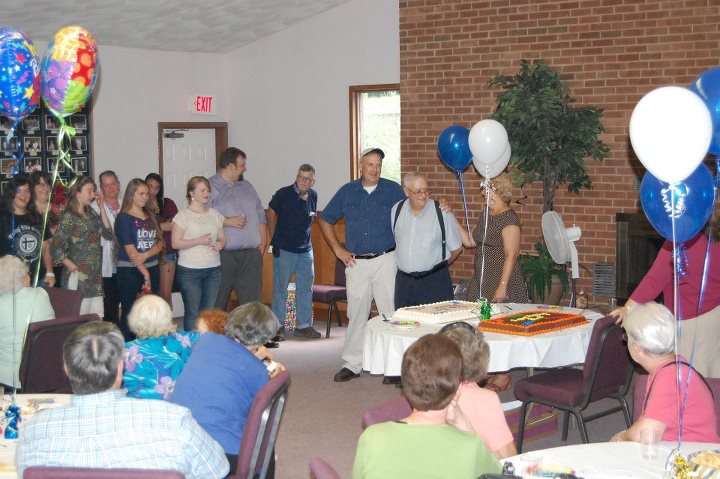
Dad (in the suspenders) celebrating with family and friends at his combined birthday and retirement party on Saturday.
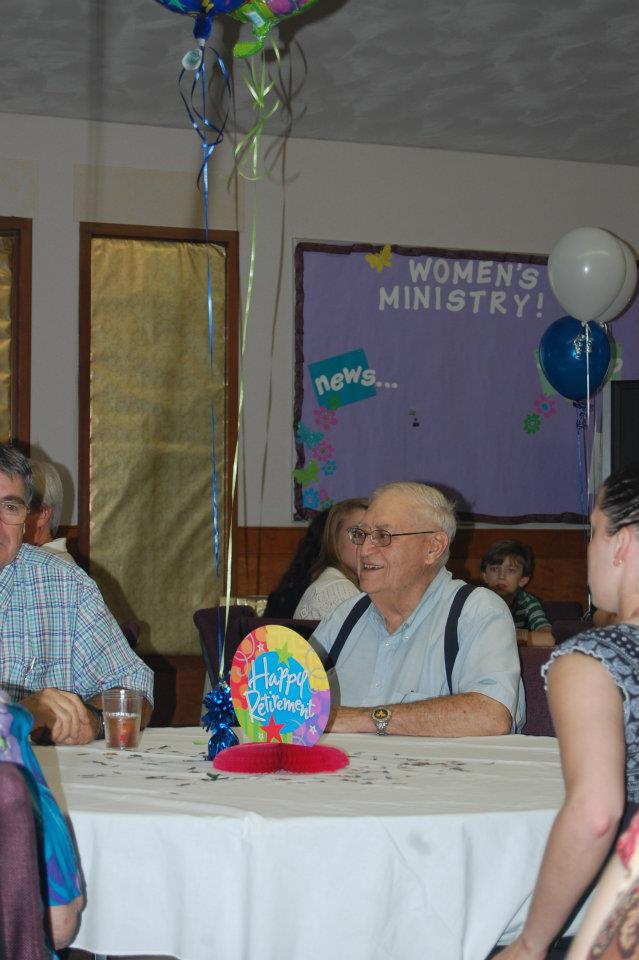
Dad celebrating his retirement and 80th birthday.

Our Hometown Olympians

I have always loved watching the Olympics and cheering on the USA.  In 1992 the Summer Olympics held a special significance as two recent graduates of  my alma mater, Stafford High School, were selected to represent the United States in Barcelona. 

Mark Lenzi graduated from Stafford High in 1986.  He had been a wrestler in high school, but he switched to diving after watching Greg Louganis win Olympic gold in 1984.  Mark joined a nearby diving team and quickly excelled in the sport.  He went on to dive for Indiana University, winning two NCAA  Championships. In the 1992 Olympics, Mark competed in 3-meter diving.

Jeff Rouse was a couple of years behind Mark, graduating in 1988.  Jeff had been swimming since the age of 5 and had set national age records at the age of 11.  He swam in college for Stanford University, specializing in the back stroke.  In the 1992 Olympics, Jeff competed in the 100-meter backstroke and the  4 x 100 medley relay.

Having two local residents competing in the Summer Olympics created quite a stir.  We live in an area where football and basketball dominate the local sports scene.  However, the entire community was proud of our local Olympians and prayed for their success.

Remarkably, both men returned home from Barcelona victorious.  Mark won the 3-meter diving competition, becoming the last American man to win a Gold medal in diving.  He returned to the Olympics in 1996 and won a bronze medal in his event.  Jeff came home from Barcelona with two medals–he won Gold in the relay and Silver in his individual event.  He bettered his results in the 1996 Olympics, winning two Gold medals.

This year marks the 20th anniversary of their Gold medal performances in Barcelona. To the best of my knowledge, Mark and Jeff are the only local athletes to have achieved Olympic success.  It is amazing that they graduated from the same high school and they competed in the same two Olympics.  We are very proud of our hometown Olympians.

Sadly, Mark Lenzi passed away earlier this year.  Jeff Rouse lives in our area and is a valuable member of our business community.

Sneak Peak at Reconciliations

The following excerpt is from my second novel Reconciliations, published by Oak Tara in November 2011.  I hope you enjoy it. 

If you would like to read a longer sample, please email me at susan@susaneball.com.   Reconciliations is available on Amazon and Christian Book Distributors.

Josh took a deep breath. “If Christine were in trouble, would you help her?”

Kevin stopped chewing and swallowed hard. “Why would you ask something like that?”

“Just answer the question. Would you help her if she needed you?”

“If you mean financial trouble, no way. Absolutely not. I was more than generous with her in the divorce. If she can’t handle her money, that’s her problem.” Kevin had been blindsided when Christine left him. It had taken him a long time to get over the hurt, and he had no intention of allowing her to hurt him again. And he was certain she would, if he got involved in her life.

Josh shook his head. “No, I mean if she were in real trouble and had no one else to turn to. Suppose she was in a bad relationship with a creep who treated her bad. Would you help her get out of it?”

Josh had Kevin’s full attention now. “You’re not just supposing, are you?” Although Kevin tried desperately to sound nonchalant, he was dismayed by the concern he felt for Christine’s well-being. “You know something. What’s happening with Christine?”

“I saw her the other day.” Josh dropped his voice and scanned the restaurant, as if afraid someone might overhear them. Kevin recognized Josh’s mannerism—he acted like this whenever he was about to tell Kevin something he’d rather not have to say. “Lisa and I were shopping, and we ran into her. She was with a guy—Larry something or other. She said they’re living together.”

Kevin scowled. “Of course she is. Christine has always been able to find a man to take care of her, at least for a little while. Unfortunately she usually picks losers. He’s probably the next guy in a long line of losers.”

“She seemed skittish, like she was in a hurry to get away. And she kept tugging at her sleeve, pulling it down to make sure her forearm was covered. When she raised her hand to wave good-bye, her sleeve fell back, and I saw a large bruise on her arm.”

“Maybe she bumped into something. Christine’s clumsy. She was always banging into the dresser or the bed post and getting bruised.” Kevin didn’t think a little bruise was anything to be concerned about.

“No,” Josh shook his head adamantly. “It looked like someone, I assume Larry, had grabbed her hard. I saw impressions of fingers on her arm.”

Kevin was alarmed, but there was no way he was getting involved in Christine’s domestic problems. “Christine’s a big girl,” he said flatly. “She can take care of herself. If this guy isn’t treating her right, she can move out.”

“Yeah, I guess.” But Josh didn’t seem convinced. “Thought you should know. That’s all.”

“I appreciate your concern, but I’m sure Christine will be fine.”

Despite Kevin’s assertion that Christine was no longer part of his life and none of his concern, he couldn’t stop thinking about her. She’d hurt him deeply when she left him after he caught her with another man. His pain was increased when he learned she’d been involved with two other men during the final months of their eleven-year marriage. Since their breakup, Kevin had one serious girlfriend while Christine had, according to the rumors, gone from one bad relationship to another. She was showing her true colors, and Kevin told himself he was glad to be rid of her. Yet the thought of some guy manhandling her disturbed him more than a little.

Kevin knew Christine Miller was a wild child the moment he laid his eyes on her. That had been part of the attraction.

Helping Marine Veterans Start New Businesses

Yesterday I had the privilege of participating in a program at Quantico Marine Base to educate Marines on the steps required to start a new business.  The program, Boots to Business, is designed to assist Marines who are transitioning out of the Corps to evaluate whether entrepreneurship is right for them, and if so, to assess opportunities and write a business plan.  Yesterday’s class was a 90-minute introduction to business ownership which I taught.  Those Marines who want to explore business ownership further are able to take an 8-week online class which will culminate with them having written business plans.


Me teaching Marines at Quantico the basics of business ownership.

My father served in the Marine Corps for 26 years and retired while I was in college, so Marines are near and dear to my heart.  It was a privilege for me to be asked to be a part of this program.  In my job as a business consultant with a Small Business Development center, I assist people daily to start or grow their businesses.  I love helping people fulfill their dreams of owning a business.  Since my office is located about 20 miles south of Quantico, many of my clients are veterans.

As we tell the Marines in this program, veterans make great business owners.  Many of the skills, attitudes, and attributes they learned in the military are keys to success in business.  These include teamwork, leadership, self-discipline, respect for rules and authority, respect for subordinates, patience, persistence, and making do with limited resources.  Veterans make of 6 percent of the American population but 14 percent of business owners.  Military service is a key factor in business ownership success.

Some of the Marines in yesterday’s class have already started businesses or are returning home to join family owned businesses.  Others are just beginning to explore the idea of starting or buying a business.  The government has provided for SBA resources partners, such as Small Business Development centers and SCORE offices, to assist them in exploring business ownership, starting a business, or growing an existing business.  The Marines I met yesterday were intelligent, thoughtful, and enthusiastic.  I am sure that each of them has the experience, abilities, and passions to be a successful business owner.

An Unplanned Day of Rest

Last week I read a blog by life coach Marie Wetmore  http://mariewetmore.com/2012/07/05/a-day-of-rest-key-to-your-happiness-and-well-being/.  Marie suggested that we would all be happier, healthier, and more productive if we plan a day of rest each week.  I couldn’t agree more, even if I don’t always follow that advice.  After all, God dictated to us that we should set aside one day per week, the Sabbath, as a day to worship Him and to rest. And in the story of creation in Genesis, we are told that God worked for 6 days and rested on the seventh.

Of course, as a Christian I go to church on Sundays and spend the day rather leisurely, but it certainly isn’t always a complete day of rest.  A typical Sunday for me involves doing a couple of loads of laundry and a trip to the grocery store so that I am prepared for the week ahead.  Yesterday was not planned to be any different from my usual Sunday, although I had managed to do laundry on Saturday.  In mid-afternoon I did a few errands, including shopping for groceries.  My intention was to cook a large dinner with planned leftovers for some lunches during the week.  However, my best intentions were interrupted by a severe storm.

Just as I was gathering the ingredients for dinner, I noticed a nasty storm brewing.  I decided to wait a few minutes as I didn’t want to chance the power going out with dinner half-cooked.  We lost power a week earlier for about 18 hours after a derecho (a widespread, long-lived, straight-line windstorm that is associated with a fast-moving band of severe thunderstorms–no I had never heard of it either before experiencing it last week) hit our community.  Within minutes the storm struck bringing with it a 20-minute hailstorm.  As expected, the power went out and remained out for a few hours.

This is what my yard looked like after the hailstorm yesterday.

Fortunately, it was early enough that it was still light outside.  Steve was at a movie with our oldest son Chris, so I was home alone.  Without electricity, I couldn’t cook, watch television, or surf the web.  I concluded that my only option was reading a book on my Kindle.  Since reading is my favorite pastime, I thoroughly enjoyed my unplanned hours of rest.  I immersed myself in a book for a couple of hours, until I estimated that the movie would be over.  Then I texted both Steve and Chris telling them to pickup dinner on their way home.  It was only after Steve had come home with fried chicken that he reminded me we have a gas stove, which continues to work in the absence of electricity.

Somewhere deep in the recesses of my mind, I’m sure I knew that the stove worked–especially as he mentioned it several times during the previous power outage.  However, we didn’t actually use the stove while the power was out and the information didn’t really process in my brain.  I should probably mentioned that we moved into this house recently and we have never before cooked on a gas stove.  I am still getting used to the peculiarities of this house and to cooking with gas.

I’m glad that I didn’t realize that I could have cooked dinner and had it waiting for Steve when he came home from the movies.  The hours I spent relaxing and reading were hours of rest that I needed.  He was relaxing at a movie and I relaxed at home.  Today I feel more rested and less stressed due to my unplanned day of rest yesterday.  I have to agree with Marie Wetmore that we all need a day of rest, or at least an afternoon of rest, regularly.  We need to unwind and recharge.  I hope that I make Sundays a day of true rest in the future.  I believe my work days will be more productive because of it, and it will allow me to catch up some good books I’ve been planning to read.

My Night at the Sleep Clinic

I spent last Friday night at our local sleep clinic being evaluated for sleep apnea.  I was evaluated about 12 years ago and told that I stop breathing 65 times every hour.  I was given a PAP machine to gently blow air into my nose and keep my breathing passages open.  However, the mask interfered with my sleep more than the sleep apnea, so after a few months I gave up on the mask.  I now know that I should have worked with the technicians to come up with a solution. The timing was bad as we moved from Florida to Virginia about 6 weeks after my diagnosis.  In the past few months, both of our twin sons have been diagnosed with sleep apnea and are using the breathing machines.  Progress has been made with the masks and the machines in the past decade, so I decided to give it another try.

I arrived at the sleep clinic at 8:30.  Soon afterwards, the technician began attaching monitors to various parts of my body.  Most were attached to my head and face; others were attached to both legs, my chest, and my back near my kidneys.  By the time the technician was done, I looked a lot like this man.

Once I was completely wired up, the technician helped me into bed.  It was difficult to find a comfortable position, but I did manage to go to sleep.

I should probably mention that a major storm hit while I was being prepped and we lost power.  The backup generators kicked in and things proceeded smoothly until 3 a.m. when the AC went out.  As difficult as it was to sleep with so many attachments, it was impossible once the temperature began to rise. Thankfully, I was scheduled to be awaken at 4:30, so I didn’t have to combat the heat for very long.  It was a great relief to have all the monitors removed and I was thrilled to be allowed to jump in the shower.  As I shampooed my hair, I was startled by an alarm going off.  A peak into the bathroom informed me that it was the fire alarm going off.

I assumed that the power must have come back on and triggered the fire alarm, so I continued with my shower. Within a minute, a female technician was knocking  on the door, urging me to come out.  I quickly finished and dressed.  Of course, there was no emergency.  After 15 minutes or so of standing outside, the fire department arrived.  It took another 20 minutes for them to give us the all clear.  I was very happy that I had decided to finish my shower.  Several of the other sleep client patients were still asleep when the alarm went off and stood outside in their pajamas with the monitors still attached.

By 7 a.m. I was headed home.  While this will probably stand as my most eventful trip to the sleep clinic, I do not expect it to be my last trip.  If the study reveals to the doctors that I do suffer from sleep apnea,  I will have to spend another night there so that I can be fitted for a sleep mask and the technicians can adjust it to my needs.

I don’t like the idea of sleeping with a breathing machine for the rest of my life.  However, it is preferable to being tired despite sleeping 7 – 8 hours a night.  It is also preferable to dealing with health issues or a possible early death due to sleep apnea.  So, I will make a real effort this time to adjust to the mask, if it is prescribed.

The Coffee Shop was not Invented in Seattle

As a coffee lover, I was intrique by a blog written yesterday by 19th Century Historical Tidbits on the history of coffee shops. I was surprised to learn that coffee shops have existed for 200 years or more and were not started in Seattle. Seattle can claim, however, to have started the modern day revival of the coffee shops.

The 19th Century Historical Tidbits provides quotes from the book, “Coffee: It’s History, Cultivation, and Uses.” The book was written in 1982 by Robert Hewitt. One of these quotes describes the Tontine Coffee-House in the 1820’s. The blog also contained an interesting quote of people enjoying their coffee purchased from street coffee-stands in New York. Hewitt even attributes sharing a cup of coffee on the street with a diverse group of coffee drinkers as contributing to making people sociable. Finally, the blogs quotes Hewitt’s comments about the healthy attributes of coffee.

I was unable to provide a link to the blog, so I have copied it (it is short and concise) below for you to read.

I am married to a non-coffee drinker. Steve doesn’t like the taste of coffee and doesn’t comprehend the ‘social’ nature of coffee drinking. His parents both were regular coffee drinkers, but did not pass on that habit. I was destined to be a coffee lover. My grandmother give me coffee heavily laced with milk and sugar as a toddler. Iced coffee was a regular summertime drink in our home. I love coffee hot or iced (but never lukewarm). It is satisfying to me to know that I am helping to carry on a long-standing American tradition.

Coffee (by 19th Century Historic Tidbits)

Posted: 28 Jun 2012 04:30 AM PDT

Coffee is an essential part of many people’s lives these days. In the 19th century it also had it’s place. In 1872 a book “Coffee: It’s History, Cultivation, and Uses” by Robert Hewitt.

In the preface he writes:
If occasion for enthusiasm is found in discussing the merits of roasted pig, surely very much stronger is the argument in behalf of roasted Coffee.

Another interesting comments:
The European, the Creole, the New Englander, the men of the West and the far-off Orient, all visit the coffee-stands. While partaking there is for the instant a touch of nature which makes mankind akin, for it is observable that the recipients of the morning cup of pure Java are sociable. Artificial distinctions are discarded in the very act of drinking in the crowded market, or even standing in the open street. But it is the very thing, this mixture of the rude and the refined, that adds zest to the “open-air cup of coffee.” The merry twinkle of the eye of the attendant quadroon, her quiet manners, her attentive observance of the wants and tastes of the various customers, the very polish of the tall copper kettle, the jet of steam, the whiteness of the crockery, constitute associations that, once realized, one never forgets, and justly places coffee among the most grateful, innocent, and healthful things that we Americans include among the necessaries of life.

The coffee-houses of New York are intimately associated with the history of the city.

* * *
“In 1826 and 1827 the Tontine Coffee-House was in the hands of John Morse, who had formerly kept the old StageHouse at the corner of Church and Crown streets, New Haven. He turned the entire house into a tavern, and it so remained for several years. The first floor was in one room, running the full length of the house, and fronting Wall street. At the back of the room, extending nearly its whole length, was the old-fashioned bar. Jutting out from the counter were curious arms of brass, supporting the thick, round, and mast-like timber on which the heavy dealers leaned while ordering refreshments. About the room were numerous small tables, and after supper, in fair weather, around the tables could be seen many of the wealthy city men, diminishing the contents of their pewter mugs, or planning, amid the curling smoke in the room, their operations for the next day. Morse was not successful in the Tontine, and was finally sold out for the benefit of ‘whom it might concern.’

* * *
Taken in moderation, especially if combined with sugar and milk, coffee is unquestionably the most wholesome beverage known. In a medical point of view, it has been regarded as a cerebral stimulant and anti-soporific, and an antidote to opium. As a medicine, it should be strong, and taken lukewarm.
Coffee, when taken early in the morning before rising, sometimes alleviates an attack of asthma or coughing, and thus proves of great service to many sufferers. Still it must not be forgotten that it is a stimulant, and if taken too strong, or in too great quantities, may give rise to nervous complaints; and although for a time an aid to digestion.
* * *