
8 Steps to Help You Survive Times of Financial Challenges

Sometimes we find ourselves in challenging financial situations, despite our best efforts to budget and manage our money. For my family, one of these times came in 2009 when my husband was laid off from his job. As the primary wage earner, his salary accounted for 70% of our income. Little did we know, it would be nearly three years before he returned to work. 

You may be in a similar situation. Amazon announced this week that they would be laying off 9,000 workers in addition to the 18,000 layoffs that were announced in January. Yahoo plans to lay off 20% of its staff by the end of 2023, and Zoom has recently laid off 1,300 workers. Even if you are in no danger of losing your job, your budget and finances may have been negatively impacted by the steep increase in interest rates or rising prices for food and gasoline.

When my husband called me at work to say he was packing up his office belongings, I did not panic. I was filled with an amazing amount of peace. My faith has never been in the government or the economy; it is in God, and God takes care of His people. I am comforted by the words Jesus spoke to His disciples in Luke 12:27-28. Jesus told His followers, “Consider how the wild flowers grow. They do not labor or spin. Yet I tell you, not even Solomon in all his splendor was dressed like one of these. If that is how God clothes the grass of the field, which is here today, and tomorrow is thrown into the fire, how much more will he clothe you—you of little faith!”

If you find yourself negatively impacted by rising costs and your peace shaken, the first step is to put your faith in God. If you have been tithing and managing your money in ways that honor God, He will bless you during this challenge. However, He also expects you to use wisdom to evaluate your expenses and make cuts where possible. Godly principles apply to all areas of our lives, including becoming financially sound during unstable times. 

Here are some of the steps we took that helped us survive without my husband’s salary:

  1. Examine your expenses. Be ruthless in cutting all unnecessary costs. Our first cut was the daily newspaper. Our second was trash pickup service. There is a convenience center near our home, and my husband could drop off our trash. We did not cut out cable and Internet, but we reduced our cable package to save money.
  2. Apply for unemployment. You have been paying into this fund for many years for just such a circumstance. You will likely receive 25% or less of your previous salary, but you will appreciate having it.
  3. Update your resume and start your job search. Let your family and friends know that you are job hunting. They may know someone who knows someone who has a job for you.
  4. Commit to cooking at home and not eating out. Home-cooked meals are healthier and less costly than eating out. Make a list of low-cost meals you like. We “dusted” off the dozen or so meals we fixed regularly as poor graduate students when we were first married. In college, we saved money on food by eating meatless meals occasionally for a week, and we did that again during this period.
  5. Freeze all discretionary spending. Do not spend your new-found free time shopping on the Internet. Only buy what is absolutely necessary, and then shop for the best deal.
  6. Make a list of all the ways you can have fun without spending any money. Invite friends over and pull out the board games and puzzles for hours of free leisure time. Visit free venues like public parks, museums, and community events. Re-engage in activities you have been too busy to enjoy, such as biking, fishing, and hiking. 
  7. Finish projects you started. You may have home repairs that you never got around to doing or unfinished crafts/sewing/needlepoint projects that could be completed and given as gifts.  
  8. Sell unneeded items. While you are unemployed, clean out your closets and basement and have a yard sale. You may have higher ticket items, such as furniture, that you no longer need that you can sell to generate some extra cash.

These are just a few tips to help you survive financial challenges. I would also urge you to (1) continue tithing on any income you receive during this period and (2) record God’s faithfulness to provide for you in unexpected ways during this time.

To learn more about how to honor God with your money and build treasure in Heaven, please click the Finances categories tab to find many blogs on money management, budgeting, and stewardship. My book Honoring God with Your Money is a great tool for financial money management.

Methods for Tracking Spending

Have you overdrawn your bank account recently?  Are you running up balances on your credit cards because you don’t have enough money to cover your monthly expenses? Do you find yourself wondering where all your money went? Do you want to save money for a memorable trip, yet find your savings balance decreasing rather than increasing?    If you answered yes to any of these questions, you need to create a budget and set financial goals.

Creating and sticking to a budget will allow you to stay out of debt and achieve your financial goals.  However, you need to know where your money is going before you can create a budget that will work for you. Start by tracking your spending for a few months.

Cell phone with spending app open

In times past, most people tracked their spending using a notepad and pen. I recently found a spiral notebook that my grandmother used to record her spending in 1956. She used a separate page for each month. She listed her take home income at the top of the page and carefully noted each expense. As a single woman, she brought home about $275 each month, so it was imperative that she managed her money well. This method still works well if you faithfully write down all your expenditures.

I am a big fan of spreadsheets. When my husband and I started our own home twenty-five years later, I used a pen and paper method, too. But, a few years later, when Lotus 1-2-3 (precursor of Excel) was introduced, I graduated to using a spreadsheet to track income. Today, I use Quicken to track and balance my bank accounts, and I use a spreadsheet to develop our budget. I balance my checkbook every week or two to be aware of my spending and how much money is in my accounts.

Other people use different methods. I have friends who use the envelope system. On each pay day, they cash their checks, put their budgeted savings into their savings account, and allocate the rest toward expenses. The money for each expense category goes went into a separate envelope. They pay cash for all expenses, and when the envelope is out of cash, they spend no more on that category for the remainder of the money.

Today there are many apps to help you track your spending. Some can be connected to your bank accounts and credit cards. Some apps simply track your spending, while others allow you to input spending parameters and are indeed budgeting tools. Apps benefit those who do not balance their checking accounts regularly. According to StatisticBrain.com, 79% of people rarely or never balance their checking accounts.

Some of the most popular spending apps currently are:

  1. Mint. This free app can sync to your bank accounts and credit cards. It allows you to set goals, track investments, and be reminded of when to pay bills. It will also alert you when you have exceeded your spending goals.
  2. YNAB (You Need a Budget)–This zero-based budgeting system lets users allocate all income into spending categories, debt reduction, and savings. It also lets users set goals. The downside is that after the free 34-day trial ends, you must enroll and pay a monthly or annual fee.
  3. Goodbudget. This system mimics the envelope method. The user assigns an amount to each “envelope.” This method does not connect to bank accounts or credit cards, so the amounts must be entered manually. This is a good version for those who do not want all of their accounts connected. There is a free version, but if you want to track more than a few categories, you may need to pay a fee.
  4. Every Dollar. This method is similar to my method of recording expenses in Quicken and using a spreadsheet to track totals. Like Goodbudget, it does not connect to bank accounts or credit cards. All expenses must be entered manually. It does allow the user to set reminders to pay a bill.

There are many other apps available that you might want to consider. Choose a method based on compatibility with your style and personality. Mint or YNAB might be a good choice if you want to connect all your accounts without entering expenditures manually. On the other hand, these systems may not be suitable for you if you worry about identity theft and the risks of having things too automatic. So, set aside a few hours to evaluate the options available and decide to start using one of them to track your expenditures.

If you need help to learn to manage your money and improve your credit, please check out some of my other blogs on Finances, Money Management, and Stewardship. My book Honoring God with Your Money is a great tool for financial money management.

For more money management tips, subscribe to my quarterly newsletter: newsletter signup

Four Reasons to Check Your Credit Report

Most people have easy access to their credit scores.  Mine is available on my credit card statements each month and from my banks.  People are less likely to look at their credit report, especially if their credit score is good or excellent.  However, it is a good idea to review your report occasionally.  Here’s why.

  • Check for identity theft.  If someone has gotten access to your personal information, they may have applied for a loan or credit card in your name.  You need to review your report periodically for any accounts that you are unaware of.  One of my credit card companies checks this for me and notifies me each month as to whether any new accounts have been open in my name.  You may want to check with your credit card company to see if that service is available to you.
  • Check for errors.  Credit card companies process more than a billion transactions each day. They are going to make some mistakes. The sooner you catch a mistake, the sooner it can be corrected and the less likely it will negatively impact your credit score.  Additionally, some lenders may fail to report closed accounts or debts that have been paid in full, so you will want to check for those type of errors, as well.
  • Learn why your credit score is not higher.  I spoke with a lady recently who told me her credit score was 580.  That is on the cusp between Poor and Fair.  She could not understand why it was so low, as she said she had no debt other than her home mortgage and a loan on one of her four family vehicles.  We pulled her Experian credit report, which told a very different story.  The woman had seven accounts that were flagged as Potentially Negative.  Each of them was small debt that she had not paid and did not realize that she owed.  It was immediately obvious why her score is so law.
  • Make a plan to improve your score.  The seven debts that the lady had not paid have all been sent to collections.  She needs to take care of each of these.  Her plan is to (1) contact each creditor to verify that the bill is correct, and (2) pay each debt that is truly owed.  In her case, one debt was for about $350 and the other 6 were approximately $100 each. She can pay off all seven bills for less than $1,000.  She should see a significant increase in her credit score in 30 – 45 days.

In the case of the lady I spoke with, her credit score was quite low due to unpaid debts totaling less than $1,000.  She can easily pay all of these bills, once she verifies they are accurate.  In other instances, however, someone may have no debts that have gone to collection, yet still have a low credit score.  This could be due to a pattern of paying bills late, opening too many new accounts in a short period of time, or having too much debt in relation to your maximum.  It is difficult to assess why your score is low and make a plan to improve it without reviewing your credit report.

Everyone is entitled to a free copy of their credit report once a year from each of the three major credit rating agencies.  Some financial experts recommend checking all three at the same time each year and comparing them, while other experts recommend spacing them out during the year.  The lady I worked with pulled her Experian report last week. She will take care of each of the debts and allow 45 days for her records to be updated. Then she will get one from either TransUnion or Equifax to verify that the debts have been removed, and later in the year she will get the third one to ensure that she is staying on track with all of her open account.

To access your free credit report, go to annualcreditreport.com

If you need help to learn to manage your money and improve your credit, please check out some of my other blogs on Finances, Money Management, and Stewardship. My book Honoring God with Your Money is a great tool for financial money management.

For more money management tips, subscribe to my quarterly newsletter: newsletter signup

How To Organize Your Tax Information

It’s February, and all of your W-2’s, 1099s, and other tax documents should have arrived in the mail. Now it’s time for you to get your tax information ready for your accountant. Be kind to your accountant, and do not give him or her an unorganized mess. 

Pile of unorganized receipts and tax documents

Take the time to go through the documents in the large manila envelope (or box or drawer) you stored them in.  If you are not itemizing deductions, your accountant only needs documents related to income you received and adjustments to income. Documents used to report income include W-2, 1099, 1099-R, 1099-INT, 1099-NEC, and 1099-MISC.  You may have also received a 1098-T for student loan interest, which is an adjustment to income.

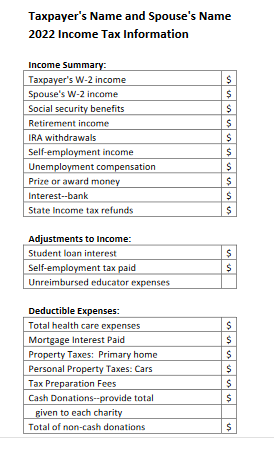
If you are not itemizing, these are likely the only documents your accountant needs.  Put your documents in order as they appear on form 1040 and paperclip together.  I recommend that you provide a summary list of all income and adjustments to income.  If you itemize, you should also include your deductible expenses on the list.  Do not give your accountant receipts for deductions; he only needs to know the categories and amounts.

Your deductible expenses might include:

  • Health related expenses that exceed 7.5% of your adjusted gross income (AGI).  For example, if you AGI is $65,000 and you have medical expenses of $9.400, you can deduct $4,525 of medical expenses ($94,00 – ($65,000*.075)).
  • Property taxes
  • State income taxes paid
  • Fees paid to have your taxes prepared by a tax professional
  • Moving expenses, if you moved 50 or more miles for a job
  • Charitable donations—you need a receipt to claim deductions of more than $250 to a single charity.  Separate cash and non-cash donations. You may also deduct mileage on your personal vehicle while performing volunteer services.  Your accountant only needs to know the mileage associated with service for each charity.

My tax summary form looks like this:

These steps will make preparing your tax return easier for your accountant, which may translate into a lower tax preparation fee.

To learn more money management tips and how to honor God with your money, please click the Finances categories tab to find many blogs on money management, budgeting, and stewardship. My book Honoring God with Your Money is a great tool for financial money management.

5 Options to Avoid Debt Next Christmas

A client of mine recently mentioned that he had dropped $7,500 on gifts this Christmas.  That’s a lot of money.  This man has a large family, and he had a very good business year. Maybe he was making up for leaner Christmases during covid, or perhaps he wanted to celebrate a great increase in the volume of his business.  Either way, he spent a lot of money.

5 options to avoid debt next Christmas with a Christmas background

Americans tend to spend more money on Christmas presents, food, decorations, and trees than they have saved, and wind up dealing with after-Christmas debt each January.  Here are some numbers that illustrate this:

Average spending per couple$1,864
Average money spent on each child$330
Average cost for a Christmas tree$200
Average after-Christmas debt$1,242

 If you are an average family who spends $1,864 all-in for Christmas, you need to save $155 per month to avoid being in debt in January. Of course, you do not have to spend that much on Christmas, and you should not unless it fits into your budget.  Whatever amount you decide that you can spend for Christmas 2023, you should start saving now.  That is easier said than done, and it is unlikely to happen without plan. 

What are your options for starting to set aside money now for Christmas 2023?

  1. Christmas club account. Christmas clubs allow you to set aside an equal sum of money each week, month, or paycheck. Money cannot be withdrawn without penalty until November.  The interest rates are on the low side; however, the plan is simple, it pays interest, and payments can be deducted from your paycheck.  This was popular when I was a child, and I had such an account for many years.
  2. Opening a savings special account just for Christmas.  The idea is the same as the Christmas club, but you have access to the money at any time. So, you must be able to resist the temptation to withdraw the money for other expenses that arise during the year.
  3. Creating a sub-account in an existing savings account.  A sub-account allows you to save money for special events, such as Christmas, by automatically transferring money each month or pay period.  To learn more about savings sub-account: https://www.iwillteachyoutoberich.com/blog/tip-using-sub-savings-accounts-for-unexpected-expenses/#:~:text=What%20is%20a%20sub%2Dsavings,each%20of%20my%20sub%2Daccounts.
  4. Budgeting the money.  If you have great self-control, you can simply budget the amount you need and not spend it on other things.  Most people don’t have that much self-control so another option will work better.
  5. Buy presents throughout the year.  This is the strategy that I employ.  I start shopping in the summer for gifts for my eight grandchildren.  This allows me to pay for gifts a few at a time. This method works well, if it is done in conjunction with a budget.  You must track your spending and stay within your budget.

Budgeting is important to manage your finance and control your spending on all categories.  If you struggle with budgeting, I have many blog articles on creating budgets under the Finance tab.  I have also published a Bible study, Honoring God with Your Money, to help you learn and implement godly principles of money management.

Make Tax Time Simple With These Tips

Income tax returns are not due for three months, but your preparation should start now. Here are my tips to make tax time easier for you.

  1. Get a large envelope (11″ x 14″) to put your tax documents in.
  2. Watch the mail for envelopes marked “Important tax information enclosed. For now, put these documents into your envelope.
  3. Gather tax information that was provided during the year and put into the envelope.
  4. Make a quick estimate of your deductions. For most taxpayers, the largest deductible expenses will be home mortgage interest and charitable donations. Add those values. If the sum is much lower than your standard deductions, then don’t bother with adding up your other deductible expenses, unless you had extraordinary health care costs for the year.
  5. Be prepared to get a smaller refund, or to owe more, this year. Tax law changes may result in you having a larger tax liability.

Tax information being sent out in January includes:

  • W-2’s and 1099’s for earned income
  • Social security payments
  • Mortgage interest statements
  • 1099’s for dividends, interest, retirement income, and IRA withdrawals
  • Statements on rental income and expenses from property managers
  • 2021 state income tax refund statements
  • Receipts for charitable donations larger than $75

Other tax information was provided to you during the year. This includes property taxes you paid on homes, vehicles, motorcycles, and boats. You likely received receipts throughout the year for donations that you made to charities that were less than $75 each and donations of non-monetary goods and services made to charitable organizations.

The 2022 standard deduction levels were increased, making it less likely that you will benefit from itemizing. The 2022 standard deductions are:

  • Married couples filing jointly = $25,900
  • Heads of households = $19,400
  • Single individuals and married couples filing separately = $12,950

Major Tax Changes for 2022:

  • Smaller child tax credits and credits for child and dependent care. These credits were temporarily increased by the American Rescue Plan of 2021. They have now reverted back to 2020 levels.
  • Charitable donations are no longer deductible without itemizing. The American Rescue Plan allowed up to $300 for a single taxpayer and $600 for a married couple filing jointly to be deducted without itemizing.
  • Income from side hustles will be reported to the IRS. To be fair, we were always supposed to report ALL income earned from side jobs and hobbies. New regulations will require all third-party payment processors, such as Etsy and PayPal, to send 1099’s to all vendors who have generated more than $600 in revenue in a calendar year. Recently, the IRS announced that it will postpone enforcement of this regulations for one more year. This year, 1099’s will only be sent to vendors who earned more than $20,000 or had 200 or more transactions.

So, watch the mail for tax documents and start reviewing your paperwork for information that will be needed to complete your tax return.

Oh, and while you’re thinking about taxes, get an 11″ x 14″ envelope and write on it “2023 Tax Info.” Use it to collect receipts for donations, property tax bills, and other documents received during the year. This will give you a head start for next year.

Watch for blog in early February on preparing your information for your accountant.

5 Changes To Instantly Save Money

Inflation has slowed to 7.1%. Still, Moody’s Analytics estimates that the average family spent $396 more per month this fall than they did in 2021 for the same goods and services. The Census Bureau calculated the median household income at the end of 2021 as $69,021. The average worker received a raise of 4.8% in 2022. For a family earning $69,021, the raise was $3,313 for the year, or $276 a month. That translates to a take-home increase of about $201. After paying $28 tithe on the extra salary, they have an extra $173 per month. That’s a nice sum, but it falls $223 short of the average increase in monthly costs.

If you are in this situation, now is the time to rework your budget and try to cut $223 from your normally re-occurring expenses. If you manage your money well and live below your means, you likely have some room in your budget. However, it is still important to examine your expenses and make cuts where you can.

Here is a plan to cut on spending without feeling deprived.

  1. Cut back on technology expenses. Most home today have an internet and cable television plan, in addition to a cell phone plan, and perhaps a landline telephone. The average household spends $116 on internet and cable and another $114 on cell phones, and many spend much more than that. This is a good time to research your options and see if you can find a more economical plan. Tom’s Guide offers an analysis of the best cell phone plans for 2023 to help you make a wise decision (https://www.tomsguide.com/best-picks/best-family-cell-phone-plan, and cabletv.com has analyzed the best home internet plans (https://www.cabletv.com/blog/best-cheap-internet-packages). Let’s assume for this example that you are able to reduce your technology expenses to $170 per month, saving $60.
  2. Reduce streaming services. Two-thirds of all American households subscribe to Netflix, sixty percent to Amazon Prime, and nearly half to Hulu and Disney+. The cost of these plans is about $42 per month, plus the costs of any movie rentals that are not covered by a plan. When you are researching cable television packages, try to find one that includes free movies that you enjoy. If you do so, you can cancel these subscriptions and save $42 per month. Even if you don’t find a plan with free movies, you can cancel two or three of these subscriptions and save up to $27 a month.
  3. Reduce food waste. RTS (Recycle Track System) estimates that the average household wastes $1,866 in food each year. That’s more than $155 per month. The biggest culprit is produce which goes bad. Meat and dairy products are also highly perishable. Reduce food waste by planning meals before you shop and making a point to use perishable food items in a timely manner. We will assume, that with some effort, you can reduce food waste by $80 per month.
  4. Unplug appliances and electronics when not in use. Estimates are that the average household could save $15 per month by unplugging the coffee pot and other kitchen appliances when not in use.
  5. Reduce money spent eating out. Fast food prices jumped about 15% in 2022. The average lunch out now cost more than $11 for one person, while a sit-down lunch will run closer to $20 with tip. If you cut out two fast-food lunches and one sit-down lunch per month, you will save $42 per month.

These five changes will save you enough money to make up for the loss of purchasing power from inflation. If you find that you need, or want, to reduce your spending more, coffee and beverages on the go are another source of potential savings. A large soda or a cup of regular coffee at a drive-up restaurant will cost you $2 or more, while a specialty beverage could cost you $4 – $6. If you buy one beverage each workday, you are spending between $44 and $132 per month. This amount could be significantly reduced by brewing coffee at home and buying other beverages at the grocery store.

God expects us to be faithful stewards of the financial resources He entrusts to us. Money allows us to meet the needs of our families and bless others. However, it can be a cause of great stress if it is not managed properly. Prayerfully ask God to help you budget and manage your money, and rely on Him to meet all your needs.

To learn more about how to honor God with your money and build treasure in Heaven, please click the Finances categories tab to find many blogs on money management, budgeting, and stewardship. My book Honoring God with Your Money is a great tool for financial money management. Click here to sign up for my quarterly newsletter on managing your money: newsletter signup

If you have never accepted Jesus Christ as your Savior, you may not understand what it means to rely on God to meet your needs. Please click on Basics of Salvation in the tool bar above to learn how you can accept the wonderful free gift of salvation.

Money Won’t Buy You More Time

As I read Psalm 49 this week, it brought to mind the lyrics of Dust in the Wind, “Now don’t hang on. Nothing last forever but the earth and sky, It slips away and all your money won’t another minute buy.”

Psalm 49: 6 – 9 expresses a similar sentiment this way, “Those who trust in their wealth
And boast in the multitude of their riches,  None of them can by any means redeem his brother, Nor give to God a ransom for him— For the redemption of their souls is costly,
And it shall cease forever that he should continue to live eternally, and not see the Pit.”

There is great truth in both the Psalm and the lyrics by Kansas. Money cannot buy us a longer life or a future in Heaven. Only faith in the blood of Jesus Christ can provide assurance of eternal life.

Photo by Jordan Benton on Pexels.com

Another stanza of Dust in the Wind goes like this, ” Same old song. Just a drop of water in an endless sea. All we do crumbles to the ground, though we refuse to see.”

If you live seeking riches, power, and pleasure, then your works will be futile and meaningless, as expressed above by Kansas or in Psalm 49:10, “Life the fool and the senseless person perish, and leave their wealth to others.” The psalm continues, “For when he dies, he shall carry nothing away; His glory shall not descend after him.” (Psalm 49:16)

If you want your life to have meaning after you are gone, you need to live a life of selflessness and trust in God. Put your faith in Jesus Christ, serve your fellow man, give money to those who are less fortunate, and spend your money as God leads you. Then you will build eternal treasure in Heaven. No, you cannot take your wealth with you, but as Randy Alcorn says, you can send it on ahead of you.

Are you living a life that pleases God and will secure you a place in Heaven? If you are not, you should make it a priority to give your heart to Jesus. Not only will you have the promise of eternal life, you will have a more fulfilling life on earth. Please click on Basics of Salvation in the tool bar above to learn how you can invite Jesus to be your Lord and Savior.

To learn more about how to honor God with your money and build treasure in Heaven, please click the Finances categories tab to find many blogs on money management, budgeting, and stewardship. My book Honoring God with Your Money is a great tool for financial money management.
Grocery Shopping Amid Empty Shelves and Rising Inflation

The government announced last week that the inflation rate for December 2021 was 7%.  This is the highest rate of inflation since 1982.  Two of the hardest hit sectors were energy and food.  MarketWatch reports that prices for eggs have increased more than 20%, beef and chicken prices are up 13 – 15%, and coffee is up 10%. 

To make matters worse, grocery prices are expected to rise another 5% in 2022.  The biggest increases are expected to be for steak, chicken, mayonnaise, eggs, cereal, and vegetables.

Additionally, grocery shelves are emptier than we are used to seeing them.  Inflation and shortage combine to make feeding your family more challenging than we are used to dealing with in America.  And it is wreaking havoc on family budgets.

To keep your budget in balance, you must (1) find ways to keep your grocery spending within your means or (2) cut expenses in other areas and allocate more money for groceries.

Photo by Kevin Malik on Pexels.com

So, I am offering these ideas to help you eat well and stay within your budget.

  1. Eliminate waste. Americans waste on average one pound of food per person per day.  To reduce your food waste:
    • Plan meals and shop using a list.
    • Check the vegetable bins in your refrigerator daily to assess what needs to be eaten and plan meals accordingly.
    • Keep a food log, so you know when you cooked each dish.  Check log to see what needs to be eaten first.
  2. Make the most of leftovers—turn leftovers into soups, casseroles, and sandwich fillings.
  3. Buy cheaper cuts of meat and cook in a crockpot or instapot to tenderize.
  4. Buy store brands. You may have to try multiple stores to find the brands you like best.
  5. Shop at multiple stores to get the best buys and find items that were out of stock at your usual store.  Plan trips, though, to save gas and time.
  6. PLAN, PLAN, PLAN—but be prepared with backup plans, as shortages are expected to continue.
  7. Plant a garden and grow some of your own produce.
  8. When you find a good price for produce, stock up and freeze or can the excess.
  9. Shop at Discount stores, such as Wal-Mart, Costco, and Dollar General.
  10. Buy less than perfect or ugly produce.  Prepare immediately or process to eat later.
  11. Purchase meat that is nearing its sell-by date and has been marked down. Cook immediately or freeze.
  12. Invest in food storage dishes to keep leftovers.
  13. Invest in a vacuum sealer to freeze uncooked meats and leftovers to be eaten later.
  14. Search Pinterest and other internet sites for new recipes using ingredients that you have on hand.
  15. Challenge yourself to come up with new recipes using items you have in your pantry.
  16. Ask God for wisdom to help you make wise shopping decisions.  “If any of you lacks wisdom, let him ask of God, who gives to all liberally and without reproach, and it will be given to him.” James 1:5

I hope that you will find some of these tips to be helpful as you navigate empty grocery shelves and higher food prices.

What grocery saving tips can you add to this list?

You will find additional information on creating budgets and managing your finances in many of my other blog posts by clicking on the Finances tab on the right. If you have money questions you would like me to answer, you may email me at susan.ball5@aol.com or write your question in the Comment section.  

Those who email me will be signed up to receive my free quarterly newsletter with money management tips, encouraging stories, and Scripture inspirations.  For those desiring a better understanding of Biblical principles of money management, I have written a book Honoring God with Your Money. It is available on Amazon and from Barnes and Noble.

Pepperonis as Quarters

Pepperoni Pizzas
Photo by Polina Tankilevitch on Pexels.com

In a different phase of life, my husband and I bought a pizza franchise and opened a restaurant in the little town of Orange, VA.  Our good friend, and pizza mentor, Jerry told us that we should look at “pepperonis as quarters.”  An individual pepperoni probably costs a penny or less–I never did the math, but I got the point.  Wasting food costs me money, and small wastes add up quickly and take money out of my pocket.  Little things matter whether you are trying to make money in your business or trying to live within your means on a tight budget.

In my current job, I am a consultant in a small business development center.  I meet with people each week who would like to start businesses.  Many of these dreams will be derailed or postponed due to poor credit and/or lack of financial resources to get a business started.  Often these people have plenty of income, yet they have failed to live within their means.  Some of them have made big financial mistakes, such as buying a house that they cannot afford, but many are in trouble because they have failed to control small expenses.  They forget that lunches out and $4 cups of coffee can make a big dent in their budgets.

As a Christian, I am a steward of all that God has entrusted to me.  When someone mentions stewardship, money management is probably the first thought that comes to mind.  Stewardship, however, encompasses all phases of your life, including how you use your time and how you use your talents.  We can relate the “pepperonis as quarters”  adage to time and talents, as well as to money.  Saving a few moments here and there throughout your day can add up and allow you more time to play a game with your child, read a book for pleasure, relax with your spouse, or start a new project.  Honing your talents little by little can help you gain speed and proficiency.

I Corinthians 4:2 tells us, “Moreover it is required in stewards that one be found faithful.”  I hope that this word will encourage you to look for small ways to be a better steward of your time, talent, and money.