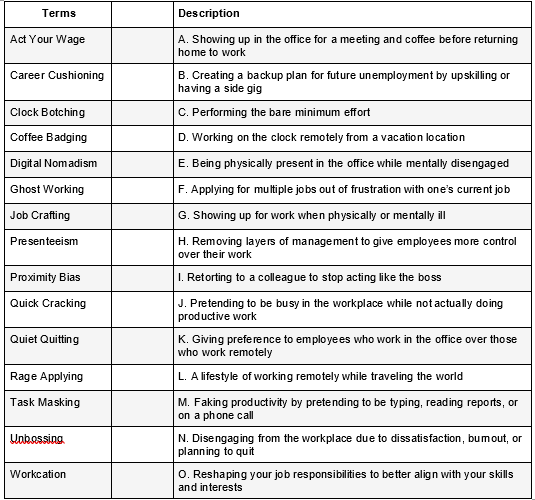
Workplace Trends Quiz

I recently came across the term “clock botching,” which was new to me. Upon researching the term, I learned that it was coined earlier this month to describe a new workplace trend. That led me to explore other terms—many of which describe behaviors that have emerged in recent years.

Test your knowledge! Match each workplace trend (left column) to the correct description (right column).

In the next few blogs, we will look at the factors that influenced these trends, the pros and cons of each, and how they impact your business.

Answer Key

  1. I — Act Your Wage
  2. B — Career Cushioning
  3. E — Clock Botching
  4. A — Coffee Badging
  5. L — Digital Nomadism
  6. M — Ghost Working
  7. O — Job Crafting
  8. G — Presenteeism
  9. K — Proximity Bias
  10. F — Quick Cracking
  11. C — Quiet Quitting
  12. F — Rage Applying
  13. J — Task Masking
  14. H — Unbossing
  15. D — Workcation

Leadership Mistakes: How to Turn Them Around

In recent blogs, we explored effective leadership approaches that help small business owners succeed. But many leaders still struggle to manage employees well. In fact, a study by Cake.com found that only 29% of employees trust their leaders, and just 20% believe they’re managed in a way that helps them work productively.

If you feel frustrated in your role as a leader, it may help to recognize which management styles are ineffective—and more importantly, how to correct them. Let’s look at four of the most common ineffective leadership styles and practical ways to overcome them.

Micromanagement

Micromanagers closely monitor every action their employees take. They resist delegating, and when they do, they often interfere with the work and demand constant updates. This creates an atmosphere where employees feel distrusted, fearful of mistakes, and discouraged from being creative. The result? Low morale, reduced productivity, and high turnover.

How to overcome micromanagement:

  • Acknowledge the behavior and identify the root cause. Is it fear of failure? Perfectionism? Lack of trust?
  • Start small by delegating low-risk tasks. Give clear expectations but avoid dictating every step.
  • Focus on goals and outcomes, not micromanaging the process.
  • Celebrate employee creativity and innovation.
  • Schedule regular check-ins rather than constant oversight.
  • Ask employees for feedback on how empowered they feel.
  • Invest in leadership development training—for yourself and your team.

Authoritarian Leadership

Authoritarian leaders make decisions alone, without input from their employees. While this style may feel efficient, it creates a fear-based culture, stifles creativity, and leaves employees disengaged.

How to shift away from authoritarian leadership:

  • Reflect on why you lead this way—often it’s driven by fear of failure or a need for control.
  • Invite feedback and listen to your employees’ concerns.
  • Delegate tasks and focus on results rather than process.
  • Adopt a coaching mindset: guide and encourage rather than command.
  • Encourage collaboration and shared decision-making.
  • Celebrate progress when you successfully empower employees.

Passive (Hands-Off) Leadership

At the opposite end of the spectrum, passive leaders avoid leading altogether. They focus only on their own tasks, leaving employees without direction or support. Conflicts go unresolved, decisions are delayed, and performance suffers.

How to become more engaged as a leader:

  • Acknowledge the avoidance. Remind yourself that you were chosen to lead because you are capable.
  • Ask your employees what they need from you and really listen.
  • Work with your team to set goals, priorities, and clear expectations.
  • Interact regularly and provide feedback—both praise and constructive guidance.
  • Gather information before making decisions rather than avoiding them.
  • Empower your team to make decisions and develop their skills.

Indecisive Leadership

Indecisive leaders procrastinate on decisions out of fear of mistakes. This creates confusion, frustrates employees, and causes missed opportunities for growth. Over time, employees lose confidence in their leader.

How to overcome indecisiveness:

  • Revisit why you started your business and define three priorities to guide your decisions.
  • Create a decision-making process (such as pros/cons lists or SWOT analysis).
  • Set deadlines to avoid procrastination.
  • Delegate decision-making where appropriate to reduce your burden.
  • Build confidence by making smaller, low-risk decisions first.
  • Accept that mistakes are part of leadership—learn from them and move forward.

Final Thoughts

As you can see, many of the corrective steps apply to more than one ineffective leadership style. Each plan of corrective action involves building relationships and trust with your employees. Whether you are a small business owner or a team leader within a company, your employees are your greatest assets. Treat your employees with respect and build their confidence so that they will partner with you to accomplish the goals of your company.

This blog concludes our leadership series, where we’ve explored both effective and ineffective leadership styles. Over the past several weeks, we’ve looked at transformational, servant, and coaching leadership—styles that inspire, guide, and empower employees. We’ve also examined the challenges of leading different generations in the workplace. Now, by addressing ineffective patterns such as micromanagement, authoritarianism, passivity, and indecision, you have a full picture of what to avoid and what to strive toward. Strong leadership is not about perfection—it’s about growth, self-awareness, and a commitment to creating a culture where both you and your employees can thrive.

Serve First:  The Leadership Style That Boosts Profits

In the last few blogs, we’ve explored six effective leadership styles: servant, transformational, results-driven, hands-on, adaptive, and coaching.

While no single style works best for every employee, servant leadership consistently ranked highest across most generations of workers. Beyond boosting morale and engagement, servant leadership can also improve the bottom line. A 2023 study found that business owners who shifted to a servant leadership approach saw an increase in profits.

What Makes a Servant Leader?

Servant leaders stand out by:

  • Allowing employees to share their feelings and suggestions
  • Listening to feedback from employees, customers, and stakeholders
  • Admitting mistakes and acknowledging they don’t have all the answers
  • Recognizing the contributions of others
  • Leading with authenticity
  • Committing to personal growth and improvement
  • Building a culture of trust and safety

Jesus modeled this style of leadership, reminding His disciples:

Whoever wants to become great among you must be your servant, and whoever wants to be first must be slave of all. For even the Son of Man did not come to be served, but to serve.”               — Mark 10:43–45

How Servant Leadership Benefits Businesses

Servant leadership doesn’t just feel good—it produces tangible results that can strengthen and grow a business:

1. Greater Employee Engagement

  • Employees feel valued, connected, and empowered in their roles
  • Engaged employees are more likely to stay, reducing costly turnover
  • Lower turnover = reduced hiring/training expenses = higher profits

2. Stronger Customer Relationships

  • Servant leaders prioritize customer needs and resolve issues quickly
  • Genuine care builds loyalty and trust
  • Better service and stronger relationships = repeat customers = higher revenues

3. More Innovation and Adaptability

  • Employees feel safe suggesting improvements and new ideas
  • A culture of trust encourages flexibility and openness to change
  • Increased efficiency and adaptability = happier customers = higher profits

4. Ethical Business Practices

  • Servant leaders model integrity in all dealings
  • Customers, employees, and partners are more likely to trust the business
  • Strong partnerships and customer loyalty = sustainable growth

5. Inspires Employees with a Sense of Purpose

  • Employees who believe in the mission bring passion and energy to their work
  • Purpose-driven employees are more productive and efficient
  • Greater productivity = lower costs = stronger profitability

Final Thoughts

Practicing servant leadership fosters a culture of trust, respect, and collaboration. These qualities not only make the workplace more positive but also contribute to long-term profitability.

The apostle Paul captured this spirit well:

Do nothing out of selfish ambition or vain conceit. Rather, in humility value others above yourselves, not looking to your own interests but each of you to the interests of the others.” — Philippians 2:3–4 (NIV)

When business owners choose to serve first, both people and profits thrive.

Leading Across Generations: How to Motivate and Manage a Multigenerational Team

If your business has more than a handful of employees, chances are you’re managing people from multiple generations. While many members of the Silent Generation and Baby Boomers are past traditional retirement age, about 16% of Americans aged 65+ are still working—some by choice, others by necessity. Older workers now make up around 12% of the workforce.

Millennials, on the other hand, represent the largest generational group, accounting for over one-third of today’s workforce. The rest is fairly evenly split between Gen X and Gen Z.

Each generation brings different values, communication preferences, and expectations to the workplace. If you want to lead your team effectively, you’ll need to adopt leadership styles that connect with and motivate individuals across these generational divides.

Let’s start with a quick overview of each generation in today’s workforce.

Generational Snapshot

Traditionalists (Silent Generation)
Born 1928–1945
Having lived through the Great Depression and World War II, Traditionalists value discipline, loyalty, and hard work. They prefer structured environments, respect hierarchy, and are most comfortable with formal communication. Only about 5% are still in the workforce, but their presence is slowly growing, especially in consulting or part-time roles.

Baby Boomers
Born 1946–1964
Many Boomers are nearing or already past retirement age, yet many continue working—often in leadership or consulting roles. Boomers are resourceful and competitive, value job security, and prefer in-person communication or phone calls over digital tools.

Generation X
Born 1965–1980
Gen Xers are often in leadership or upper management roles. They’re independent, tech-savvy, and appreciate a strong work-life balance. They prefer autonomy and clear performance expectations and tend to communicate via email or phone.

Millennials
Born 1981–1996
Millennials are rising leaders in business and bring a collaborative, purpose-driven approach to work. They embrace flexibility, value frequent feedback, and gravitate toward tech-enabled communication like video chat, messaging, and email.

Generation Z
Born 1997–2012
The youngest members of the workforce, Gen Zers are digital natives who expect fast, transparent communication and flexible, inclusive work environments. They value mentorship, purpose, and adaptability.

Leading Across Generations

Let’s take a look at how each generation responds to different leadership styles. Understanding these preferences can help you tailor your approach for stronger engagement and performance.

Traditionalists

  • Prefer clear goals and structured direction
  • Value stability and loyalty
  • Respond best to servant, results-oriented, and hands-on leadership
  • Prefer formal communication—written memos or face-to-face conversations

Baby Boomers

  • Competitive and committed, with a strong work ethic
  • Thrive on recognition and purpose
  • Prefer phone calls and face-to-face meetings
  • Respond best to servant, results-oriented, and hands-on leadership

Generation X

  • Independent and results-driven
  • Prefer autonomy, but want clear performance metrics
  • Communicate through email and phone
  • Respond well to results-oriented, adaptive, and hands-on leadership

Millennials

  • Value collaboration, flexibility, and meaningful work
  • Appreciate frequent feedback and transparency
  • Communicate via email, text, and video
  • Respond well to transformational, servant, and coaching leadership styles

Generation Z

  • Digital natives who expect quick communication and adaptability
  • Value diversity, mentorship, and growth
  • Communicate via instant messaging, video, and social apps
  • Respond well to coaching, transformational, and adaptive leadership

Leadership Style Effectiveness by Generation

6 = Most Effective | 1 = Least Effective

This chart shows how different generations respond to various leadership styles. As you can see, no single style works best for everyone—and generational stereotypes don’t tell the whole story. Individuals within a generation may have very different preferences and personalities.

How to Lead a Multigenerational Team

Here are some practical strategies to manage generational differences while maintaining a strong team culture:

1. Get to know your employees as individuals.
Use simple assessments or surveys to learn how each person prefers to communicate, be led, and receive feedback.

2. Blend leadership styles.
You don’t have to stick to one approach. Be hands-on with those who need guidance, and give more autonomy to those who thrive independently.

3. Diversify your communication methods.
Use email, text, video, and face-to-face conversations strategically. For important messages, follow up through more than one channel.

4. Encourage feedback.
Invite employees to share their preferences and ideas for improvement. This creates a culture of openness and mutual respect.

Final Thoughts

Leading across generations can feel complex—but it’s also an opportunity. When you adapt your leadership to meet your team where they are, you build trust, improve retention, and unlock greater performance.

Start small. Listen well. And don’t be afraid. Your employees—and your business—will thank you for it.

Who’s in Charge When You’re Away?: Identifying a Trusted Leader

In my last blog, I shared how important it is to develop one or more employees who can manage the business while you’re away. Whether you call them a lead employee, acting manager, or person in charge, choosing the right person matters.

When you’re away from the business, you want someone who will represent you well—someone you trust to protect and even enhance the reputation you’ve worked hard to build. That’s why I want to walk you through what I’ve learned over the years about identifying potential leaders in your workplace.

The best lead employees are reliable, trustworthy, knowledgeable, and respectful. These are the people who will give you peace of mind when you take time off—whether it’s for a vacation, family need, or just a day to recharge.

What to Look for in a Lead Employee

Someone Who Is Reliable

When you’re not around, you need someone who consistently follows through and doesn’t require reminders. A reliable employee:

  • Is on time and dependable
  • Gives notice when they need to change their schedule
  • Follows your policies and procedures
  • Completes tasks correctly and on time
  • Can be trusted with tasks like ordering supplies or making bank deposits
  • Keeps their commitments and doesn’t make excuses

Someone You Can Trust

You need someone who will do the right thing—even when no one’s watching. A trustworthy employee:

  • Works well without constant oversight
  • Is honest and transparent
  • Makes decisions with integrity
  • Admits mistakes and works to correct them
  • Respects your business and protects its value
  • Puts the company’s best interests first when you’re not there

Someone Who Knows the Business

A qualified leader understands how the business works and how you want things done. A knowledgeable employee:

  • Understands day-to-day operations
  • Supports your business goals and works to achieve them
  • Can confidently explain products and services to customers
  • Exercises good judgment in difficult or unusual situations
  • Anticipates how you would respond and acts accordingly
  • Brings you thoughtful ideas for improvement

Someone Who Is Respectful

Your lead employee should treat others with professionalism and kindness. A respectful employee:

  • Shows courtesy to customers and coworkers
  • Listens well and communicates clearly
  • Considers all perspectives before making decisions
  • Offers praise in public and correction in private
  • Maintains composure when tensions rise
  • Recognizes and appreciates their team members

Leadership Benefits Everyone

If you select and train the right people, you’ll be able to step away from your business knowing it’s in capable hands. Not only will you enjoy peace of mind and time to rest, but your lead employees will grow in their own confidence, responsibility, and job satisfaction.

Paul reminds us in Scripture,
Now it is required that those who have been given a trust must prove faithful.”1 Corinthians 4:2 (NIV)

Developing trustworthy leaders within your business is one of the best investments you can make—not just for your time off, but for the future of your company.

Stepping Away from a Small Business Without Losing Control: How to Develop a Trusted Team Leader

Recent surveys show that many employees today are not interested in stepping into management roles. Instead, they prefer positions where they can contribute as individuals without supervising others. For larger firms—where multiple layers of management are essential—this creates a challenge. In response, many of these organizations are developing alternative career paths to retain talent and allow for growth without forcing people into unwanted leadership roles.

As a small business owner, you might think this trend doesn’t apply to you—especially if you currently wear all the management hats. But if you have employees, it’s vital to develop at least one who can step into a leadership role in your absence. Imagine spending a week at the beach, completely unplugged, while a capable, trusted team member handles the day-to-day responsibilities of your business.

So, how do you encourage and prepare someone to be your go-to leader?

Understand Why Employees May Avoid Management

Especially among younger workers, there is often hesitancy to move into management. Common concerns include:

  • Increased stress
  • Longer working hours
  • Interference with family or personal life
  • Strained relationships with co-workers

Understanding these concerns allows you to build a leadership development plan that reassures potential leaders and sets them up for success.

Steps to Develop a Lead Employee

Here’s a practical approach to cultivating leadership in your business:

1. Reframe the Role

  • Use the title leader instead of manager to make the role feel more approachable.
  • Emphasize that the goal is to help the business run smoothly when you’re away—not to burden the employee with unnecessary stress.

2. Define Responsibilities

  • Make a clear list of tasks the employee will be expected to handle in your absence.
  • Outline which decisions they can make independently and which ones require your input.
  • Create easy-to-follow checklists and protocols for recurring responsibilities.
  • Provide a contact file with supplier, client, employee, and emergency information.

3. Begin Delegating Gradually

Start by assigning small tasks and increasing responsibility over time. These might include:

  • Opening or closing the business
  • Handling customer questions or complaints
  • Responding to employee needs or schedule changes
  • Ordering supplies
  • Making bank deposits

4. Try a Trial Run

Choose a day to delegate full authority to your lead employee while you remain on-site.

  • Step back and allow them to make decisions.
  • If other employees approach you, direct them to the lead.
  • Provide feedback afterward and evaluate what went well and what needs refining.

5. Create a Vacation Handbook”

Prepare your employee with a written guide that includes:

  • Task checklists and contact lists
  • Necessary passwords and system access
  • Emergency protocols and clear instructions on when to contact you

6. Take a Short Break First

Before your big vacation, take a day off and let the lead employee manage independently.

  • Review the experience together.
  • Answer questions that came up.
  • Clarify anything that was unclear.

7. Schedule and Take Your Vacation

Once your lead is ready, take that well-deserved time off. Trust the process, and trust your employee.

If Your Business Has Extended Hours…

If your business is open more than eight hours a day or more than five days a week, consider developing two or three lead employees. That way, they can rotate shifts and avoid burnout—ensuring full coverage without exhausting your team.

Benefits for You and Your Business

Following these steps prepares your lead employee to handle daily operations with confidence. When employees feel equipped and supported, their stress decreases and their performance improves. For you, it means peace of mind and the freedom to step away when needed—whether it’s for a vacation, family event, or simply a much-needed break.

Leadership doesn’t have to be about titles—it’s about trust, preparation, and partnership.

A Guide for Small Business Owners: Finding Peace Without Losing Your Drive

A friend commented recently that one of his children had been so content as a young man, he worried it might keep him from achieving all that God intended for him in life.

Contentment—being at peace and satisfied with one’s station—is a valuable quality. People who are content tend to experience lower stress levels and a deeper appreciation for daily life. The apostle Paul modeled this beautifully, writing:

“I have learned in whatever state I am, to be content.”
Philippians 4:11 (KJV)

But while contentment is healthy, it can become a drawback if it leads to complacency. A person who is too content may neglect personal development, avoid pursuing opportunities, or settle for less than their best. For a small business owner, this might mean missing out on ways to better serve customers, grow the business, or create jobs.

Conversely, unchecked ambition can be equally harmful. The Bible warns against selfish ambition:

For where you have envy and selfish ambition, there you find disorder and every evil practice.
James 3:16 (NIV)

The key is finding a healthy balance—striving to improve your business while maintaining contentment in the journey and integrity in your methods.

How to Balance Contentment and Ambition in Your Business

If you’re a small business owner, it’s important to regularly evaluate your goals, values, and ambitions to ensure they align with your faith, lifestyle, and vision. Here’s a practical process to help you balance ambition with contentment:

1. Reflect on Your Personal and Business Goals

Before you can decide how much to grow your business, be clear about what you want from it. Consider:

  • Do you want to work as a solopreneur, generating income through your own skills without managing employees?
  • Does your business idea require more labor than you can handle alone?
  • Do you want to create jobs and provide reliable income for others?
  • How many hours per week are you willing to work?
  • What type of schedule would you like to maintain?

Example:
If you value evenings and weekends off, a manufacturing or professional service business might suit you better than a restaurant, retail shop, or entertainment business.

2. Define Your Financial Needs

Understand how much income you need to meet your personal and family obligations. Your financial goals will shape your business structure:

  • As a solopreneur, your income depends solely on your labor and the rates you charge.
  • As an employer, your income potential grows with employee productivity and overall business revenue.

3. Develop a Business Plan That Reflects Your Priorities

Once your goals are clear, develop a plan that honors those objectives.

  • Choose your legal structure.
  • Launch your marketing strategy.
  • Build your customer base through personal connections and word-of-mouth.

Remember: The startup phase is typically slow—be patient as customers become aware of your business.

4. Regularly Assess Your Growth and Contentment

Periodically evaluate whether you’re satisfied with your business’s size, revenue, and operations.

Questions to consider:

  • Are you content with your current workload and income?
    • Has demand exceeded your capacity? If so, would you prefer to turn away work or hire help and grow your business?
  • Would expanding your hours, services, or product lines serve your goals—or cause unnecessary stress?
  • Is maintaining your current size better aligned with your personal and family priorities?

There’s no wrong answer—what matters is that your decisions reflect thoughtful, prayerful discernment.

5. Avoid Complacency While Maintaining Contentment

Even if you’re satisfied with your business size, remain proactive:

  • Monitor industry trends and customer preferences.
  • Stay current with new technologies that improve efficiency.
  • Review your offerings to meet evolving customer needs.
  • Keep your physical space welcoming and well-maintained.
  • Stay compliant with legal and regulatory changes.
  • Invest in employee development through training and advancement opportunities.

Final Thoughts

Business ownership can bring both financial rewards and personal fulfillment when managed wisely. But it can also lead to stress and dissatisfaction if you chase goals that don’t align with your values or allow others to pressure you into expanding beyond your comfort zone.

Strive to operate a business that honors your definition of success, serves others well, and allows you to live with contentment and integrity. In doing so, you’ll find a healthy, God-honoring balance between ambition and peace.

📢 Id love to hear from you!

How have you balanced contentment and ambition in your business? What decisions helped you stay true to your values while pursuing growth? Share your thoughts in the comments!

Small Business Owners: Free Up Your Time and Boost Profits with a Virtual Assistant

The demands of running a business are endless. As a small business owner, you’re responsible for overseeing daily operations, managing employees, handling financials, filing taxes, networking, planning marketing campaigns, making growth decisions—and that’s just the start.

It’s no surprise that many entrepreneurs experience stress and overwhelm.

One proven way to lighten the load is by outsourcing tasks that either fall outside your comfort zone or don’t require your direct decision-making. A virtual assistant (VA) can be an affordable, flexible solution to help you manage your workload while allowing you to focus on growing your business.

Tasks Commonly Outsourced to Virtual Assistants

Start by identifying which responsibilities you’re comfortable handing off. Many small business owners delegate tasks in the following areas:

Marketing Tasks

  • Creating ads and promotions for traditional marketing outlets
  • Developing content for social media platforms
  • Responding to comments and messages on social media
  • Creating and maintaining a marketing calendar
  • Graphic design and video editing

Administrative & Back-Office Tasks

  • Data entry
  • Scheduling appointments and meetings
  • Replying to customer inquiries and messages
  • Invoicing and recording payments
  • Paying bills

Bookkeeping Tasks

  • Recording daily transactions
  • Payroll processing
  • Reconciling bank statements
  • Maintaining ledgers
  • Filing insurance claims

Financial Reporting Tasks

  • Filing quarterly and annual payroll reports
  • Filing monthly sales tax reports
  • Running monthly profit and loss statements
  • Developing cash flow analyses

Technical & Web Support Tasks

  • Developing and maintaining your website
  • Updating site links and plugins
  • Providing IT support
  • Overseeing cybersecurity

How to Hire a Virtual Assistant

If you’ve decided a virtual assistant might be right for you, follow these steps to get started:

1. Identify Tasks to Outsource
Make a list of the duties you’d like a virtual assistant to handle.

2. Estimate Time Requirements
Determine how many hours per week these tasks will require.

3. Research Pay Rates
Check the going rates for the type of work you need in both the U.S. and international markets.

4. Evaluate Your Budget
Decide what you can afford. If needed, prioritize only your most time-consuming or uncomfortable tasks.

5. Create a Job Description
Be clear about responsibilities and required skills—such as bookkeeping certification, social media experience, or website management. If hiring internationally, specify proficiency in English.

6. Search for Candidates
You can find virtual assistants through:

  • Freelance platforms (Fiverr, Freelancer, Upwork)
  • Virtual assistant services (Zirtual, Time etc., Belay)
  • Referrals from your professional network

7. Screen and Interview Applicants
Look for:

  • Relevant work experience
  • Strong communication skills
  • Proven reliability and time management
  • Positive references
  • Optional: assign a short test task

8. Onboard Your VA

  • Set clear expectations for tasks and deadlines
  • Use affordable project management tools like Monday.com, ClickUp, or Teamwork.com
  • Provide regular feedback and encouragement

Final Thoughts

If you find the right virtual assistant and outsource the tasks that take the most time or cause the most stress, your workload — and stress level — can be reduced significantly. More importantly, youll free up valuable time to focus on the aspects of your business that only you can do.

While hiring a virtual assistant does require an investment, it can pay for itself in several ways. For example:

  • A skilled virtual assistant managing your social media accounts can increase engagement and attract new clients.
  • Delegating routine administrative or bookkeeping tasks frees you to spend more time meeting with clients, networking, or developing new services.
  • An assistant handling website updates or email responses ensures customers receive timely attention, which can improve customer satisfaction and lead to repeat business.

When you use your reclaimed time to focus on revenue-generating activities, your business can become more profitable — turning your virtual assistant from an expense into an investment.

If youve ever hired a virtual assistant, Id love to hear your insights and advice in the comments!

Helping Employees Build Financial Security: A Guide to Employee Emergency Savings Accounts

As a small business owner, you have an opportunity to support your employees’ financial well-being in meaningful ways — and it doesn’t have to strain your budget. One increasingly popular option is offering an Employee Emergency Savings Account (ESA).

These accounts gained attention following the passage of the SECURE 2.0 Act in 2022, which updated retirement legislation and introduced Pension-Linked Emergency Savings Accounts (PLESAs).

PLESAs are simple to implement, require no employer contributions, and give employees a practical way to save for financial emergencies without tapping into their retirement funds.

What Is a Pension-Linked Emergency Savings Account (PLESA)?

A PLESA is a savings option tied to an existing retirement plan, such as a 401(k), allowing employees to automatically set aside money for emergencies via payroll deductions.

The key benefits include:

  1. Reduced employee financial stress
  2. Improved financial wellness
  3. Better employee retention and engagement

Employees can access these savings when unexpected expenses arise — without penalties or complicated processes.

Key Features and Requirements

Here’s a quick overview of how PLESAs work:

  1. Eligibility: Available to employees earning less than $160,000 in 2024 (classified as non-highly compensated for 2025).
  2. Contribution Limits: Maximum annual contribution is 3% of an employee’s pay, up to $2,500 per year.Contributions are made with after-tax dollars and held in a Roth IRA within the retirement plan.
  3. Withdrawals: Can be made at any time, penalty-free.
  4. Employer Contributions: Optional. If offered, employer matches must go into the employee’s main retirement account, not the PLESA.

Appropriate Uses for PLESA Funds

While there are no legal restrictions on how PLESA funds are used, the intended purpose is to help cover genuine financial emergencies, such as:

  • Medical bills
    • Car repairs
    • Emergency home repairs
    • Temporary loss of income
    • Essential living expenses during hardship

Employees should be encouraged to avoid using these funds for vacations, investments, or routine bills that should be part of a regular budget.

How to Set Up a PLESA for Your Business

If you’re interested in offering this valuable benefit, follow these steps:

  1. Confirm your retirement plan provider supports PLESAs. Contact your plan administrator to discuss setup, automatic enrollment, sub-account creation, and tracking procedures.
  2. Implement automatic enrollment, with an opt-out option.
  3. Clearly communicate program details to employees. Explain how it works, contribution limits, withdrawal procedures, and opt-in/opt-out options.
  4. Offer financial wellness education. Provide resources and workshops to help employees build money management skills.
  5. Track contributions and withdrawals for accurate reporting.

Final Thoughts

Providing your employees with tools for financial security is one of the most meaningful ways you can care for your team. Establishing a Pension-Linked Emergency Savings Account plan takes some effort but requires no employer funding — and the benefits to employee morale, wellness, and retention are significant.

If you have the means to offer a PLESA, I encourage you to explore it. Helping your team be financially prepared for life’s unexpected challenges isn’t just good for them — it’s good for your business too.

Motivate and Retain: How Incentives and Appreciation Build a Stronger Team

Your business is only as strong as the people behind it. Great employees drive growth, innovation, and profitability — and it’s essential to ensure your team feels valued and recognized. Two powerful tools for fostering this kind of positive workplace culture are incentives and appreciation.

Incentives vs. Appreciation

While often related, incentives and appreciation serve different purposes in the workplace:

  • Incentives are performance-based motivators. They encourage employees to meet specific goals by offering a reward when those goals are achieved.
  • Appreciation is an expression of thanks — recognizing and valuing your team’s efforts, regardless of outcomes.

The two often go hand in hand. For example, a sales team might be incentivized to reach a target by the promise of a bonus. When the goal is met, a manager can express sincere appreciation, publicly acknowledging the team’s hard work while announcing the earned incentive.

Designing Effective Incentives

Incentives can take many forms:

  • Financial: bonuses, raises, or gift cards
  • Non-financial: extra time off, public recognition, or professional development opportunities
  • Individual or team-based

For incentives to be effective, they should:

  • Be viewed as a bonus, not part of regular compensation
  • Be clearly defined and achievable
  • Offer a fair opportunity for all employees to succeed

A word of caution: poorly designed incentives can have unintended consequences. Team incentives may frustrate high performers if others aren’t contributing equally, and incentives that feel like withheld compensation rather than earned rewards can lower morale.

Showing Appreciation

Expressions of appreciation don’t have to be complicated or expensive — but they should always be sincere. From a simple “thank you” to larger gestures, showing gratitude goes a long way in building trust and loyalty.

A few ideas for meaningful appreciation:

  • Handwritten notes: A personal, sincere message highlighting specific ways an employee contributes to your business can make a lasting impact.
  • Celebrate birthdays: Even a simple greeting or card makes employees feel seen. Some companies offer a paid day off on an employee’s birthday — a small gesture that leaves a big impression.
  • Acknowledge work anniversaries: Especially for significant milestones like five, ten, or twenty years.
  • Company newsletters: Recognize employees who’ve accomplished milestones, earned certifications, or led successful projects.
  • Employee appreciation celebrations: Host an event, whether it’s a formal lunch with recognition and door prizes, or a casual morning with donuts and coffee. Add decorations to distinguish it from a routine meeting and make it feel special.

I recall a thoughtful gesture from my days as a teacher: our principal asked each of us for our favorite snacks and surprised us with them during workdays. At my current job, we once had an annual employee appreciation lunch — a tradition that was replaced by an appreciated paid day off. While we enjoyed the lunches, everyone agreed the day off was even better!

Final Thoughts

Balancing performance incentives with genuine, everyday appreciation creates a workplace culture where employees feel both motivated and respected. When people know their efforts are seen, valued, and rewarded, they’re more likely to stay engaged, loyal, and invested in your business’s success.