As a small business owner, you have the opportunity to honor Christ in the way you operate your business.
Honoring God doesn’t necessarily mean sharing the plan of salvation with every customer, vendor, or employee you meet. Instead, it means consistently living out your faith in a way that points others to Christ. A well-known saying expresses this well: “Preach the Gospel at all times. When necessary, use words.”
Here are some meaningful ways you can demonstrate your commitment to Christ and Christian values through your business:
1. Treat Everyone with Respect
Whether you’re correcting an employee, handling an unhappy customer, or navigating a disagreement with a competitor, respond with grace and dignity. “Let your conversation be always full of grace, seasoned with salt, so that you may know how to answer everyone.” — Colossians 4:6
2. Practice Honesty in Every Transaction
Be truthful in your dealings—whether paying taxes, recording expenses, setting prices, honoring contracts, or communicating expectations. “The Lord detests dishonest scales, but accurate weights find favor with him.” — Proverbs 11:1 “Render therefore to Caesar the things that are Caesar’s, and to God the things that are God’s.” — Matthew 22:21
3. Keep Your Promises
If you’ve committed to giving an employee a raise, conducting a performance review, or teaching them a new skill, follow through. Failing to keep your word is a form of dishonesty. “The Lord detests lying lips, but he delights in people who are trustworthy.” — Proverbs 12:22
4. Pay Fair Wages
Compensate your employees fairly for the work they perform. Pay them for every hour worked, honor overtime regulations, and ensure your pay rates reflect their contributions. “The laborer is worthy of his wages.” — Luke 10:7
5. Use Uplifting Language
Avoid speaking harshly, using profane language, or belittling others. Instead, choose words that encourage, empower, and reflect God’s love. “Do not let any unwholesome talk come out of your mouths, but only what is helpful for building others up according to their needs, that it may benefit those who listen.” — Ephesians 4:29
6. Support Charities That Reflect Your Values
Many business owners support local causes. Prayerfully consider which ministries or charities to partner with. “So let each one give as he purposes in his heart, not grudgingly or of necessity; for God loves a cheerful giver.” — 2 Corinthians 9:7
7. Assist Employees in Need
While employment law requires equal pay for equal work, you can personally bless employees facing hardship. Consider ways to quietly help—a single mom with childcare, a financially struggling employee with extra hours, or a stressed team member with a small personal gift. “But when you do a charitable deed, do not let your left hand know what your right hand is doing.” — Matthew 6:3
8. Model Servant Leadership
Demonstrate that no task is beneath you. Set an example of excellence, humility, and integrity in everything you do. “In the same way, let your light shine before others, that they may see your good deeds and glorify your Father in heaven.” — Matthew 5:16
9. Seek God’s Wisdom in Decision-Making
Ask the Holy Spirit for guidance in your daily operations and major business decisions. “Commit to the Lord whatever you do, and he will establish your plans.” — Proverbs 16:3
10. Cover Your Business in Prayer
Start each day by seeking the Lord, and let employees know you’re praying for them when appropriate. “My voice You shall hear in the morning, O Lord; in the morning I will direct it to You, and I will look up.” — Psalm 5:3
Final Thoughts
As you seek God’s guidance and aim to honor Him in your business practices, He will open opportunities for you to share your faith naturally—with your actions, your words, and your example.
How has God allowed you to honor Him through your business? I’d love to hear your story—feel free to share it in the comments!
The final fruit of the Spirit is self-control. When we hear that term, our minds often go straight to resisting temptation — avoiding that extra dessert, holding our tongue in a heated moment, or passing up an impulse purchase.
But self-control runs much deeper than momentary restraint. It’s about aligning our actions with godly wisdom and long-term values. In the financial realm, self-control not only guards against overspending but also ensures our generosity is Spirit-led rather than emotionally driven.
It might surprise you that even our giving requires self-control. While the world often celebrates extravagant generosity, the Bible reminds us that not all giving honors God. Some people find themselves in financial trouble, not because they’ve overspent on themselves, but because they’ve given beyond their means — motivated by guilt, pride, or the desire for approval.
True self-control helps us navigate both sides of the financial equation: when to say “no” to unnecessary spending and when to give thoughtfully, as the Holy Spirit leads.
The Dangers of Unchecked Spending and Impulsive Giving
The Bible is filled with warnings about the consequences of poor financial management:
“The rich rule over the poor, and the borrower is slave to the lender.” Proverbs 22:7
“He who loves pleasure will be a poor man; he who loves wine and oil will not be rich.” Proverbs 21:17
Whether it’s overspending on pleasures or giving to impress others, a lack of self-control leads to debt, stress, and missed opportunities to use our resources wisely.
Jesus cautioned against performing acts of charity for the wrong reasons: “Take heed that you do not do your charitable deeds before men, to be seen by them. Otherwise, you have no reward from your Father in heaven.” Matthew 6:1
Generosity should never be a tool to seek validation or soothe a guilty conscience. Spirit-led giving, balanced with financial stewardship, honors God and builds peace in our lives.
Cultivating Financial Self-Control
So how do we grow in self-control? It starts with intentional, Spirit-led living. Self-control is not self-generated discipline alone; it’s a fruit of the Spirit cultivated through prayer, wisdom, and surrender to God’s guidance.
Paul highlights this quality as essential for believers: “For the grace of God… teaches us to say ‘No’ to ungodliness and worldly passions, and to live self-controlled, upright and godly lives in this present age.” Titus 2:11–12
And Peter reminds us to actively pursue it: “For this very reason, make every effort to add to your faith goodness; and to goodness, knowledge; and to knowledge, self-control…” 2 Peter 1:5–6
Here are some practical, biblical steps to develop financial self-control:
Ask God to transform your perspective on money. “I can do all things through Christ who strengthens me.” (Philippians 4:13)
Seek wisdom to establish a spending and giving plan. “If any of you lacks wisdom, you should ask God, who gives generously to all without finding fault.” (James 1:5)
Let the Holy Spirit direct your charitable giving beyond your tithe. “You are to receive the offering for me from everyone whose heart prompts them to give.” (Exodus 25:2)
Pause before making unplanned financial decisions. Ask yourself:
Why do I want to spend or give this money?
Am I meeting a true need or reacting impulsively?
What adjustments will I need to make if I use this money now?
Is this Spirit-led or emotionally driven?
If the decision aligns with wisdom and biblical stewardship, adjust your budget accordingly, ensuring you’re not sacrificing long-term stability for a temporary impulse.
The Reward of Self-Control
As you consistently practice self-control in both spending and giving, it will become easier and more natural. The reward isn’t deprivation — it’s peace of mind, financial freedom, and the joy of being a faithful steward of God’s resources.
Self-control guards us against debt, stress, and the temptation to find our identity in material things or the approval of others. And it positions us to give generously in ways that truly honor God.
May we ask the Lord daily to help us exercise self-control, trusting Him to meet our needs and lead us in wise, Spirit-directed generosity.
Discussion Questions:
In what areas of your finances do you find it hardest to practice self-control? How can you invite God into those decisions?
Have you ever struggled with giving impulsively or for the wrong reasons? How can you better discern when and how to give?
What practical steps can you take this week to grow in self-control regarding your spending, saving, or giving habits?
Think of a time when practicing financial self-control brought you peace or helped someone else. How did it impact your relationship with God or others?
How might growing in self-control influence other areas of your life, such as your relationships, time management, or health habits?
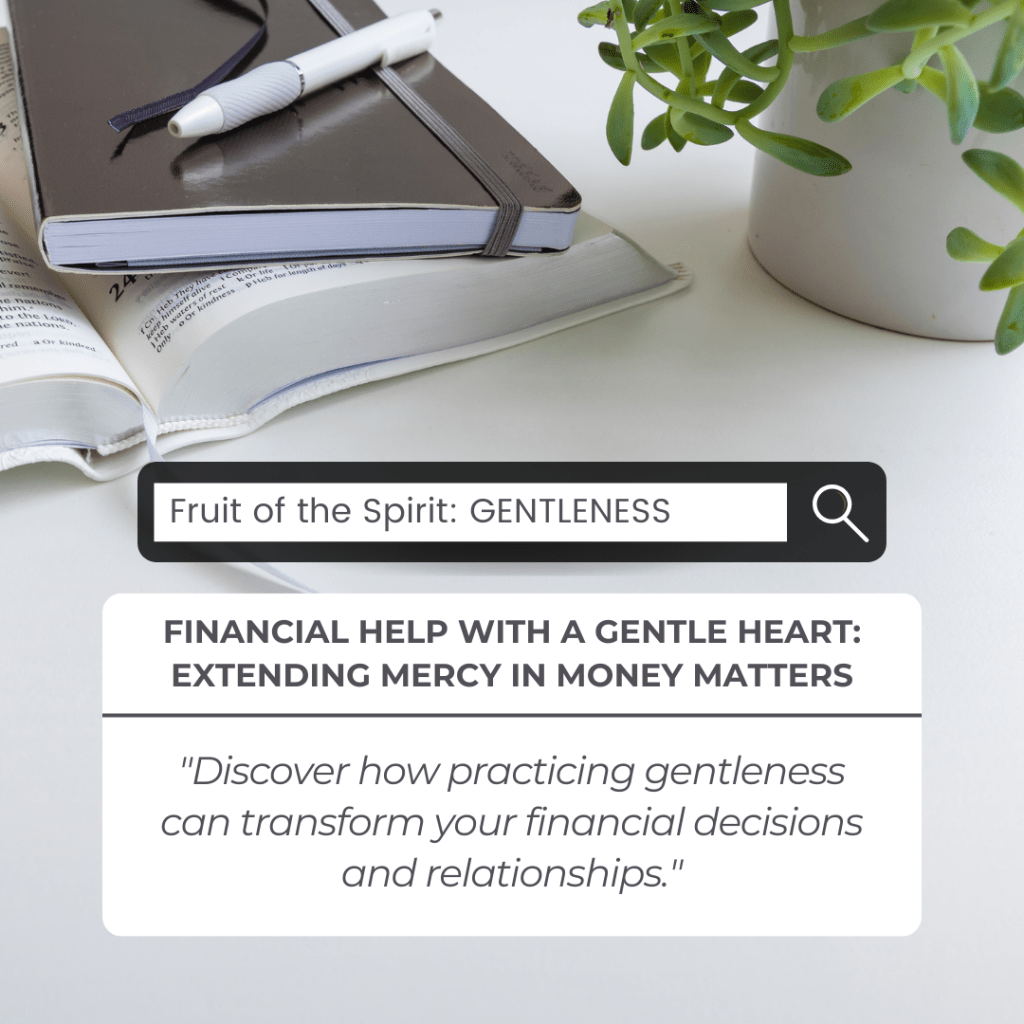
The eighth fruit of the Spirit is gentleness. When I think of gentleness, I picture a mother lovingly cradling her baby in her arms. She carefully supports her infant’s head, providing the nourishment and love the child needs. Paul describes this in his first letter to the Thessalonians: “We were gentle among you, just as a nursing mother cherishes her own children” (1 Thessalonians 2:7).
It’s natural to be gentle with an infant or an elderly person who is frail and in need of assistance. But it’s not always easy to be gentle when you’re bailing someone out of trouble or when they’ve wronged you.
How do you respond to the person who has failed to repay the money they borrowed from you?
How do you react to the person who just caused significant damage to your vehicle?
How do you assist a relative who has gotten himself into a financial mess—again?
Hopefully, you respond with gentleness and the love of Christ.
True gentleness can be defined as “treating others as you want to be treated; showing mercy and forgiveness without judgment.” In terms of money, gentleness can be applied to helping someone in need in a way that maintains their dignity and self-esteem. This means offering financial assistance without judgment. If I am showing gentleness, I cannot berate someone for their financial difficulties. In fact, gentleness may even require me to forgive the debt they owe me, just as Christ forgave my much larger debt.
Gentleness in Helping Others
If the Lord has provided for your needs, He expects you to help others: “But whoever has this world’s goods, and sees his brother in need, and shuts up his heart from him, how does the love of God abide in him?” (1 John 3:17).
It’s easy to feel compassion and gently help someone who has faced financial setbacks due to illness, an accident, a job layoff, or a national economic downturn. But it can be more difficult to extend compassion to someone who has mismanaged their money, lived beyond their means, or made reckless investments in hopes of getting rich quickly. You might even feel that their difficulties are the result of sin and find yourself reluctant to help. However, gentleness compels us to help others without making them feel ashamed. Galatians 6:1 reminds us, “If someone is caught in a sin, you who live by the Spirit should restore that person gently.”
If you struggle with gentleness, remember that fortunes can change quickly. Today, you might be in a position to give, but tomorrow, you might need help yourself: “Cast but a glance at riches, and they are gone, for they will surely sprout wings and fly off to the sky like an eagle” (Proverbs 23:5).
Offering Assistance with Gentleness
Seek God’s direction before offering help: “But the wisdom that is from above is first pure, then peaceable, gentle, willing to yield, full of mercy and good fruits, without partiality and without hypocrisy” (James 3:17).
Consider how you would want to be approached for assistance and follow the Golden Rule: “Do to others as you would have them do to you” (Luke 6:31).
Offer assistance discreetly and with humility: “Be careful not to practice your righteousness in front of others to be seen by them. If you do, you will have no reward from your Father in heaven. So, when you give to the needy, do not announce it with trumpets, as the hypocrites do in the synagogues and on the streets, to be honored by others. Truly I tell you, they have received their reward in full. But when you give to the needy, do not let your left hand know what your right hand is doing” (Matthew 6:1–3).
Offer help not to seek praise from others, but as an opportunity to share the gospel: “Nor did we seek glory from men, either from you or from others, when we might have made demands as apostles of Christ. But we were gentle among you, just as a nursing mother cherishes her own children. So, affectionately longing for you, we were well pleased to impart to you not only the gospel of God, but also our own lives, because you had become dear to us” (1 Thessalonians 2:6–8).
Practical Ways to Assist Someone Financially with Gentleness
Pay a bill anonymously.
Send a check with a note that says, “The Lord instructed me to give this to you.”
Drop off a bag of groceries or a gift card to a grocery store.
Pay attention to their needs and purchase specific items to meet those needs.
Offer them an opportunity to do paid work for you, such as:
Yard work
Home repairs and maintenance
Errands and/or shopping
Housecleaning
Temporary work at your business (e.g., seasonal sales or extra labor for large jobs)
Contract work for your business (e.g., website design, bookkeeping, marketing, or janitorial services)
Conclusion:
Gentleness is more than just a soft-spoken demeanor; it is an intentional choice to treat others with dignity, compassion, and humility, especially when it comes to our financial dealings. Whether helping someone in need, forgiving a debt, or practicing patience in difficult financial situations, gentleness reflects Christ’s love and grace in practical ways. As we cultivate this fruit of the Spirit, we not only honor God, but we also create an environment of peace, trust, and healing in our relationships with others.
Ask God to open your eyes to those in need around you and pray for wisdom to meet those needs, as led by the Holy Spirit, with gentleness and a heart that reflects His love. Let gentleness guide you in your financial decisions and interactions, and watch how it transforms not only your heart but the lives of those around you. May we continue to be faithful stewards of the resources God has entrusted to us, using gentleness as a reflection of His love in all things.
Discussion Questions:
How can you apply gentleness when helping someone with a financial need, especially if their situation is a result of poor financial decisions? How can you balance compassion and wisdom in such situations?
What are some ways gentleness can influence how you manage your own finances? For example, how might gentleness affect your approach to budgeting, saving, or giving?
In what areas of your life do you struggle to show gentleness in your financial interactions, whether it’s forgiving a debt, giving to others, or paying your bills on time? How can you ask God for help in those areas?
Think about a time when you needed financial help or guidance. How did the gentleness or lack thereof from others impact your relationship with them? How can you practice gentleness in your own financial dealings to build trust and understanding?
Goodness is the next fruit of the Spirit. While it includes acts of kindness, goodness goes beyond that—it encompasses honesty, fairness, and always choosing to do the right thing.
We display goodness when we use our financial resources to demonstrate God’s goodness and direct others toward Him. To embody goodness, we must first acknowledge that only God is truly good, and that all goodness flows from Him.
God is Good, and He Provides for Us by His Goodness
God is inherently good, and He blesses His children with good things. Recognizing God’s goodness in our lives is key to understanding how we should use our finances. We must thank Him daily for His faithfulness. Psalm 34:8 reminds us:
“Oh, taste and see that the Lord is good; blessed is the man who trusts in Him!”
1 Chronicles 16:34 echoes this truth:
“Give thanks to the LORD, for He is good; His love endures forever.”
Psalm 107 starts with an invitation to give thanks for God’s goodness:
“Oh, give thanks to the Lord, for He is good! For His mercy endures forever.” (verse 1)
The chapter goes on to highlight how God demonstrates His goodness: He redeems us, protects us, provides for us, heals us, and lifts us out of distress. The psalmist concludes with the call to reflect on God’s loving deeds:
“Let the one who is wise heed these things and ponder the loving deeds of the Lord.” (Psalm 107:43)
Jeremiah 33:9 further illustrates how God’s provision is rooted in His goodness:
“Then it shall be to Me a name of joy, a praise, and an honor before all nations of the earth, who shall hear all the good that I do to them; they shall fear and tremble for all the goodness and all the prosperity that I provide for it.”
God Is Pleased When We Do Good
We honor God when we do good for others, especially by sharing the blessings He has given us. Hebrews 13:16 tells us:
“And do not forget to do good and to share with others, for with such sacrifices God is pleased.”
Demonstrating goodness points others to God’s love. 1 John 3:17-18 challenges us:
“But whoever has this world’s goods, and sees his brother in need, and shuts up his heart from him, how does the love of God abide in him? My little children, let us not love in word or tongue, but in deed and in truth.”
Loving in deed means that we share what God has entrusted to us, including our finances. Failing to do so, particularly when it comes to caring for those in need, is a missed opportunity to reflect God’s love. James 4:17 says:
“Anyone who knows the good he ought to do and doesn’t do it, sins.”
Proverbs 21:13 offers a stern warning:
“Whoever shuts their ears to the cry of the poor will also cry out and not be answered.”
Being Good Points Others to God
Jesus taught His followers in Matthew 5:16:
“Let your light so shine before men, that they may see your good works and glorify your Father in heaven.”
We let our light shine when we share our resources and show goodness to others. Paul also encouraged the Galatians to persist in doing good:
“Let us not become weary in doing good, for at the proper time we will reap a harvest if we do not give up. Therefore, as we have opportunity, let us do good to all people, especially to those who belong to the family of believers.” (Galatians 6:9-10)
The harvest we reap by doing good will be souls added to God’s kingdom—a true treasure in Heaven.
Conclusion
God has been incredibly good to us, and He expects us to reflect His goodness by doing good for others, especially when it involves sharing our financial resources. By following God’s example, we can trust that He will meet all our needs.
Discussion Questions:
Recognizing God’s Goodness: How have you experienced God’s goodness in your life recently? How does recognizing His goodness impact the way you manage your finances?
The Role of Finances in Showing Goodness: In what ways can our financial decisions reflect God’s goodness to others? Can you think of a time when you were able to use your resources to bless someone else?
Sharing and Generosity: 1 John 3:17-18 challenges us to love in deed and truth. What are some practical ways we can demonstrate God’s love through our financial resources, particularly in times of need?
The Connection Between Goodness and Obedience: James 4:17 tells us that failing to do the good we know we should do is a sin. How does this verse challenge you to reconsider your approach to generosity and caring for others?
God’s Provision and Trusting Him: Jeremiah 33:9 speaks about God’s goodness leading to prosperity. How does trusting in God’s provision influence your decisions about managing money and sharing with others?
Persevering in Doing Good: Galatians 6:9-10 encourages us to continue doing good, especially for those in the faith. How do you stay motivated to keep doing good when you feel weary or discouraged, especially when it comes to financial giving?
A Life That Points Others to God: Matthew 5:16 says we should let our good works shine before others to glorify God. How can we intentionally use our finances to point others to Christ, both within and outside the church community?
Reflecting on Personal Action: As you reflect on your current financial situation, how can you align your use of money more closely with God’s goodness? Is there a specific change or action God is calling you to make?
Kindness is the fifth fruit of the Spirit. A kind person is friendly, generous, and compassionate. The root word “kin” in kindness reminds us to treat others as family. As God’s people, we’re called to show kindness, especially by helping those less fortunate. Kindness can be as simple as offering a kind word or as significant as giving one’s resources, time, and energy to improve the situation of another.
True kindness eases others’ burdens and points them to Christ. As we grow closer to the Lord and allow the fruit of the Spirit to develop within us, the Holy Spirit empowers us to demonstrate kindness.
Kindness Cannot Co-Exist with Unforgiveness
Having the right attitude is essential when practicing kindness—particularly when it comes to sharing our financial resources. If we harbor animosity or unforgiveness in our hearts toward someone, it will be difficult to open our hearts (and our pocketbooks) to help them when the Holy Spirit nudges us to do so.
The Bible teaches us that in order to please God and cultivate kindness, we must rid our hearts of bitterness and unforgiveness. Ephesians 4:31-32 reminds us: “Get rid of all bitterness, rage and anger, brawling and slander, along with every form of malice. Be kind and compassionate to one another, forgiving each other, just as in Christ God forgave you.”
Paul also emphasizes this in Colossians 3:12-13:
“Clothe yourselves with compassion, kindness, humility, gentleness and patience. Bear with each other and forgive whatever grievances you may have against one another. Forgive as the Lord forgave you.”
God Expects Us to Be Kind
In the Old Testament, God commanded His people to show kindness. He even withheld His favor when they failed to do so. In Isaiah, God expresses His displeasure when kindness is withheld, especially toward the poor and oppressed. Isaiah 58:6-7 states:
“Is not this the kind of fasting I have chosen: to loose the chains of injustice and untie the cords of the yoke, to set the oppressed free and break every yoke? Is it not to share your food with the hungry and to provide the poor wanderer with shelter—when you see the naked, to clothe them, and not to turn away from your own flesh and blood?”
Job also reminds us of the importance of kindness in relationships: “Anyone who withholds kindness from a friend forsakes the fear of the Almighty” (Job 6:14).
Jesus taught that when we serve the least among us, we are serving Him (Matthew 25:31-46). The acts of kindness Jesus described involved sharing our possessions—food, water, clothing—with those in need. As God provides for us, He expects us to share those resources with others.
God Rewards Those Who Show Kindness
God blesses those who are kind and share their resources. Solomon wisely wrote, “A kind man benefits himself” (Proverbs 11:17), and “Whoever is kind to the poor lends to the Lord, and He will reward them for what they have done” (Proverbs 19:17).
When we are kind, we are building treasure in Heaven. This is especially true when we do so without making a spectacle of it. Jesus warned against doing good deeds for the sake of recognition, teaching His disciples:
“Take heed that you do not do your charitable deeds before men, to be seen by them. Otherwise, you have no reward from your Father in heaven. Therefore, when you do a charitable deed, do not sound a trumpet before you as the hypocrites do in the synagogues and in the streets, that they may have glory from men. Assuredly, I say to you, they have their reward. But when you do a charitable deed, do not let your left hand know what your right hand is doing” (Matthew 6:1-3).
When we show kindness to others, we honor God and demonstrate His love to those who are hurting. We should not show kindness to gain God’s favor or heavenly rewards, but when done in obedience to God’s commands and with the right attitude, God will reward our kindness.
A Reflective Question for Your Heart
As you reflect on your relationship with money and kindness, consider the following questions:
How has kindness played a role in your financial decisions?
Can you think of a time when showing kindness to someone changed their situation—or yours?
Take a moment to reflect and invite God to help you be more intentional with your kindness, especially in how you manage and share your resources. Remember, the kindest act you can do is to share the gospel of Jesus Christ, so that others can look forward to eternity in Heaven.
Patience is the ability to wait for someone or something without becoming agitated or frustrated. It’s a calm, self-controlled attitude that isn’t instinctively present at birth but rather develops over time, especially through challenges and adversity. The apostle James teaches that patience grows in the midst of trials and hardships
James 1:2-4, says: “My brethren, count it all joy when you fall into various trials, knowing that the testing of your faith produces patience. But let patience have its perfect work, that you may be perfect (mature) and complete, lacking nothing.”
A patient person reaps many benefits: reduced stress, greater perseverance, improved problem-solving skills, and healthier relationships. In contrast, impatience often leads to restlessness, irritability, and rushed decisions without proper thought.
When it comes to finances, patience plays a crucial role in making wise financial decisions, avoiding costly mistakes, and preventing the burden of debt. Patience helps us delay gratification and trust God to meet our needs, while also teaching us to manage our money in a way that allows us to grow our savings over time and make big purchases without relying on debt.
Patience to Delay Gratification
It’s no secret that waiting for something you really want can be frustrating. Whether you’re saving for a special vacation, a new car, your first home, a new outfit, or the latest gadget, delaying that immediate gratification isn’t easy. However, the benefits of saving and waiting are substantial.
Avoiding Debt: By saving for an item instead of charging it, you avoid the stress of debt that can take months or even years to pay off, often with interest.
Increased Satisfaction: The anticipation of waiting often heightens your satisfaction when you finally make the purchase, and the joy of avoiding debt adds to that satisfaction.
Better Deals: Waiting gives you the time to research the best deals, potentially finding better prices or discovering a product that better meets your needs.
As Solomon wisely observed in Proverbs 22:7, “The rich rules over the poor, and the borrower is a servant to the lender.” Patience helps you avoid this type of financial bondage.
Patience to Accumulate Wealth Over Time
One of the best financial strategies is to start saving small amounts early, allowing your investments to grow over time. Consider this: If you begin saving $25 a month at age 25 into an annuity paying 3% interest, by the time you turn 65, your $12,000 investment will grow to $23,209. It’s not hard to save $25 a month—just skip one dinner or two lunches out each month, and you’ll be able to invest that money. If you increase it to $25 a week, your balance would grow to $100,547.
This principle is found in Proverbs 13:11, “Whoever gathers money little by little makes it grow.”
Trying to get rich quickly can often lead to risky, costly mistakes. Some people resort to gambling or high-risk investments that promise large returns. However, gambling can lead to addiction and financial ruin, and get-rich-quick schemes often end in loss. In fact, the Federal Trade Commission estimates that Americans lost more than $8 billion in 2023 to risky investments and scams, and nearly $117 billion was lost to gambling.
Patience to Wait on God
Patience is also about waiting on God’s timing. It’s about trusting that He will fulfill His promises, even when it seems like our prayers go unanswered. Patience allows us to stay faithful, even when we feel overwhelmed by financial difficulties. God has promised to meet all our needs, and He is faithful to His word.
In Philippians 4:19, Paul expressed his confidence that God would provide for the needs of the Philippians: “And my God shall supply all your need according to His riches in glory by Christ Jesus.” Despite the trials Paul faced, he had learned to be content, knowing that God would meet his every need. Patience and faithfulness during trials helped Paul grow in his trust in God’s provision.
When we wait on God, we develop patience and maturity, learning that God’s timing is perfect. Even when waiting feels difficult, remember that the trials we endure can build perseverance, and perseverance leads to maturity in our faith.
A Reflective Question for Your Heart
As you reflect on your relationship with money, consider the following:
Have you made financial decisions in the past that might have turned out better if you had been more patient?
Can you recall instances where God rewarded your patience with a better outcome than you expected?
Take a moment to think about these questions, and feel free to share your thoughts in the comments. Let this be an opportunity to invite God’s peace and patience into your financial journey.
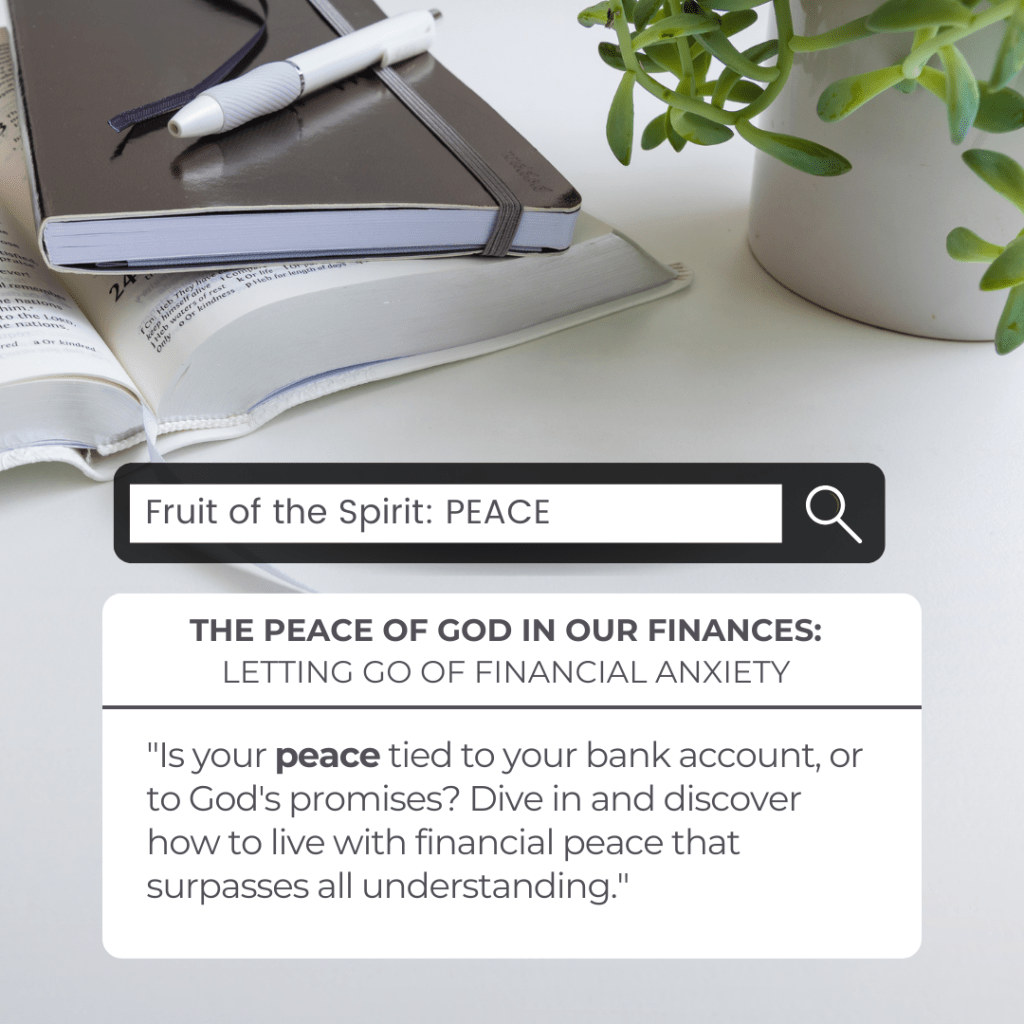
The third fruit of the Spirit is peace—a deep sense of inner contentment and calm. Peace of mind stands in stark contrast to worry or stress. We experience peace when we feel safe and secure. However, in today’s world, feelings of peace can be rare and short-lived. We find ourselves worrying about our family’s safety and health, job security, political turmoil, and, of course, whether we have enough money to meet our obligations.
Money is consistently one of the top causes of stress. In fact, a recent study revealed that 70% of Americans report feeling stressed about their finances, and 90% say that thinking about money causes them anxiety. But God does not want us to live in fear or anxiety about money. He desires for us to have peace, no matter our financial situation.
True Peace Comes from God
The first step in experiencing peace is recognizing that only God can truly supply all of our needs. As Philippians 4:19 reminds us: “And my God will meet all your needs according to the riches of his glory in Christ Jesus.”
When we bring our needs before God in prayer, He listens and responds in a way that aligns with what’s best for us. Philippians 4:6-7 encourages us: “Do not be anxious about anything, but in every situation, by prayer and petition, with thanksgiving, present your requests to God. And the peace of God, which transcends all understanding, will guard your hearts and your minds in Christ Jesus.”
As we bring our needs to God and trust Him to guide us, we begin to experience the true sense of peace that comes from knowing Christ as our Savior and recognizing God as our ultimate provider.
Money Cannot Give Us Peace
It’s also crucial to acknowledge that no amount of money can provide lasting peace. A 2024 study found that the average American household believes they need an annual income of $186,000 to feel financially secure. However, the most recent Census Bureau data shows that the median household income is $78,538, with only 10% of households earning $186,000 or more. This means that the vast majority of Americans feel insecure about their financial situation. It’s no wonder that many experience stress when they think about money.
Even those whose income greatly exceeds $186,000 often admit feeling financially insecure and wishing for “just a little more.” King Solomon understood this idea when he wrote in Ecclesiastes 5:10: “Whoever loves money never has enough; whoever loves wealth is never satisfied with their income. This too is meaningless.”
True peace comes not from accumulating wealth but from trusting in God, who provides for our needs.
Money Is Fleeting
Even if you have accumulated enough money to feel financially comfortable, it’s important to remember that wealth can be lost in an instant. A stock market crash or economic downturn can wipe out fortunes overnight. Political unrest or war can destroy the wealth of entire nations. Many people have lost their wealth due to bad investments or unscrupulous financial advisors.
King Solomon described this in Proverbs 23:4-5: “Do not wear yourself out to get rich; do not trust your own cleverness. Cast but a glance at riches, and they are gone, for they will surely sprout wings and fly off into the sky like an eagle.”
Paul also warned against putting our hope in wealth. He wrote to Timothy: “Command those who are rich in this present world not to be arrogant nor to put their hope in wealth, which is so uncertain, but to put their hope in God, who richly provides us with everything for our enjoyment.” (1 Timothy 6:17)
We can only feel secure and at peace with our finances when we depend on the Lord to provide for our needs. Isaiah 26:3 assures us: “You will keep him in perfect peace, whose mind is stayed on You, because he trusts in You.”
A Reflective Question for Your Heart
As you consider your relationship with money, ask yourself: Do I place my peace and security in my financial situation, or am I trusting God to provide for my needs, no matter what my bank account looks like? Take a moment to reflect on whether your financial outlook aligns with God’s call to trust Him fully or if you’re still holding on to worry and insecurity. Let this be an opportunity to invite God’s peace into your financial journey.
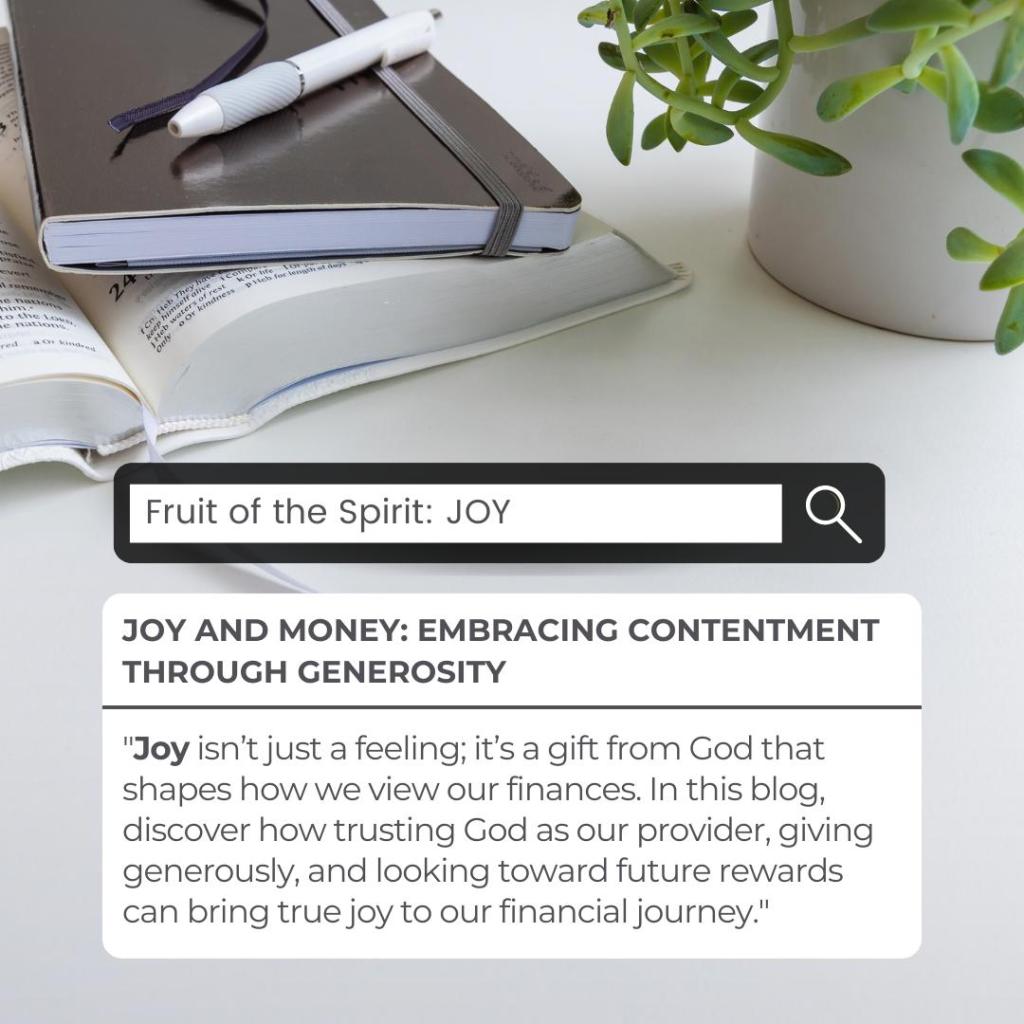
The second fruit of the Spirit listed is joy—a word often associated with gladness and delight. While joy is frequently tied to specific events, such as a parent celebrating their child’s graduation, this type of joy tends to be temporary, fading as circumstances change.
True joy, however, is different. It is internal, unshaken by life’s ups and downs, and is a gift from God. As Romans 15:13 says, “May the God of hope fill you with all joy and peace as you trust in Him, so that you may overflow with hope by the power of the Holy Spirit.”
When it comes to finances, joy plays a critical role in how we handle money. Let’s explore a few ways joy connects to our financial lives.
Joy in Knowing God Is Our Provider
Knowing that God is our provider should bring us great joy. Jesus reminded His disciples not to worry about life’s necessities, assuring them that God would meet their needs. As He said in Matthew 6:25-26, “Therefore, I say to you, do not worry about your life, what you will eat or what you will drink; nor about your body, what you will put on. Is not life more than food and the body more than clothing? Look at the birds of the air, for they neither sow nor reap nor gather into barns; yet your heavenly Father feeds them. Are you not of more value than they?”
During times of financial stress, it’s easy to let worry steal our joy. But in these moments, remembering God’s past faithfulness can restore our peace. I can personally attest to this—when my husband was laid off, and our income dramatically decreased, my first thought was that God would provide. Even in uncertainty, I felt joy and peace knowing He was in control.
When you face financial challenges, take your needs to God in prayer. Jesus promised, “Ask, and you will receive, that your joy may be full” (John 16:24).
Joy from Helping Others
There’s also joy in sharing our resources with those in need. Acts 20:35 teaches, “It is more blessed to give than to receive.” If you’ve ever helped someone less fortunate—whether providing a meal for the hungry or offering relief after a disaster—you’ve likely experienced the satisfaction and joy that comes from easing someone else’s burden.
God calls us to care for the poor and promises to bless those who obey. Deuteronomy 15:10 says, “Give generously to them and do so without a grudging heart; then because of this the Lord your God will bless you in all your work and in everything you put your hand to.” This promise should fill your heart with joy, knowing that your generosity brings blessings.
Furthermore, God delights in those who give with a cheerful heart. As 2 Corinthians 9:6-7 reminds us, “He who sows sparingly will also reap sparingly, and he who sows bountifully will also reap bountifully. So let each one give as he purposes in his heart, not grudgingly or of necessity; for God loves a cheerful giver.”
Future Joy for Faithfulness
We also look forward to the joy of future rewards in heaven for our faithfulness in giving. Jesus taught that we should store up treasures in heaven by being generous on earth. As He said in Matthew 6:19-21, “Do not store up for yourselves treasures on earth, where moths and vermin destroy, and where thieves break in and steal. But store up for yourselves treasures in heaven, where moths and vermin do not destroy, and where thieves do not break in and steal. For where your treasure is, there your heart will be also.”
When we care for others, we are building treasure in heaven. Jesus further emphasized this in Matthew 25:31-36, explaining that when we feed the hungry, give drink to the thirsty, welcome strangers, clothe the naked, visit the sick, and care for prisoners, we are serving Him. These acts of kindness lead to eternal rewards and deepen our joy in Christ.
Finding Joy Through Generosity
As we trust God to provide for our needs and follow the Holy Spirit’s direction in giving, we experience true joy. This joy is not found in accumulating wealth, but in living out God’s call to be generous and compassionate. When we honor God with our finances, we discover contentment and peace, no matter our circumstances.
“But the fruit of the Spirit is love, joy, peace, patience, kindness, goodness, faithfulness, gentleness, self-control.” Galatians 5:22-23
As Christians, we’re called to grow closer to Jesus, allowing His life and teachings to shape every part of our lives—including how we handle money. The way we manage our finances can reflect Christ and influence those around us, especially in a world where many are struggling with financial stress.
Money is simply a tool—it helps us navigate life and conduct business—but it should never be the focus of our lives. Your worth is not determined by how much you have in the bank; it’s rooted in the truth that you were created by God, who loves you deeply. The way we handle money, however, should reflect God’s heart, shining His light in a world full of need.
In this blog, we’ll explore how the Fruit of the Spirit can guide us in our approach to money. Think of this post as an overview—a beginner’s guide or refresher on how these biblical qualities intersect with our financial lives. Over the coming weeks, I’ll dive deeper into each characteristic, offering more insights and practical tips for applying these principles in your finances. This series can serve as a personal study, a group discussion for Sunday school, or a home group study to help you grow in both your financial stewardship and your walk with Christ.
Love
When you accept Christ, God’s love fills your heart. In fact, He calls us to love Him with all that we are: “You shall love the Lord your God with all your heart, with all your soul, and with all your strength.” (Deuteronomy 6:5)
Desiring money isn’t sinful, but loving it can be. When we place too much emphasis on acquiring wealth, we risk letting it take God’s rightful place in our hearts. Jesus makes this clear in Matthew 6:24: “No one can serve two masters. Either you will hate the one and love the other, or you will be devoted to the one and despise the other. You cannot serve both God and money.”
When we love money more than God, it can lead to destructive behaviors like theft, fraud, or worse. As 1 Timothy 6:10 warns: “For the love of money is the root of all kinds of evil.”
We all want joy, but it’s different from happiness. Happiness is based on circumstances—it’s temporary, like the joy you feel when you receive good news. Joy, on the other hand, is deeper and more lasting. It comes from knowing our sins are forgiven and that we are part of God’s eternal family.
Romans 15:13 tells us, “May the God of hope fill you with all joy and peace as you trust in Him.” This kind of joy isn’t dependent on money or possessions.
While an unexpected windfall may bring a moment of happiness, it can’t provide the lasting joy that only comes from Christ. As Jesus reminds us in Luke 6:23–24, “Rejoice in that day and leap for joy, because great is your reward in heaven. For that is how their ancestors treated the prophets. But woe to you who are rich, for you have already received your comfort.”
True peace comes from knowing we are secure in Christ. As Jesus said, “In this world, you will have trouble. But take heart! I have overcome the world” (John 16:33). No amount of money can provide that kind of peace.
Even the wealthiest people often feel insecure. Studies show that even multi-millionaires regularly feel that they need even more money to feel “secure.” King Solomon understood this when he wrote in Ecclesiastes 5:10: “Whoever loves money never has enough.”
True peace comes from trusting in God, not in wealth.
Patience helps us avoid rushing into poor financial decisions. It allows wealth to grow over time and teaches us to wait before making big purchases until we can afford them. Without patience, we might impulsively invest in get-rich-quick schemes or fall into debt by buying things we can’t afford.
Proverbs 13:11 teaches, “Dishonest money dwindles away, but whoever gathers money little by little makes it grow.” And Proverbs 22:7 reminds us, “The rich rules over the poor, and the borrower is a servant to the lender.” Patience and self-control in money management are key.
Kindness means treating others as family—especially those in need. As God’s people, we’re called to show kindness by helping those less fortunate, both with our resources and our time. True kindness eases others’ burdens and points them to Christ.
Job 6:14 says, “Anyone who withholds kindness from a friend forsakes the fear of the Almighty.” Jesus also taught that when we serve the least among us, we are serving Him (Matthew 25:31-46).
Isaiah 58:6-7 explains that true fasting is about meeting the needs of the poor and oppressed. “Is it not to share your bread with the hungry, and to bring the poor who are cast out into your house?”
Goodness is about using what we have to fulfill God’s purpose, especially in helping others. James 4:17 tells us, “Anyone who knows the good he ought to do and doesn’t do it, sins.” When we fail to care for others, especially the poor, we miss an opportunity to show God’s love.
1 John 3:17-18 challenges us: “If anyone has material possessions and sees a brother or sister in need but has no pity on them, how can the love of God be in that person? Dear children, let us not love with words or speech but with actions and in truth.”
Proverbs 21:13 warns that if we ignore the cries of the poor, God may not answer us in our own time of need. “Whoever shuts their ears to the cry of the poor will also cry out and not be answered.”
God is faithful to provide for us, and we are called to be faithful with what He has entrusted to us. This includes being faithful to give—whether through tithing or supporting others in need. Malachi 3:8-10 reminds us that failing to tithe is like robbing God, and that He will bless those who are faithful in their giving.
Jesus also promises rewards for those who use their resources wisely. In Luke 19:17, the faithful servant is told, “Well done, good servant; because you have been faithful in a very little, you shall have authority over ten cities.”
Gentleness compels us to help others without making them feel ashamed. It’s easy to judge those in financial trouble, but the Bible calls us to restore them gently. Galatians 6:1 reminds us, “If someone is caught in a sin, you who live by the Spirit should restore that person gently.”
As we help others, we must remember that our fortunes can change. Today, we may be the ones in a position to give, but tomorrow, we might need help ourselves (Proverbs 23:5). We should offer assistance discreetly and with humility, following the Golden Rule: “Do to others as you would have them do to you” (Luke 6:31).
Self-control is essential for avoiding impulse spending and debt. It also applies to giving. While it’s important to be generous, we must be careful not to give beyond what we can afford, trusting that God will meet our needs (Philippians 4:19).
Jesus warned against giving to be seen by others. “When you give to the needy, do not let your left hand know what your right hand is doing” (Matthew 6:3). Self-control in giving, just like in spending, helps us maintain balance.
Proverbs 21:17 reminds us that “He who loves pleasure will become poor; whoever loves wine and oil will never be rich.” We must practice self-control in all areas of life to manage our resources well.
A Personal Bible Study on Money and the Fruit of the Spirit
As you reflect on the principles of money and the Fruit of the Spirit, I encourage you to take a moment to think about how each characteristic applies to your own financial life. The Fruit of the Spirit isn’t just a list of qualities to admire—it’s a call to live out the very nature of Christ in every area of life, including how we handle our finances.
Would you like to make this a personal study? Consider printing out this blog and keeping it in your Bible as a reminder. You can use it for daily reflection or as a study guide with family or friends. Allow the Holy Spirit to reveal areas in your financial life where you can grow in love, joy, peace, patience, kindness, goodness, faithfulness, gentleness, and self-control. Ask God to give you wisdom as you apply these principles, and trust that as you do, He will bless your efforts and help you reflect His character in all you do.
“I hate my job,” a friend told me recently. Her feelings reached beyond a typical bad day scenario. She dislikes the work that she is doing and the people at work. A study by the Pew Research Center in the spring of last year revealed that half of workers are highly satisfied with their jobs. That means that the other half are not. And 19% of workers reported being miserable in their careers. My friend fell into that 19% of people who are miserable in their jobs.
For many people, like my friend, their work is just a paycheck to provide for themselves. She can not articulate what she would enjoy doing, complicating her situation. She is not alone.
If you do the work God has called you to do, you will not be miserable. Of course, you will have stressful days, but generally, you should feel fulfilled by your work. If you are miserable, you can take steps to figure out what God created you to do.
God demonstrates through stories in the Bible that He has a plan for each of us. God created us with unique abilities, temperaments, interests, and talents. In Exodus 31, God instructed Moses to build the Tabernacle, and He provided the names of two specific artisans whom He had filled with the knowledge to do specific jobs. The craftsmen had different skills, and they could oversee all the specialized work together. When God set the Levites apart to be priests, He assigned different jobs to different Levite families. In the New Testament, Paul tells us that God created some people to be evangelists, some to be prophets, and some to be teachers, among other callings.
God also created you to do specific work. Ephesians 2:10 says, “For we are His workmanship, created in Christ Jesus to do good works, which God prepared beforehand that we should walk in them.”
To help my friend, I turned to “The Purpose Drive Life” by Rick Warren. He suggests several questions that a person should ask themselves to help them determine their purpose. I made a list of the questions from the book to help my friend consider other job options as she prays and seeks the Lord’s guidance.
Here are 6 questions Rick Warren suggests to help you determine your purpose:
What were your favorite family experiences? Favorite memories?
What were your favorite subjects in school?
What jobs have you had that you enjoyed or found meaningful?
What are the most memorable times you have had with God?
What Christian service/ministries have you enjoyed?
What have you learned from your life’s problems, challenges, hurts, and trials?
God wants you to get up excited to face each day. Your job should be more than a way to get a paycheck. It should give you joy and satisfaction knowing that you are where God intended you to be, doing the work He created you to do.
The path to finding your purpose is not an overnight journey. It would help if you took the time to answer the questions and also ask your closest friends and family to help you evaluate what you enjoy. Ultimately, it is for you to decide with God’s help.
Now is an excellent time to begin searching for a new path.





 Susan's Reflections
You must be logged in to post a comment.