Financial Help with a Gentle Heart: Extending Mercy in Money Matters

The eighth fruit of the Spirit is gentleness. When I think of gentleness, I picture a mother lovingly cradling her baby in her arms. She carefully supports her infant’s head, providing the nourishment and love the child needs. Paul describes this in his first letter to the Thessalonians: “We were gentle among you, just as a nursing mother cherishes her own children” (1 Thessalonians 2:7).

It’s natural to be gentle with an infant or an elderly person who is frail and in need of assistance. But it’s not always easy to be gentle when you’re bailing someone out of trouble or when they’ve wronged you.

  • How do you respond to the person who has failed to repay the money they borrowed from you?
  • How do you react to the person who just caused significant damage to your vehicle?
  • How do you assist a relative who has gotten himself into a financial mess—again?

Hopefully, you respond with gentleness and the love of Christ.

True gentleness can be defined as “treating others as you want to be treated; showing mercy and forgiveness without judgment.” In terms of money, gentleness can be applied to helping someone in need in a way that maintains their dignity and self-esteem. This means offering financial assistance without judgment. If I am showing gentleness, I cannot berate someone for their financial difficulties. In fact, gentleness may even require me to forgive the debt they owe me, just as Christ forgave my much larger debt.

Gentleness in Helping Others

If the Lord has provided for your needs, He expects you to help others: “But whoever has this world’s goods, and sees his brother in need, and shuts up his heart from him, how does the love of God abide in him?” (1 John 3:17).

It’s easy to feel compassion and gently help someone who has faced financial setbacks due to illness, an accident, a job layoff, or a national economic downturn. But it can be more difficult to extend compassion to someone who has mismanaged their money, lived beyond their means, or made reckless investments in hopes of getting rich quickly. You might even feel that their difficulties are the result of sin and find yourself reluctant to help. However, gentleness compels us to help others without making them feel ashamed. Galatians 6:1 reminds us, “If someone is caught in a sin, you who live by the Spirit should restore that person gently.”

If you struggle with gentleness, remember that fortunes can change quickly. Today, you might be in a position to give, but tomorrow, you might need help yourself: “Cast but a glance at riches, and they are gone, for they will surely sprout wings and fly off to the sky like an eagle” (Proverbs 23:5).

Offering Assistance with Gentleness

Seek God’s direction before offering help: “But the wisdom that is from above is first pure, then peaceable, gentle, willing to yield, full of mercy and good fruits, without partiality and without hypocrisy” (James 3:17).

Consider how you would want to be approached for assistance and follow the Golden Rule: “Do to others as you would have them do to you” (Luke 6:31).

Offer assistance discreetly and with humility: “Be careful not to practice your righteousness in front of others to be seen by them. If you do, you will have no reward from your Father in heaven. So, when you give to the needy, do not announce it with trumpets, as the hypocrites do in the synagogues and on the streets, to be honored by others. Truly I tell you, they have received their reward in full. But when you give to the needy, do not let your left hand know what your right hand is doing” (Matthew 6:1–3).

Offer help not to seek praise from others, but as an opportunity to share the gospel: “Nor did we seek glory from men, either from you or from others, when we might have made demands as apostles of Christ. But we were gentle among you, just as a nursing mother cherishes her own children. So, affectionately longing for you, we were well pleased to impart to you not only the gospel of God, but also our own lives, because you had become dear to us” (1 Thessalonians 2:6–8).

Practical Ways to Assist Someone Financially with Gentleness

  • Pay a bill anonymously.
  • Send a check with a note that says, “The Lord instructed me to give this to you.”
  • Drop off a bag of groceries or a gift card to a grocery store.
  • Pay attention to their needs and purchase specific items to meet those needs.
  • Offer them an opportunity to do paid work for you, such as:
    • Yard work
    • Home repairs and maintenance
    • Errands and/or shopping
    • Housecleaning
    • Temporary work at your business (e.g., seasonal sales or extra labor for large jobs)
  • Contract work for your business (e.g., website design, bookkeeping, marketing, or janitorial services)

Conclusion:

Gentleness is more than just a soft-spoken demeanor; it is an intentional choice to treat others with dignity, compassion, and humility, especially when it comes to our financial dealings. Whether helping someone in need, forgiving a debt, or practicing patience in difficult financial situations, gentleness reflects Christ’s love and grace in practical ways. As we cultivate this fruit of the Spirit, we not only honor God, but we also create an environment of peace, trust, and healing in our relationships with others.

Ask God to open your eyes to those in need around you and pray for wisdom to meet those needs, as led by the Holy Spirit, with gentleness and a heart that reflects His love. Let gentleness guide you in your financial decisions and interactions, and watch how it transforms not only your heart but the lives of those around you. May we continue to be faithful stewards of the resources God has entrusted to us, using gentleness as a reflection of His love in all things.

Discussion Questions:

  1. How can you apply gentleness when helping someone with a financial need, especially if their situation is a result of poor financial decisions? How can you balance compassion and wisdom in such situations?
  2. What are some ways gentleness can influence how you manage your own finances? For example, how might gentleness affect your approach to budgeting, saving, or giving?
  3. In what areas of your life do you struggle to show gentleness in your financial interactions, whether it’s forgiving a debt, giving to others, or paying your bills on time? How can you ask God for help in those areas?
  4. Think about a time when you needed financial help or guidance. How did the gentleness or lack thereof from others impact your relationship with them? How can you practice gentleness in your own financial dealings to build trust and understanding?

Goodness and Money: How Practicing Goodness Can Transform Your Finances

Goodness is the next fruit of the Spirit. While it includes acts of kindness, goodness goes beyond that—it encompasses honesty, fairness, and always choosing to do the right thing.

We display goodness when we use our financial resources to demonstrate God’s goodness and direct others toward Him. To embody goodness, we must first acknowledge that only God is truly good, and that all goodness flows from Him.

God is Good, and He Provides for Us by His Goodness

God is inherently good, and He blesses His children with good things. Recognizing God’s goodness in our lives is key to understanding how we should use our finances. We must thank Him daily for His faithfulness. Psalm 34:8 reminds us:

“Oh, taste and see that the Lord is good; blessed is the man who trusts in Him!”

1 Chronicles 16:34 echoes this truth:

“Give thanks to the LORD, for He is good; His love endures forever.”

Psalm 107 starts with an invitation to give thanks for God’s goodness:

“Oh, give thanks to the Lord, for He is good! For His mercy endures forever.” (verse 1)

The chapter goes on to highlight how God demonstrates His goodness: He redeems us, protects us, provides for us, heals us, and lifts us out of distress. The psalmist concludes with the call to reflect on God’s loving deeds:

“Let the one who is wise heed these things and ponder the loving deeds of the Lord.” (Psalm 107:43)

Jeremiah 33:9 further illustrates how God’s provision is rooted in His goodness:

“Then it shall be to Me a name of joy, a praise, and an honor before all nations of the earth, who shall hear all the good that I do to them; they shall fear and tremble for all the goodness and all the prosperity that I provide for it.”

God Is Pleased When We Do Good

We honor God when we do good for others, especially by sharing the blessings He has given us. Hebrews 13:16 tells us:

“And do not forget to do good and to share with others, for with such sacrifices God is pleased.”

Demonstrating goodness points others to God’s love. 1 John 3:17-18 challenges us:

“But whoever has this world’s goods, and sees his brother in need, and shuts up his heart from him, how does the love of God abide in him? My little children, let us not love in word or tongue, but in deed and in truth.”

Loving in deed means that we share what God has entrusted to us, including our finances. Failing to do so, particularly when it comes to caring for those in need, is a missed opportunity to reflect God’s love. James 4:17 says:

“Anyone who knows the good he ought to do and doesn’t do it, sins.”

Proverbs 21:13 offers a stern warning:

“Whoever shuts their ears to the cry of the poor will also cry out and not be answered.”

Being Good Points Others to God

Jesus taught His followers in Matthew 5:16:

“Let your light so shine before men, that they may see your good works and glorify your Father in heaven.”

We let our light shine when we share our resources and show goodness to others. Paul also encouraged the Galatians to persist in doing good:

“Let us not become weary in doing good, for at the proper time we will reap a harvest if we do not give up. Therefore, as we have opportunity, let us do good to all people, especially to those who belong to the family of believers.” (Galatians 6:9-10)

The harvest we reap by doing good will be souls added to God’s kingdom—a true treasure in Heaven.

Conclusion

God has been incredibly good to us, and He expects us to reflect His goodness by doing good for others, especially when it involves sharing our financial resources. By following God’s example, we can trust that He will meet all our needs.

Discussion Questions:

  1. Recognizing Gods Goodness:
    How have you experienced God’s goodness in your life recently? How does recognizing His goodness impact the way you manage your finances?
  2. The Role of Finances in Showing Goodness:
    In what ways can our financial decisions reflect God’s goodness to others? Can you think of a time when you were able to use your resources to bless someone else?
  3. Sharing and Generosity:
    1 John 3:17-18 challenges us to love in deed and truth. What are some practical ways we can demonstrate God’s love through our financial resources, particularly in times of need?
  4. The Connection Between Goodness and Obedience:
    James 4:17 tells us that failing to do the good we know we should do is a sin. How does this verse challenge you to reconsider your approach to generosity and caring for others?
  5. Gods Provision and Trusting Him:
    Jeremiah 33:9 speaks about God’s goodness leading to prosperity. How does trusting in God’s provision influence your decisions about managing money and sharing with others?
  6. Persevering in Doing Good:
    Galatians 6:9-10 encourages us to continue doing good, especially for those in the faith. How do you stay motivated to keep doing good when you feel weary or discouraged, especially when it comes to financial giving?
  7. A Life That Points Others to God:
    Matthew 5:16 says we should let our good works shine before others to glorify God. How can we intentionally use our finances to point others to Christ, both within and outside the church community?
  8. Reflecting on Personal Action:
    As you reflect on your current financial situation, how can you align your use of money more closely with God’s goodness? Is there a specific change or action God is calling you to make?

The Power of Kindness: Transforming Your Finances and Relationships

Kindness is the fifth fruit of the Spirit. A kind person is friendly, generous, and compassionate. The root word “kin” in kindness reminds us to treat others as family. As God’s people, we’re called to show kindness, especially by helping those less fortunate. Kindness can be as simple as offering a kind word or as significant as giving one’s resources, time, and energy to improve the situation of another.

True kindness eases others’ burdens and points them to Christ. As we grow closer to the Lord and allow the fruit of the Spirit to develop within us, the Holy Spirit empowers us to demonstrate kindness.

Kindness Cannot Co-Exist with Unforgiveness

Having the right attitude is essential when practicing kindness—particularly when it comes to sharing our financial resources. If we harbor animosity or unforgiveness in our hearts toward someone, it will be difficult to open our hearts (and our pocketbooks) to help them when the Holy Spirit nudges us to do so.

The Bible teaches us that in order to please God and cultivate kindness, we must rid our hearts of bitterness and unforgiveness. Ephesians 4:31-32 reminds us:
“Get rid of all bitterness, rage and anger, brawling and slander, along with every form of malice. Be kind and compassionate to one another, forgiving each other, just as in Christ God forgave you.”

Paul also emphasizes this in Colossians 3:12-13:

“Clothe yourselves with compassion, kindness, humility, gentleness and patience. Bear with each other and forgive whatever grievances you may have against one another. Forgive as the Lord forgave you.”

God Expects Us to Be Kind

In the Old Testament, God commanded His people to show kindness. He even withheld His favor when they failed to do so. In Isaiah, God expresses His displeasure when kindness is withheld, especially toward the poor and oppressed. Isaiah 58:6-7 states:

“Is not this the kind of fasting I have chosen: to loose the chains of injustice and untie the cords of the yoke, to set the oppressed free and break every yoke? Is it not to share your food with the hungry and to provide the poor wanderer with shelter—when you see the naked, to clothe them, and not to turn away from your own flesh and blood?”

Job also reminds us of the importance of kindness in relationships:
“Anyone who withholds kindness from a friend forsakes the fear of the Almighty” (Job 6:14).

Jesus taught that when we serve the least among us, we are serving Him (Matthew 25:31-46). The acts of kindness Jesus described involved sharing our possessions—food, water, clothing—with those in need. As God provides for us, He expects us to share those resources with others.

God Rewards Those Who Show Kindness

God blesses those who are kind and share their resources. Solomon wisely wrote, “A kind man benefits himself” (Proverbs 11:17), and “Whoever is kind to the poor lends to the Lord, and He will reward them for what they have done” (Proverbs 19:17).

When we are kind, we are building treasure in Heaven. This is especially true when we do so without making a spectacle of it. Jesus warned against doing good deeds for the sake of recognition, teaching His disciples:

“Take heed that you do not do your charitable deeds before men, to be seen by them. Otherwise, you have no reward from your Father in heaven. Therefore, when you do a charitable deed, do not sound a trumpet before you as the hypocrites do in the synagogues and in the streets, that they may have glory from men. Assuredly, I say to you, they have their reward. But when you do a charitable deed, do not let your left hand know what your right hand is doing” (Matthew 6:1-3).

When we show kindness to others, we honor God and demonstrate His love to those who are hurting. We should not show kindness to gain God’s favor or heavenly rewards, but when done in obedience to God’s commands and with the right attitude, God will reward our kindness.

A Reflective Question for Your Heart

As you reflect on your relationship with money and kindness, consider the following questions:

  • How has kindness played a role in your financial decisions?
  • Can you think of a time when showing kindness to someone changed their situation—or yours?

Take a moment to reflect and invite God to help you be more intentional with your kindness, especially in how you manage and share your resources. Remember, the kindest act you can do is to share the gospel of Jesus Christ, so that others can look forward to eternity in Heaven.

Patience: A Fruit of the Spirit that Transforms Our Financial Journey

Patience is the ability to wait for someone or something without becoming agitated or frustrated. It’s a calm, self-controlled attitude that isn’t instinctively present at birth but rather develops over time, especially through challenges and adversity. The apostle James teaches that patience grows in the midst of trials and hardships

James 1:2-4, says: “My brethren, count it all joy when you fall into various trials, knowing that the testing of your faith produces patience. But let patience have its perfect work, that you may be perfect (mature) and complete, lacking nothing.”

A patient person reaps many benefits: reduced stress, greater perseverance, improved problem-solving skills, and healthier relationships. In contrast, impatience often leads to restlessness, irritability, and rushed decisions without proper thought.

When it comes to finances, patience plays a crucial role in making wise financial decisions, avoiding costly mistakes, and preventing the burden of debt. Patience helps us delay gratification and trust God to meet our needs, while also teaching us to manage our money in a way that allows us to grow our savings over time and make big purchases without relying on debt.

Patience to Delay Gratification

It’s no secret that waiting for something you really want can be frustrating. Whether you’re saving for a special vacation, a new car, your first home, a new outfit, or the latest gadget, delaying that immediate gratification isn’t easy. However, the benefits of saving and waiting are substantial.

  • Avoiding Debt: By saving for an item instead of charging it, you avoid the stress of debt that can take months or even years to pay off, often with interest.
  • Increased Satisfaction: The anticipation of waiting often heightens your satisfaction when you finally make the purchase, and the joy of avoiding debt adds to that satisfaction.
  • Better Deals: Waiting gives you the time to research the best deals, potentially finding better prices or discovering a product that better meets your needs.

As Solomon wisely observed in Proverbs 22:7, “The rich rules over the poor, and the borrower is a servant to the lender.” Patience helps you avoid this type of financial bondage.

Patience to Accumulate Wealth Over Time

One of the best financial strategies is to start saving small amounts early, allowing your investments to grow over time. Consider this: If you begin saving $25 a month at age 25 into an annuity paying 3% interest, by the time you turn 65, your $12,000 investment will grow to $23,209. It’s not hard to save $25 a month—just skip one dinner or two lunches out each month, and you’ll be able to invest that money. If you increase it to $25 a week, your balance would grow to $100,547.

This principle is found in Proverbs 13:11, “Whoever gathers money little by little makes it grow.”

Trying to get rich quickly can often lead to risky, costly mistakes. Some people resort to gambling or high-risk investments that promise large returns. However, gambling can lead to addiction and financial ruin, and get-rich-quick schemes often end in loss. In fact, the Federal Trade Commission estimates that Americans lost more than $8 billion in 2023 to risky investments and scams, and nearly $117 billion was lost to gambling.

Patience to Wait on God

Patience is also about waiting on God’s timing. It’s about trusting that He will fulfill His promises, even when it seems like our prayers go unanswered. Patience allows us to stay faithful, even when we feel overwhelmed by financial difficulties. God has promised to meet all our needs, and He is faithful to His word.

In Philippians 4:19, Paul expressed his confidence that God would provide for the needs of the Philippians: “And my God shall supply all your need according to His riches in glory by Christ Jesus.” Despite the trials Paul faced, he had learned to be content, knowing that God would meet his every need. Patience and faithfulness during trials helped Paul grow in his trust in God’s provision.

When we wait on God, we develop patience and maturity, learning that God’s timing is perfect. Even when waiting feels difficult, remember that the trials we endure can build perseverance, and perseverance leads to maturity in our faith.

A Reflective Question for Your Heart

As you reflect on your relationship with money, consider the following:

  1. Have you made financial decisions in the past that might have turned out better if you had been more patient?
  2. Can you recall instances where God rewarded your patience with a better outcome than you expected?

Take a moment to think about these questions, and feel free to share your thoughts in the comments. Let this be an opportunity to invite God’s peace and patience into your financial journey.

The Peace of God in Our Finances: Letting Go of Financial Anxiety

The third fruit of the Spirit is peace—a deep sense of inner contentment and calm. Peace of mind stands in stark contrast to worry or stress. We experience peace when we feel safe and secure. However, in today’s world, feelings of peace can be rare and short-lived. We find ourselves worrying about our family’s safety and health, job security, political turmoil, and, of course, whether we have enough money to meet our obligations.

Money is consistently one of the top causes of stress. In fact, a recent study revealed that 70% of Americans report feeling stressed about their finances, and 90% say that thinking about money causes them anxiety. But God does not want us to live in fear or anxiety about money. He desires for us to have peace, no matter our financial situation.

True Peace Comes from God

The first step in experiencing peace is recognizing that only God can truly supply all of our needs. As Philippians 4:19 reminds us:
“And my God will meet all your needs according to the riches of his glory in Christ Jesus.”

When we bring our needs before God in prayer, He listens and responds in a way that aligns with what’s best for us. Philippians 4:6-7 encourages us:
“Do not be anxious about anything, but in every situation, by prayer and petition, with thanksgiving, present your requests to God. And the peace of God, which transcends all understanding, will guard your hearts and your minds in Christ Jesus.”

As we bring our needs to God and trust Him to guide us, we begin to experience the true sense of peace that comes from knowing Christ as our Savior and recognizing God as our ultimate provider.

Money Cannot Give Us Peace

It’s also crucial to acknowledge that no amount of money can provide lasting peace. A 2024 study found that the average American household believes they need an annual income of $186,000 to feel financially secure. However, the most recent Census Bureau data shows that the median household income is $78,538, with only 10% of households earning $186,000 or more. This means that the vast majority of Americans feel insecure about their financial situation. It’s no wonder that many experience stress when they think about money.

Even those whose income greatly exceeds $186,000 often admit feeling financially insecure and wishing for “just a little more.” King Solomon understood this idea when he wrote in Ecclesiastes 5:10:
“Whoever loves money never has enough; whoever loves wealth is never satisfied with their income. This too is meaningless.”

True peace comes not from accumulating wealth but from trusting in God, who provides for our needs.

Money Is Fleeting

Even if you have accumulated enough money to feel financially comfortable, it’s important to remember that wealth can be lost in an instant. A stock market crash or economic downturn can wipe out fortunes overnight. Political unrest or war can destroy the wealth of entire nations. Many people have lost their wealth due to bad investments or unscrupulous financial advisors.

King Solomon described this in Proverbs 23:4-5:
“Do not wear yourself out to get rich; do not trust your own cleverness. Cast but a glance at riches, and they are gone, for they will surely sprout wings and fly off into the sky like an eagle.”

Paul also warned against putting our hope in wealth. He wrote to Timothy:
“Command those who are rich in this present world not to be arrogant nor to put their hope in wealth, which is so uncertain, but to put their hope in God, who richly provides us with everything for our enjoyment.” (1 Timothy 6:17)

We can only feel secure and at peace with our finances when we depend on the Lord to provide for our needs. Isaiah 26:3 assures us:
“You will keep him in perfect peace, whose mind is stayed on You, because he trusts in You.”

A Reflective Question for Your Heart

As you consider your relationship with money, ask yourself: Do I place my peace and security in my financial situation, or am I trusting God to provide for my needs, no matter what my bank account looks like? Take a moment to reflect on whether your financial outlook aligns with God’s call to trust Him fully or if you’re still holding on to worry and insecurity. Let this be an opportunity to invite God’s peace into your financial journey.

How LOVE Shapes Our Financial Choices

Love is a word we use frequently, but often in different ways. We say “I love that!” when we talk about food, clothing, or even our favorite vacation spots. While these may reflect strong preferences, they’re far from the deeper, more self-sacrificial love we’re called to show our family, friends, and ultimately, God.

In his paper The Fruit of the Spirit: Love, James Hernando defines love as a relationship term within the context of redemption. He writes, “Love…defines our relationship to ourselves, to God, to our neighbor, and to the members of God’s body.” God’s love is self-giving, intimate, and requires personal involvement. It’s the kind of love that drives us to share our resources—especially our finances—to meet the needs of others.

Love and Giving: A Call to Action in Christian Finances

We demonstrate love in tangible ways when we open our pocketbooks and share the financial blessings God has given us. The Bible is clear about this. In the Old Testament, God commands the Israelites to care for the poor: “For the poor will never cease from the land; therefore, I command you, saying, ‘You shall open your hand wide to your brother, to your poor and your needy, in your land.’” (Deuteronomy 15:11) Similarly, in the New Testament, John reminds us that the love of God isn’t just a feeling; it’s actionable: “But whoever has this world’s goods, and sees his brother in need, and shuts up his heart from him, how does the love of God abide in him?” (1 John 3:17)

You might be thinking, “I work hard for my money. Why should I sacrifice my earnings for others?” The answer lies in understanding the depth of God’s love for you. He loved you so much that He gave His only Son to die for you. Jesus’s love was sacrificial—it cost Him everything. Our love should reflect that same generosity, both spiritually and financially, as we strive to honor God with our money.

Intimacy in Love: A Heart Connection in Financial Stewardship

God’s love is intimate. Hernando writes, “Intimacy involves close personal interaction resulting in commitment, emotional bonding, and mutual care and concern.” Jesus modeled this intimacy with His disciples—He spent time getting to know them, understanding their needs, and responding with love.

As we grow in love, our relationships deepen, and we naturally start to care for others, not just emotionally, but practically, including financially. This was evident as the early church met daily to pray, fellowship, share meals and meet one another’s needs. “Now all who believed were together and had all things in common, and sold their possessions and goods, and divided them among all, as anyone had need.” (Acts 2:44-45) Christian stewardship means being generous with our resources to help those around us.

Avoiding the Love of Money: A Biblical Warning

As we mature in the Fruit of the Spirit, we become less attached to money and more devoted to loving God and others. Jesus warned that it’s impossible to serve both God and money: “No one can serve two masters. Either you will hate the one and love the other, or you will be devoted to the one and despise the other. You cannot serve both God and money.” (Matthew 6:24, NIV)

The love of money can harm our relationship with God and create all kinds of problems. “For the love of money is a root of all kinds of evil, for which some have strayed from the faith in their greediness, and pierced themselves through with many sorrows.” (1 Timothy 6:10) Money, when idolized, becomes a barrier to a relationship with God and others. It can even destroy relationships, as people prioritize wealth over love and well-being.

Loving money leads people away from God and into many types of sin.  “For men will be lovers of themselves, lovers of money, boasters, proud, blasphemers, disobedient to parents, unthankful, unholy.” 2 Timothy 3:2 The sins depicted in this verse are attitudes that destroy relationships with God, family members, and friends.  As these attitudes take root in a person’s heart, he or she may go to great extremes to get more money. For some this involves sacrificing their families and relationships to seek promotions and raises in order to earn larger salaries and achieve more status.  Others violate the law to gain more money.  Stealing, fraud, tax evasion, identity theft, and robbery are just a few of the ways that greedy people try to gain more money.  No matter how much money they obtain—either through hard work and ingenuity or through theft and crime—lovers of money will never be satisfied.

Despite what culture tells us, money can never fulfill our spiritual and emotional needs. “He who loves money will not be satisfied with money, nor he who loves wealth with his income; this also is vanity.” (Ecclesiastes 5:10-11, ESV) Biblical stewardship teaches us that contentment comes not from accumulating wealth, but from trusting God to provide all we need.

Loving Others: A Practical Application of Financial Stewardship

Romans 12 offers practical instructions for loving others, many of which tie directly into how we handle money. Take your Bible or open your Bible app and look up Romans 12:9-15 & 20-21. Discover how some of the instructions apply directly to our use of money:

  • Entertain strangers
  • Demonstrate hospitality
  • Feed and give drink to our enemies
  • Provide for the needy

These actions often require us to spend our resources—time, energy, and yes, money. Christian hospitality doesn’t have to be extravagant, but it does require sacrifice. We are called to share freely, not to impress others, but to genuinely care for their needs.

As you grow in your relationship with God, your heart for others will deepen. Be attentive to the Holy Spirit’s promptings, and seek opportunities to love others with your finances, just as Christ loves you. In doing so, we demonstrate biblical generosity and honor God with the resources He has entrusted to us.

Final Thoughts on Stewardship and Love

As we reflect on how love impacts our finances, we are reminded that it’s not about the amount we give, but the heart behind it. True love—God’s love—compels us to be generous, sacrificial, and intimate in our care for others. Let that love guide your financial choices today, and trust that God will bless your generosity.

Franchise Considerations: Key Points for Small Business Owners

I frequently advise clients on the intricacies of franchising their business or purchasing a franchise. Both parties in such a transaction must understand what is being offered in exchange for the franchise fee. Whether you’re looking to expand your business model or are considering franchise ownership, here are essential factors to weigh.

Before You Franchise Your Business

Successfully operating a single business location doesn’t automatically translate into a franchise-ready model. Each time you replicate your business by opening additional locations, you gain invaluable insights that help you develop and refine your business model. These expansions allow you to gather crucial feedback on operational procedures, customer preferences, staffing needs, and other aspects essential for scalability and consistency across multiple locations.

  1. Expand Your Business: Open second, third, and fourth locations, each managed by family members or trusted associates. This process not only tests the replicability of your business model but also provides firsthand experience in managing multiple sites.
  2. Gather Feedback: Encourage owners/managers of these replicated locations to provide feedback on operational procedures, policies, equipment, staffing needs, and customer interactions. This feedback loop is essential for refining your business processes and ensuring they can be easily replicated by future franchisees.
  3. Refine Your Operational Guides: Based on the lessons learned from each replication, develop clear and comprehensive operational guides. These guides should document standardized procedures that maintain consistency across all franchise locations, ensuring a seamless customer experience and operational efficiency.
  4. Create a Franchise Disclosure Document: Consult with a franchising expert to develop a legally compliant franchise disclosure document (FDD). This document outlines all aspects of your franchise opportunity and is essential for legal compliance.
  5. Set Franchise Fees and Royalties: Determine the initial franchise fee and ongoing royalties you’ll charge franchisees. Industry standards typically range from 4% to 8% of sales, but research what’s competitive in your specific industry.

What to Expect When You Buy a Franchise

If you’re considering buying a franchise, ensure you’re getting value for your investment. Here are key benefits typically offered by franchisors:

  1. Established Branding: Benefit from the brand recognition of a well-established franchise. This can significantly boost your business’s visibility and customer trust from day one.
  2. Operational Processes and Support: Access proven operational processes, including recipes, product standards, and operational protocols. These streamline your business operations and ensure consistency across locations.
  3. Supplier Relationships: Franchises often have established relationships with suppliers, simplifying procurement and ensuring consistent product quality.
  4. Location Assistance and Build-Out Support: Franchisors typically provide guidance on site selection and may assist with lease negotiations and store build-out, leveraging their experience and industry connections.
  5. Marketing and Advertising Support: Benefit from collective marketing efforts by the franchisor, including national campaigns and marketing materials. This can reduce your marketing costs and increase brand awareness locally.
  6. Continued Training and Support: Franchisors offer ongoing training programs, owner meetings, and support to keep franchisees updated on best practices and industry trends.
  7. Innovation and New Product Development: Franchisors often innovate and introduce new products/services, leveraging their research and development capabilities to keep the brand competitive.

Conclusion

Choosing to franchise your business or invest in a franchise is a significant decision. While franchising offers numerous benefits, including brand recognition and operational support, it’s essential to weigh the costs and benefits carefully. Consulting with a franchise expert can provide valuable insights tailored to your specific industry and goals.

For expert guidance on franchising opportunities or further advice, reach out to professionals in your area. They can offer personalized advice and support to help you navigate this exciting path of entrepreneurship.

Honoring God with Your Money

When you sit down to pay bills, does it create stress and anxiety for you? Do you feel guilty for not tithing, but you barely make ends meet? Is your first thought, if only I could make more money? If so, you are not alone. For most people, a lack of money does not cause their financial pressure. They do not budget their current salary or live within a budget, allowing their wants and desires to dictate their spending. However, when you see your earnings as a blessing from God, most of your stress turns into financial peace. The first step is recognizing that God has entrusted you with your income. Next is embracing the principles that He laid out in His word. If you consistently live outside of your means, you live in debt. God does not want us to live as debtors. 

Bible study on stewarding financial resources
Honoring God with Your Money

I read Dwight L. Moody’s book Pleasure and Profit in Bible Study several years ago. It inspired me to do a word search on what the Bible says about money which led to searches on riches, wealth, poverty, giving, charity, tithing, and greed. I realized that the Bible has much to say about money and finances and began to create teachings based on those guidelines so others could live in financial freedom.   

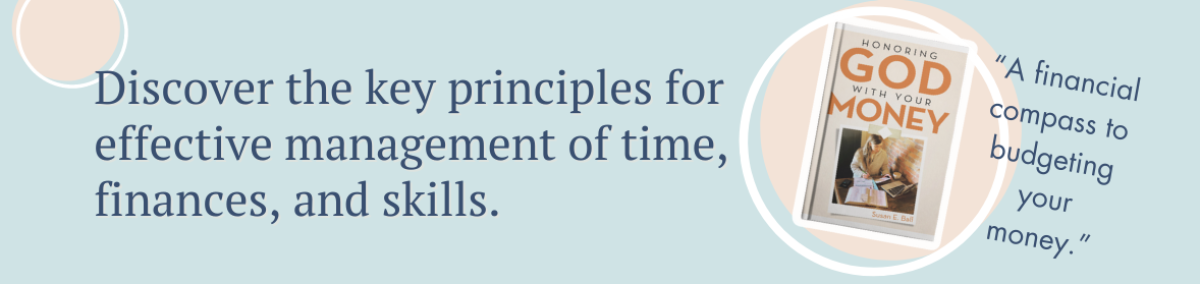
From these teachings, I created a Bible study, Honoring God with Your Money. Part One of this book is an in-depth study of what God’s word says to us on the subject of:

  • The role of money in our lives
  • Appropriate attitudes toward money
  • The foolishness of trusting in money
  • Tithing, offerings, and charitable donations
  • Business practices

Part Two applies the biblical teachings and budgeting principles and helps you create a budget for your family to achieve your financial goals. 

This Bible study is an excellent tool for young people about to graduate from high school or college, newly married couples, and anyone who struggles to manage their finances. Individuals, couples, or small groups can work through it. Also, I have developed teaching materials for instructors to use in small group settings. If you would like these materials, please email me at susan.ball5@aol.com, and I will happily email them to you. I do not charge for these materials. 

Recently, Deborah Morrison interviewed me for her YouTube channel, Greater is Jesus in Me. In the interview, we went through all the sections in the book and discussed the blessings of managing money according to godly principles. Deborah split the interview into two parts.

Part 1 of interview:  https://youtu.be/_3QFxywuzqo

Part 2 of interview:  https://youtu.be/euThkOk0Kr0

God intends for money to be a tool to help make your life easier. He does not intend for money to be a source of stress. As you go through this study, I pray that you will allow God to bless you with financial peace and empower you to use the financial resources that He entrusts to you to care for your family, help others, and honor God.

Cutting Your Losses

As a business consultant, I occasionally counsel someone who has made an unwise decision in opening a business. The business is losing money, and the business owner doesn’t want to give up. That it admirable, and in some cases, with time the business can be successful. In other cases, the business owner is pouring more money into a business that will never be successful. It is time to close up shop and cut their losses. It is a difficult and painful decision, as they often invested time and money into the business.

I was thinking about this as I read the story of King Amaziah that is recorded in 2 Chronicles 25:5-9.

“Amaziah called the people of Judah together and assigned them according to their families to commanders of thousands and commanders of hundreds for all Judah and Benjamin. He then mustered those twenty years old or more and found that there were three hundred thousand men fit for military service, able to handle the spear and shield. He also hired a hundred thousand fighting men from Israel for a hundred talents of silver.

But a man of God came to him and said, “Your Majesty, these troops from Israel must not march with you, for the Lord is not with Israel—not with any of the people of Ephraim.Even if you go and fight courageously in battle, God will overthrow you before the enemy, for God has the power to help or to overthrow.

Amaziah asked the man of God, “But what about the hundred talents I paid for these Israelite troops?”

The man of God replied, “The Lord can give you much more than that.”

Amaziah had invested 100 talents of silver to hire Israelite troops to fight for him.  In today’s economy, that is equivalent to about $1.65 million.  It is quite a lot of money to lose. However, the prophet tells him to give up the money and send the troops away. 

Old silver coins
Photo by Pratikxox on Pexels.com

The prophet also promised Amaziah that God could give him more than the 100 talents of silver he was giving up. To his credit, Amaziah obeyed the prophet.  In doing so, Amaziah secured God’s blessing and won the battle against his enemies. 

It is hard to walk away from money you have invested. Yet, if the Lord instructions you that it is the right thing for you to do, you need to be obedient. God will reward your obedience, and He is more than able to restore to you all that you lost.  Of course, it is best to seek the Lord’s counsel before investing in a business or making other major financial decisions.  Still, it is comforting to know that when you do make a mistake, you can repent of that mistake and walk away from it secure in the knowledge that God will reward your obedience.

Honoring God With Our Money: Rules of Investing

If you have created a budget and are following it, eventually you will wind up with more in savings than you need for an emergency fund.  At that point, you should think and pray about investing your excess money to meet future needs.  The following rules of investing are adapted from Larry Burkett’s book, Family Budgets That Work.

investor

Rules of Investing:

  1.  Never invest money you cannot afford to lose.  All investments have an element of risk and the possibility exist that you might lose all or a portion of the money you have invested.  One only has to look at the variability in the stock market to see that this is true.
  2. Never get involved with things you don’t understand.  Don’t try to buy individual stocks unless you know the company well and have confidence that it is well-run.
  3. Demand sufficient information to thoroughly evaluate the opportunity.  Take the time to thoroughly research possible investments.
  4. Seek good, non-involved Christian counsel.  There are many knowledgeable Christian financial counselors who will discuss your needs and goals and help you to make wise investment decisions.
    • Proverbs 19:20  Listen to advice and accept discipline, and at the end you will be counted among the wise.
  5.  Set a minimum time to pray and seek God’s direction.  Don’t let anyone rush you into an investment decision.  If the opportunity is only available for a limited time, it is probably an opportunity you should forgo.
  6.   Once you have God’s direction, write out an investment plan.  A written plan will help you keep your goals in mind and help you make investment decisions that are consistent with your goals.
    • Proverbs 20:5 The purposes of a person’s heart are deep waters, but one who has insight draws them out.
  7. Avoid ‘get rich’ schemes.  Plan for slow, steady growth.  If it sounds too good to be true, then it almost always is.
    • Proverbs 21:5 The plans of the diligent lead to profit as surely as haste leads to poverty.
    • Proverbs 28:20 – 22  A faithful person will be richly blessed, but one eager to get rich will not go unpunished.   To show partiality is not good—yet a person will do wrong for a piece of bread. The stingy are eager to get rich and are unaware that poverty awaits them.