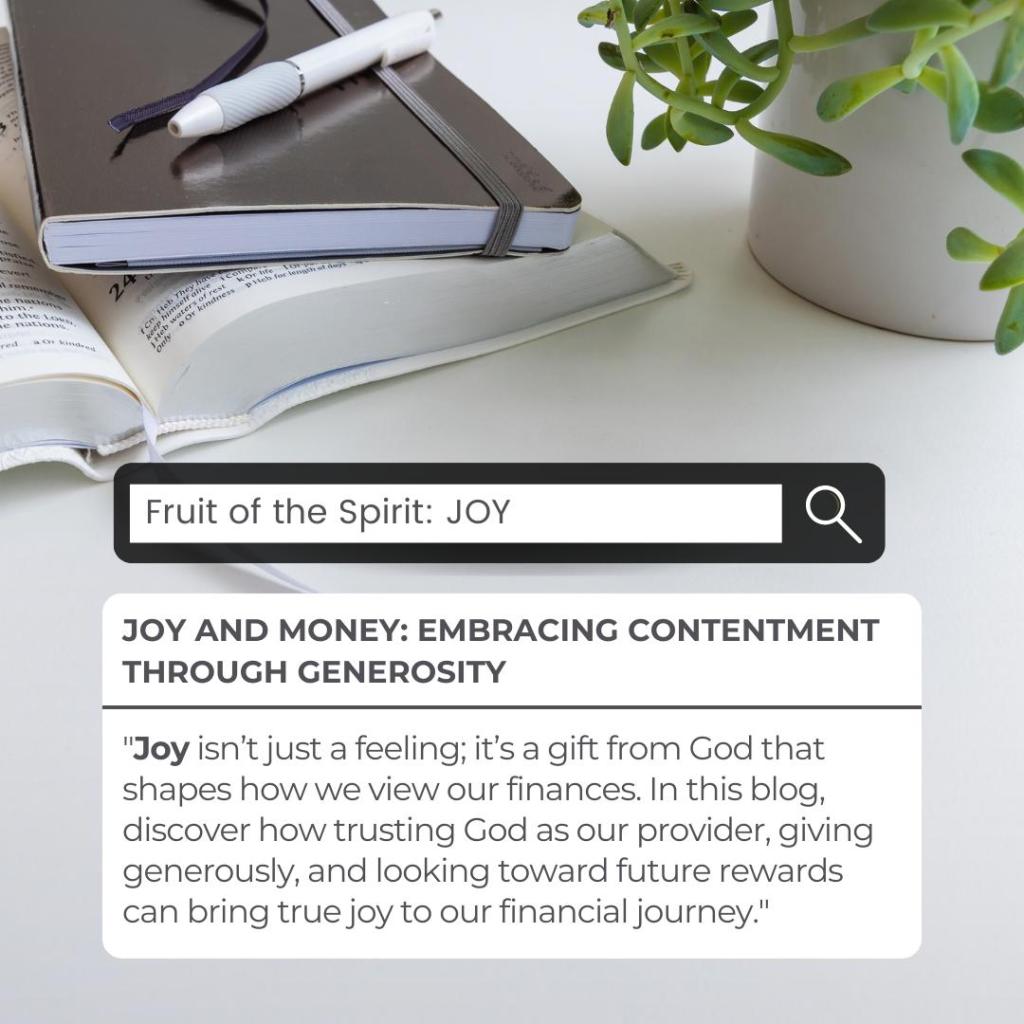
Joy and Money: Embracing Contentment Through Generosity

The second fruit of the Spirit listed is joy—a word often associated with gladness and delight. While joy is frequently tied to specific events, such as a parent celebrating their child’s graduation, this type of joy tends to be temporary, fading as circumstances change.

True joy, however, is different. It is internal, unshaken by life’s ups and downs, and is a gift from God. As Romans 15:13 says, May the God of hope fill you with all joy and peace as you trust in Him, so that you may overflow with hope by the power of the Holy Spirit.”

When it comes to finances, joy plays a critical role in how we handle money. Let’s explore a few ways joy connects to our financial lives.

Joy in Knowing God Is Our Provider

Knowing that God is our provider should bring us great joy. Jesus reminded His disciples not to worry about life’s necessities, assuring them that God would meet their needs. As He said in Matthew 6:25-26, Therefore, I say to you, do not worry about your life, what you will eat or what you will drink; nor about your body, what you will put on. Is not life more than food and the body more than clothing? Look at the birds of the air, for they neither sow nor reap nor gather into barns; yet your heavenly Father feeds them. Are you not of more value than they?”

During times of financial stress, it’s easy to let worry steal our joy. But in these moments, remembering God’s past faithfulness can restore our peace. I can personally attest to this—when my husband was laid off, and our income dramatically decreased, my first thought was that God would provide. Even in uncertainty, I felt joy and peace knowing He was in control.

When you face financial challenges, take your needs to God in prayer. Jesus promised, Ask, and you will receive, that your joy may be full” (John 16:24).

Joy from Helping Others

There’s also joy in sharing our resources with those in need. Acts 20:35 teaches, It is more blessed to give than to receive.” If you’ve ever helped someone less fortunate—whether providing a meal for the hungry or offering relief after a disaster—you’ve likely experienced the satisfaction and joy that comes from easing someone else’s burden.

God calls us to care for the poor and promises to bless those who obey. Deuteronomy 15:10 says, Give generously to them and do so without a grudging heart; then because of this the Lord your God will bless you in all your work and in everything you put your hand to.” This promise should fill your heart with joy, knowing that your generosity brings blessings.

Furthermore, God delights in those who give with a cheerful heart. As 2 Corinthians 9:6-7 reminds us, He who sows sparingly will also reap sparingly, and he who sows bountifully will also reap bountifully. So let each one give as he purposes in his heart, not grudgingly or of necessity; for God loves a cheerful giver.”

Future Joy for Faithfulness

We also look forward to the joy of future rewards in heaven for our faithfulness in giving. Jesus taught that we should store up treasures in heaven by being generous on earth. As He said in Matthew 6:19-21, Do not store up for yourselves treasures on earth, where moths and vermin destroy, and where thieves break in and steal. But store up for yourselves treasures in heaven, where moths and vermin do not destroy, and where thieves do not break in and steal. For where your treasure is, there your heart will be also.”

When we care for others, we are building treasure in heaven. Jesus further emphasized this in Matthew 25:31-36, explaining that when we feed the hungry, give drink to the thirsty, welcome strangers, clothe the naked, visit the sick, and care for prisoners, we are serving Him. These acts of kindness lead to eternal rewards and deepen our joy in Christ.

Finding Joy Through Generosity

As we trust God to provide for our needs and follow the Holy Spirit’s direction in giving, we experience true joy. This joy is not found in accumulating wealth, but in living out God’s call to be generous and compassionate. When we honor God with our finances, we discover contentment and peace, no matter our circumstances.

Did You Get a Large Tax Refund this Year?

In 2024, those who filed their taxes early received an average refund of $1,395. This amount is significant, but it’s $568 less than the average refund at this point last year. The IRS estimates that around 96 million taxpayers will receive a refund this year. Most of us hope for a refund each year, and a large refund can be exciting. It’s always nice to see an extra $1,395, or last year’s average of $1,963, in our bank account.

Many people use their tax refund to pay for a vacation or pay down credit card bills. While this is undoubtedly a good way to spend your refund, it’s important to remember that you have essentially given the IRS a large, interest-free loan. Consider reducing the amount withheld from your paycheck each month; you will have more money in your pocket. This is money that you have control over and can use to reduce interest payments or put into an interest-bearing account.

Let’s say you’re eligible for an average tax refund this year, which is $1,395. This amount is equal to about $116.25 per month. Now, suppose you spent around $1,000 on Christmas shopping last year and had to use your credit card to pay for it. If you have good credit, you might be charged an average interest rate of 16.25% on the balance you owe. But if your credit score is not great, your interest rate could be between 24% and 29%.

 To pay off your debt before next Christmas, let’s assume you’ve decided to set aside $100 every month. This chart shows how much interest you’ll have to pay each month, based on your balance and interest rate.

MonthBeginning BalancePaymentInterestPrincipalEnding Balance
January$1,000$100$13.54$86.46$913.54
February$913.54$100$12.37$87.63$825.91
March$825.91$100$11.18$88.82$737.09
April$737.09$100$ 9.98$90.02$647.07
May$647.07$100$8.76$91.24$555.83
June$555.83$100$7.53$92.47$463.36
July$463.36$100$6.27$93.73$369.63
August$369.63$100$5.01$94.99$274.64
September$274.64$100$3.72$96.28$178.36
October$178.36$100$2.42$97.58$80.78
November$80.78$80.78 $80.78$0
Total Interest  $80.78  
Paying off Christmas Debt Example 1

Paying off credit card debt can be a tough challenge for many people. For example, imagine if it took you almost a whole year to pay off your credit card debt; during that time, you ended up paying an extra $80.78 in interest charges. Unfortunately, this is a common problem that many Americans face. In fact, as of September 2023, around one-third of all Americans were still struggling to pay off the credit card debt they accumulated during the Christmas season of 2022.

Now, let’s look back to January 2023. You use the IRS tax calculator, and it reveals that you are having too many taxes withheld. You lower your withholding amount to match your expected tax liability, giving you an extra $116.25 each month. Add this to the $100 you had budgeted to pay off your $1,000 Christmas credit card debt. The table below shows the results.

MonthBeginning BalancePaymentInterestPrincipalEnding Balance
January$1,000$216.25$13.54$202.71$797.29
February$797.29$216.25$10.80$205.45$591.84
March$591.84$216.25$8.01$208.24$383.60
April$383.60$216.25$5.19$211.06172.54
May$172.54$172.54 $172.54$0
Total Interest  $37.54  
Paying off Christmas Example 2

This plan would enable you to pay off your Christmas debt in just five months instead of eleven months. By doing so, you would have saved $43.24 in interest. Moreover, you would have an additional $43.71 in May and an additional $216.25 in each of the next seven months. This would have given you a total of $1,556.99 that you could have utilized to pay for Christmas 2023, along with an additional $557.

It is not possible to change your withholdings for 2023 after the fact. However, you can make changes right now. Assuming you began 2024 with $1,000 in debt from holiday spending and budgeted $100 to reduce it, and your accountant filed your taxes on time, you have received a refund of $1,395 this week. You can use $647 of this amount to clear your debt balance (as indicated in the first table above). As a result, you will have $648 left from your refund. Additionally, you can modify your withholding now to receive an extra $116.25 monthly for the remainder of the year.

If you add the $100 you have budgeted every month to put towards your debt and the $116.25 you have available, you will have an extra $216.25 per month. By saving this amount for eight months, in addition to the $648 lump sum, you will have a total of $2,378 by the end of 2024. It’s important to note that you won’t receive a large tax refund in 2025, but you’ll have the money available throughout the year. You can use this money to pay off debt, fund a nice vacation, or cover Christmas 2024 expenses without incurring new debt.

This plan assumes that you will maintain your current spending levels for regular and Christmas expenses. On the other hand, if you are likely to fritter away the extra money and not save it for your Christmas spending, then you will be better off to maintain your current level of withholdings.

For more tips on managing money wisely, please see my other blogs. My Bible study, Honoring God with Your Money, is an excellent resource.

If You Have to File Late, Avoid Penalties and Interest

April 15 is just a few days away. If you won’t be able to mail and postmark your taxes by April 15, you may need to file for an extension. You can request an extension if you need extra time to file your tax return. However, it’s important to note that an extension only gives you more time to file your return; it does NOT mean you have an extension to pay.

All taxes that you owe must be paid by the original deadline. Otherwise, you may be charged a late fee along with an interest. If you fail to file your return on time, you will be penalized with a Failure to File penalty unless you apply for an extension.

Failure to Pay Penalty

A Failure to Pay penalty is assessed on the balance of taxes owed after April 15. The penalty for unpaid taxes incurs a monthly fee of 0.5%, with a maximum penalty of 25% of the unpaid taxes, regardless of whether you filed an extension.

Failure to File Penalty

A Failure to File penalty is assessed based on how late you file and the amount of taxes owed on the due date. This fee is assessed if you do not file your tax return AND you do not request an extension. This penalty is calculated at 5% of the unpaid balance per month and maxes out at 25%.

Both of these penalties may be assessed for the same months. However, the combined penalties will be at most 5% of the taxes owed per month.

In addition to these penalties, the IRS charges interest on past-due amounts. This interest is charged on the taxes owed, the penalty, and the accumulated interest. The more you owe, the higher the interest will be. Interest begins on the day the tax is late and continues until the tax, along with interest and penalties, is paid in full.

To avoid getting in trouble and paying penalties:

  1. File your tax return on time and pay any tax owed by the due date.
  2. If you cannot file your taxes by the deadline, you can avoid a Failure to File penalty by requesting an extension.
    a. The extension must be filed by the due date.
    b. The extension gives you to October 15 to file.
    c. File form 4868 or use IRS Free File to apply for an extension.
    d. You need to enter an estimation of your 2023 tax liability and the amount of
    payments you made in 2023 through withholdings and estimated tax payments.
    e. Include payment for the balance to avoid late penalties and interest. If you cannot pay the balance in full, pay as much as possible.
    f. Estimating high and overpaying is much better than subjecting yourself to late penalties and interest.
    g. It is much better to estimate high and overpay than subject yourself to late penalties and interest.
  3. If you are unable to pay the balance when you file the extension, you should pay as much as you can and apply for a payment plan that will allow you to pay the remaining balance over time.
    a. Apply for a short-term plan if you can pay your taxes owed within 180 days.
    b. Apply for a long-term plan to make monthly payments over some time greater than 6 months.
    c. Set-up fees are applied to long-term plans; this fee is significantly lower if payments will be made by direct deposit.
    d. If payments are made by credit card, a fee will be charged.
    e. You may be able to apply for a payment plan online, depending on how much you owe. Online setup requires a computer using a supported browser and a cell phone that receives text messages.
    f. If you cannot apply online, you will need to complete Form 9465, Installment
    Agreement Request.
    g. For more information on applying for an IRS payment plans, go to
    https://www.irs.gov/payments/online-payment-agreement-application

If you cannot pay your taxes on time, you must establish a payment plan with the IRS. If you do not follow these steps, the IRS can levy your salary, bank accounts, or property. You do not want to get into that situation.

Thinking About Doing Your Own Taxes?

Hiring a tax accountant can be expensive, so you may consider doing your own taxes. But before making that decision, you should carefully evaluate (1) whether you are capable of doing them yourself and (2) if so, how to proceed.

You might feel comfortable doing your taxes if:

  • Your taxes are relatively simple
  • All income is reported on W-2s and/or 1099s
  • Most things have stayed the same since last year, such as marriage status, jobs, etc.
  • You will take the standard deduction.
  • Your taxes are a bit more complicated, but you are willing to take the time to read the IRS instructions.
  • You have self-employment income as a single owner and feel confident to complete the Schedule C form.

You might be better off hiring an accountant IF:

  • You have multiple sources of income.
  • You worked numerous jobs or worked in various states.
  • You sold a home, investments, or a business
  • You have investment properties
  • You have investments in foreign companies.
  • You own a company with business with partners.
  • You want to be sure to maximize all your deductions and get the most significant tax refund possible.

Options for Preparing Your Taxes:

  1. IRS Fillable Forms. You can complete your taxes and file them online; however, no guidance is provided, and you must perform some calculations yourself.  
  2. Tax Software—These five options were ranked as the top 5 online tax software providers by Forbes. You should compare options to determine which one is best for your particular situation.
    • TurboTax
    • H&R Block
  3. TaxSlayer
  4. CashApp
  5. Jackson-Hewitt Online

If you have not completed your taxes yet, it’s time to get to work. Tax returns are due on April 15. Check back next week for tips on minimizing penalties and interest if you are not able to complete and file your return on time.

Honoring God with Your Money in 2024

The new year will arrive in two days. With a new year, comes a chance for new beginnings and fresh starts.  I encourage you to make a commitment in 2024 to follow the Lord’s leading in all that you do. Obeying the Lord in all things will result in spiritual growth, better mental and physical health, more joy, and less stress, including less financial stress.

Honoring God with Your Money

Plan now to reduce your financial stress in the coming year by honoring God with your money.  Here are some steps to help you.

  1. Acknowledge that all you have has been given to you by God. God gives you the ability to work and earn a living. ”And you shall remember the Lord your God, for it is He who gives you the power to get wealth.” Deuteronomy 8:18
  2. Tithe. God asks each of us to return ten percent of what we earn for the work of the church. God promises to bless those who are obedient to tithe. “‘Bring all the tithes into the storehouse, that there may be food in My house, and try Me now in this,’ says the Lord of hosts, ‘If I will not open for you the windows of heaven and pour out for you such blessing that there will not be room enough to receive it.'”  Malachi 3:10
  3. Live below your means. Living below your means will allow you to pay off existing debt and put some money aside for emergencies.
  4. Make a budget and do your best to stick to it.  Include your spouse and children.  Everyone needs to be committed to the budget, or you will not be able to maintain it. Set reasonable amounts of money for entertainment and recreation.
  5. Start saving, even if is only a small amount. Develop a regular habit of putting aside a little bit from each paycheck. Make it automatic by having your savings directly deposited before you get your paycheck.
  6. Designate some money to help out those less fortunate than you.  Don’t try to outgive others, but give within your means as led by the Lord. He who has a generous eye will be blessed, for he gives of his bread to the poor.” Proverbs 22:9
  7. Trust in the Lord.  Those who put their trust in money, jobs, or the government will be disappointed. Only God can meet all your needs.  “Trust in the Lord with all your heart, And lean not on your own understanding; In all your ways acknowledge Him, And He shall direct your paths.”  Proverbs 3: 5, 6
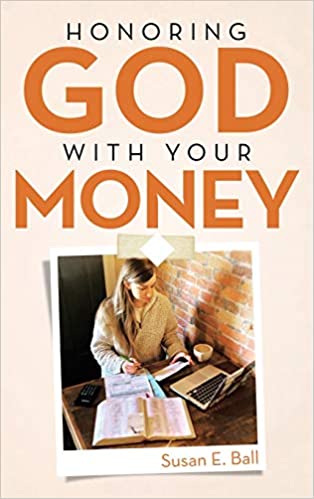
  8. Seek guidance from godly financial experts.  Completing my Bible study, Honoring God with Your Money, is a great way to start the year.  There are many other resources available from Crown Financial Ministries (crown.org) and Dave Ramsey (DaveRamsey.com).  Find tools that work for you and use them.

Reduce Stress By Planning Your Holiday Spending

Researchers estimate that 80% of consumers have started shopping for the holiday season. I shop for eight grandchildren, and I like to spread my spending over several months, so I am part of the 80%. Many people are shopping early to take advantage of promotions. Others are spreading out their spending to avoid hefty credit card balances in the coming year.

Economic forecasters predict that 95% of Americans will celebrate the holidays. The average consumer will spend $1,652 on gifts, food, decorations, clothing, and furnishings. This number is 14% more than last year, even though incomes increased by only about 5%.  

As parents and grandparents, we desire to make the holidays special for our children. We encourage them to make lists, and we try our best to fill their lists. But sometimes our budgets do not allow us to indulge our children as we would like. It’s easy to get caught up in the frenzy and spend more than we can afford. 

Before you overspend on Christmas purchases, take a hard look at your income and regular bills. Plan a time to sit down and calculate how much you can afford. Find a quiet space and clear your mind from the running to-do list constantly filling your head. Commit to not spending more than you can afford. The following ideas can help you to stay within your budget.

Prioritize. If you are a parent, buying gifts for your children should be first on your holiday shopping list. Beyond the children, you will want to purchase gifts for your spouse, parents, and spouse’s parents. Extended family, co-workers, and friends should be further down the list and may require you to cut if your budget does not allow them. 

Set Expectations. If you plan to spend less than usual this year, let your children know they may not find as many gifts under the tree. Be upfront with friends and colleagues with whom you will not be able to exchange gifts this year; they will appreciate your honesty and may be relieved to be purchasing fewer gifts themselves.

Ask for help. If your child has his heart set on a gift that does not fit your budget, ask the grandparents to chip in. They will likely be happy to contribute for the pleasure of knowing their grandchild is getting this special gift.

Start early. Research now for the best prices for the gifts you want to buy. Be alert for sales and promotions. Place online orders early enough not to have to pay for express shipping.

Cut back. Carefully consider all of your spending for your typical holiday celebration. Decide which purchases you can cut out without diminishing your celebration. Reuse gift bags and decorations rather than buying new ones. Design and send e-cards rather than spending money and postage on store-bought cards. Give some homemade gifts. Make most of your desserts and side dishes from scratch.

The spirit of Christmas is giving. As God gave His Son to redeem mankind, we give gifts to those we love. Remember that the amount of money you spend does not reflect your love for someone. Instead, it is the thoughtfulness of the gifts that demonstrates your love to your family members. It is more loving and thoughtful to stay within your budget on holiday spending than to go overboard and deal with financial stress in the new year.

For more information on reducing your financial stress, please read my other blogs on financial management and stewardship. My book Honoring God with Your Money is another excellent resource. You may also want to sign up for my free quarterly newsletter.

Buying A Car in 2023: Read This First 

When I bought my car 12 years ago, it was a gently used vehicle with about 18,000 miles. My commute to work is short, and I only put about 6,000 miles on it a year. It has low mileage and is in excellent condition for its age, and I may hold onto my car for another year or two. Yet, car shopping has been on my mind lately.

Car shopping has always been challenging. It is even more so in the current economy. Let’s examine what a buyer in today’s economy is facing. The inventory of car dealerships is lower than usual, interest rates are high, and the prices of new and used cars are higher than before the pandemic. According to Experian, the average cost for a new car is $48,000, and the average monthly payment for a new car is currently $729. If you are considering a low-mileage used car, the average price is $27,000, and the average monthly payment is $528. Car ownership costs are estimated at $300 per month, based on current gasoline prices and driving an estimated 15,000 miles per year.

Before starting the search for a new car, it is crucial to plan ahead.

First, you must review your budget and determine how much you can afford to pay for your next car. Include the total costs of owning your car in your budget, including insurance, property taxes, fuel, and repairs. Edmunds Car Affordability Calculator is a great tool to help you determine the price of the vehicle within your budget based on the payment you can afford.   Generally, your car payment and insurance should consume no more than 10% of your gross income, and your total car costs should be no more than 12%.  

Once you know how much you can afford to pay for your next car, you can use these steps to help you find the right one.

  • Research affordable options before you leave your house. Have a good idea of the models of vehicles you can afford and plan to test drive.
  • Cast a wide net. Check with multiple dealers, as well as online. Be willing to spend more time than you usually would to search for the right vehicle.
  • Buy a reliable vehicle. Take any used vehicle to your mechanic to be inspected before purchasing.
  • Be willing to compromise on features that you might like but are unnecessary. Know which features are essential and which you can live without to stay within your budget.
  • Minimize your monthly payment by saving up to make a significant down payment.
  • Pre-arrange financing with your bank or credit union.  Check with your lending institute to determine the best rate they will offer you. Knowing the interest rate will allow you to accurately calculate your expected payment based on the price of the car you seek. When you invest the time and research in advance, you can confidently accept or reject the dealer’s rate.

A crucial element in making sound financial decisions is to plan. If your car is older, now is the time to set aside money for a future down payment. You will lower your monthly payments with this one step. When your car leaves you stranded, and the repair price is overwhelming, you will feel pressured to buy a car. The temptation to quickly buy a car without researching can lead to regret.

Making wise financial decisions helps you live within your budget and reduce stress. My book Honoring God with Your Money is a great resource to help you better manage your money. Sign up for my quarterly newsletter for even more tips.

Preparing for Retirement?

Did you know that more than 10,000 Americans turn 65 every day? Once you reach that age milestone, you become eligible for Medicare. The retirement decision becomes more feasible when Medicare kicks in. In the next few months, my husband and I will join the ranks of those 65 or older. So, we discuss this topic often. 

Older husband and wife; tips for preparing for retirement

Many factors can influence your decision about when to retire. A few of those factors include your current job satisfaction and savings decisions you made earlier in your career. It is never too early to plan for retirement. Many people are nervous about diving into this overwhelming subject. Keep reading for practical questions to ask yourself about this important yet often scary decision. 

  • How much money will you need to maintain your standard of living? The cost of
    living varies significantly from state to state, community to community and person to person.
    o If you are living well below your means, you can retire early.
    o On the other hand, if you spend everything you make, you will likely have
    to keep working well past full retirement age.
    o Several years before you plan to retire, you need to take a hard look at
    your budget and make changes to live on less. Most retirees find that their
    expenses decline by 20 – 25% after retiring, and your income may
    decrease by more than that.
  • Health insurance. Medical expenses can be high as we age, and individual
    health insurance plans can be costly.
    o If you retire before age 65, you will be responsible for your healthcare
    expenses until you become Medicare-eligible.
    o For my husband and I, the high cost of private health insurance was a
    prime factor in delaying retirement until we were Medicare-eligible.
  • Job satisfaction and leisure activities. Those workers whose jobs provide a high
    degree of satisfaction may find that working past full retirement age is a positive.
    Ask yourself:
    o Do you enjoy your work?
    o Do you get enough time off to satisfy your needs?
    o What will you do to fill your time in retirement?
    o Can you retire from full-time employment but work part-time?

The question of when to retire is an individual decision. What is right for you will not be suitable for someone else. You should consider these questions and pray about your retirement decisions. God will direct you to make the decision that is right for you. Now is the time to act. You can take the suggestions above and learn the keys to successfully managing your retirement. 

For more ideas about how to manage your money and live without financial stress, sign up for my quarterly newsletter. My book Honoring God with Your Money is another great resource.

5 Steps to Prepare Your Child for Financial Success

Teaching financial responsibility falls into the lengthy job description of a parent. The topic of money intimidates many people. Parents feel at a loss about where to start. An excellent place to begin is with their allowance. You can then introduce the idea of saving for items they want to buy. As they age, begin to teach your kids how to balance a checkbook and explain basic financial information.


A recent study found that young adults are most stressed about paying off college debt and lack financial literacy. They are also concerned about their lack of investment knowledge or when to take a risk. These young people believe they will never achieve what their parents did, such as owning a home or the ability to retire at the average retirement age.

Financial education should be a regular part of family discussions. I have created a few beginning steps to help you encourage your child to feel more financially knowledgeable and understand how to manage money early on.

1. Open a bank account for them. You can use the bank statement to show your child the principle of interest and how their balance will grow by their deposits and interest. Set up a small regular deposit and demonstrate how even a tiny recurring deposit will grow to a much more significant amount over the next 5 – 10 years.
2. Ask your young child to select a toy or desired item, then research the price online. Calculate how long it will take to accumulate the money to buy the item if the child saves $1 a week, $5 a week, and $10 a week. This exercise can demonstrate savings accumulation as well as the value of money.
3. Have your teen start saving for their first car. Discuss the total costs of owning a car: car payments, gasoline, insurance, property taxes, maintenance, and repairs. Assist them in determining how much money they need to save each month to afford a car over the next few years.
4. If your child is a teen or young adult, use similar examples to demonstrate how saving a small amount of money each month beginning at age 22 will yield a large sum when they retire.
5. When making a significant purchase for your family, such as buying a new appliance or car, involve your child in the decision-making process. Share with your child what your budget is for the purchase. Let the child help research options within your budget. Discuss how you will pay for the purchase. Have you saved up the money needed? Will you use a “buy now, pay later” plan to purchase furniture or an appliance? Will you take out a loan? If you will borrow money to buy a car, share with your child how you decided whether to borrow from your bank or through dealer financing.


These 5 steps will encourage discussions that will help your child understand the value of money, the power of compound interest, and the cost of borrowing. Instill in your child the value of living beneath your means, long-term savings strategies, and the importance of minimizing debt except for mortgages and other investment opportunities.

For more ideas on how to manage your finance and train your children to use money wisely, my book Honoring God with Your Money is a great resource.

Falling Behind on Your Bills?

If you notice that it is harder to pay your bills lately, you are not alone. The prices of goods and services purchased by the average family have risen by more than $709 a month over the past two years, according to Moody’s Analytics. The higher cost of living stresses family budgets, especially since incomes have not kept up. The Census Bureau announced this week that inflation-adjusted wages fell in 2022 for the third year in a row. As prices are rising, your spending power is declining.

Are you falling behind on your bills?  These tips will help you stretch your dollar.

As a financial adviser, now is a good time to re-evaluate your budget and change your discretionary spending before you end up in debt or fall deeper into debt. 

The Washington Post reported last month that the delinquency rate for credit card payments has risen to the highest rate in over a decade. Over the past few years, consumers’ credit card usage has increased significantly. Since 2019, more than 70 million new credit card accounts have been opened, and total credit card debt has topped $1 trillion for the first time.

If you need ideas on making your dollar stretch further, here are some tips to help you manage your money in these tough economic times. 

  • Be intentional with your spending and giving. Adjust your budget for your current spending levels for food, utilities, and other necessities. Then, plan giving and discretionary spending to fit within your budget.
  • Consider cutting back on retirement savings and investments until you are better financially.
  • Look for “extra” sources of cash.  If you got a large tax refund this year, you can access that money now by reducing your payroll withholdings.  
  • Evaluate your car insurance plan and see if you can cut out some coverages or find a less expensive plan; for example, you might have duplicate benefits if you have a medical insurance plan.
  • Reduce your cable bill by eliminating one or more premium channels.
  • Fast one purchase category for a month, such as specialty coffee beverages, massages, new shoes, clothes, or lunches out. Each month, forgo a different spending category. This system allows you to save money without giving up “luxuries” for an extended time.
  • Earn some extra money on Fiverr, Freelance, or Upwork. These freelance job sites provide a way for you to use your talents to earn money when you have a bit of free time.

It is never fun to tighten one’s belt; however, making necessary changes is preferable to running up large credit card balances and feeling stressed due to the inability to meet your obligations.  

As you consider these options, ask God for guidance. He promises wisdom to those who ask Him. “If any of you lacks wisdom, let him ask of God, who gives to all liberally and without reproach, and it will be given to him.”  James 1:5

My book Honoring God with Your Money offers guidance to help you manage your money according to biblical principles.