From Self-Employment to Business Owner: Growing Your Small Business

Technically, self-employed individuals are considered small business owners. However, the term “self-employed” typically refers to individuals who independently earn a living based on their skills or efforts alone, without relying on employees or contractors

Many types of businesses naturally lend themselves to self-employment:

  • Skilled trades like plumbing, electrical work, and HVAC
  • Services such as landscaping, painting, and power washing
  • Professions like accounting, bookkeeping, and marketing consulting
  • Creative fields including artists, photography, interior design, and graphic design

Transitioning from Solo Work to Growing Your Business

Many of my clients start their businesses to pursue their passions or meet community needs. Those who excel in their work and effectively market their services often face the challenge of managing increasing demand. For those who prefer not to hire and manage employees, they may choose to limit their workload or extend project timelines.

For those ready to expand, strategic decisions become crucial:

  1. Outsourcing vs. Hiring: Consider outsourcing tasks rather than committing to full-time employees. Divide tasks into primary (core business activities) and secondary (support functions) categories. For instance, an accountant might outsource bookkeeping while keeping tax preparation in-house. A home remodeler might hire external specialists for HVAC or finish carpentry work.
  2. Seasonal Work Considerations: If your business experiences seasonal fluctuations, hiring temporary employees can be cost-effective. For example, an accountant might hire temporary staff for tax season support.
  3. Part-time vs. Full-time Employees: Evaluate whether part-time help can meet your needs while controlling costs before committing to full-time hires.
  4. Cost Considerations: Beyond wages, factor in employer contributions to Medicaid and social security, benefits, payroll software, and insurance when budgeting for new hires.

Preparing for Business Growth

Transitioning from sole proprietorship to managing employees can be both challenging and rewarding. Consider investing in training on hiring practices and employee management to ensure a smooth transition. Establish clear employee policies as your team expands, shifting your focus from hands-on work to overseeing operations.

Conclusion

Growing your business requires careful consideration of financial implications and time commitments. Evaluate your goals and preferences to make informed decisions about expanding your team. Ultimately, building a business that can sustain itself beyond your direct involvement can provide long-term security and opportunities for succession or sale.

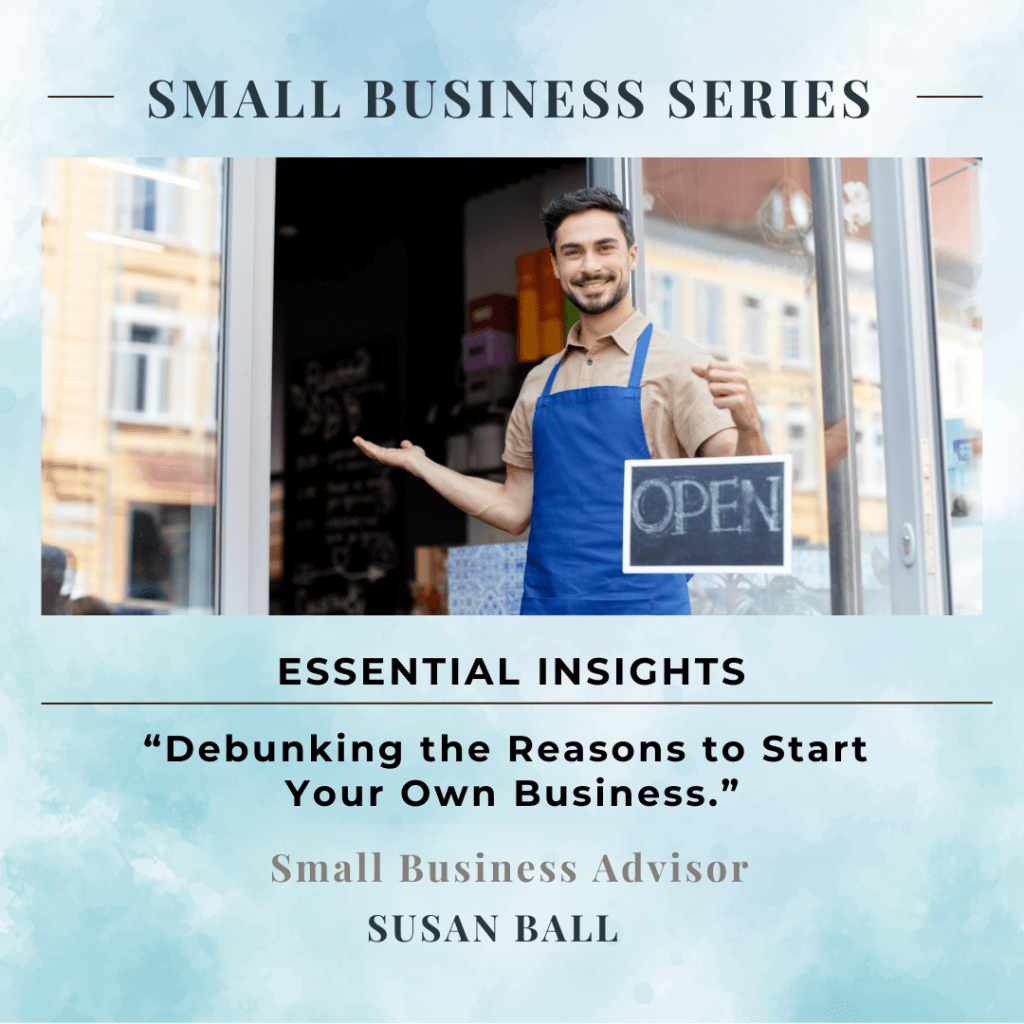
Essential Insights: Debunking Reasons to Start Your Own Business

When I speak with aspiring business owners about why they want to start a business, their motivations vary widely. While many aim to create a better life for their families or to achieve autonomy as their own boss, some reasons are less conventional. I once had a client who candidly told me, “I want to make enough money to divorce my husband,” highlighting personal motivations that might not align with traditional business goals.

While starting a business can be immensely rewarding, it’s crucial to recognize when motivations might not be grounded in sound business principles. Here are some common misconceptions about starting a business that potential business owners should consider:

1. “I want to get rich quick.” While success stories of wealthy business owners abound, the reality is that most business owners earn average incomes. Business profitability varies widely, and many new businesses struggle to survive. It’s essential to approach business ownership with realistic financial expectations and a solid business plan.

2. “I want to be my own boss.” Being a business owner means freedom from a traditional boss, but it also entails significant responsibilities. You not only have to manage your business operations but also ensure your employees are trained and productive, and that there is consistent revenue to sustain your workforce.  Customer satisfaction is an additional consideration which will ultimately land on your desk even if you have trained employees. Additionally, you must navigate and comply with a myriad of regulations from national, state, and local agencies, which can add another layer to your daily operations.

3. “I’m great at what I do.” Starting a business requires expertise in your industry, but success hinges on more than technical skills. Business owners must navigate various business functions—marketing, finance, operations—that extend beyond their original expertise. Delegating tasks and managing a team become critical to scaling a business effectively.

4. “I want more time with my family.” While starting a business can offer flexibility, achieving work-life balance is a complex endeavor. Launching and sustaining a business demands extensive time and energy. Business owners often find themselves deeply immersed in both day-to-day operations (“working in the business”) and strategic planning (“working on the business”). It’s essential to choose a business model that aligns with personal lifestyle goals.

5. “I have a groundbreaking idea.” Having a unique business idea is exciting, but its success depends on market demand. Conducting thorough market research—beyond personal validation—is crucial. Feedback from potential customers and industry experts can validate whether your idea has commercial viability.

If you’re considering starting a business, explore more insights in my Small Business Series. Additionally, seek guidance from your local Small Business Development Center or a business consultant to equip yourself with the knowledge needed to make informed decisions. These details and more are explained in detail in my other blog posts.

If this post stirs up questions for you regarding starting up a business, feel free to leave a comment below.

Small Business Success: Build Your BAIL Team

In the world of small business ownership, assembling the right team is crucial for success. Whether you’re launching a startup or expanding an existing venture, a core support team is indispensable. Enter your BAIL team – Banker, Accountant, Insurance Agent, and Lawyer.

These professionals form the cornerstone of your business’s foundation, offering essential guidance, resources, and connections to steer you toward success. Forming a relationship with a professional from each category before you start your business can also help you avoid costly mistakes.

Banker: Establishing a business checking account is pivotal from the outset, safeguarding your personal assets from business liabilities. Cultivating a rapport with a banker early on is key, positioning you favorably for future financial needs and potential loans. Their insights can prove invaluable in assessing financial health and preempting any looming threats.

Accountant: While some small business owners possess financial literacy, most benefit from the expertise of a dedicated accountant. From navigating tax complexities to optimizing financial structures, their role is pivotal in ensuring fiscal compliance and maximizing savings. Moreover, they can offer strategic advice on transitioning business entities for enhanced benefits. Remember, skimping on professional financial advice can lead to costly errors down the line.

Insurance Agent: Shielding your small business from unforeseen risks is imperative, and an adept insurance agent is your ally in this endeavor. Whether it’s safeguarding physical assets against disasters or mitigating liabilities arising from accidents, their counsel is indispensable in crafting comprehensive coverage plans tailored to your needs.

Lawyer: Legal intricacies are an inevitable part of small business ownership, underscoring the need for proficient legal guidance. Before embarking on your entrepreneurial journey, engaging an attorney to vet contractual agreements is prudent. Their expertise becomes instrumental in navigating complex contracts and resolving disputes as your business evolves. Remember, legal missteps can prove far costlier than retaining a skilled attorney from the outset.

In addition to your BAIL team, assembling a group of business professionals tailored to your specific needs is essential. From web designers to marketing experts, their collective expertise bolsters your small business’s online presence and outreach efforts. Moreover, outsourcing tasks like payroll management and administrative services can streamline operations and enhance efficiency.

Most business owners can benefit from creating a networking team.  This team will consist of non-competitive businesses serving a similar clientele to yours.  Those on your team will be business owners whose work you trust so that you are comfortable referring them to your customers; hopefully, they will return the favor and recommend you to their customers. Here are some examples of teams that might be useful for different types of businesses.

  1. If you are a wedding and events planner, you will want to form relationships with event venues, limo drivers, caterers, florists, bands, DJs, and photographers.
  2. General Contractors need the services of skilled laborers (HVAC, plumbers, electricians, painters, roofers, etc), real estate agents, home stagers, lawyers, and interior decorators.
  3. If you own a handyman service, you will want to form a referral network with carpet cleaners, power washers, landscapers, painters, and residential cleaning companies.
  4. Retail store owners want to form relationships with other store owners in their proximity. These partnerships can attract customers to your shopping area.  A florist might partner with a chocolate store and a tea shop to offer gift baskets for Mother’s Day; a restaurant might partner with a massage therapist and a carriage tour to create “date night” packages.

Irrespective of your small business niche, leveraging the expertise and networks of fellow small business owners is instrumental in fostering growth and long-term success. By cultivating strong relationships with your BAIL team and strategic collaborators, you’re prepared to navigate the world of small business ownership with confidence and resilience. Don’t forget to save this blog and create your own checklist using these four cornerstone professionals – they’re non-negotiable for your small business’s success.

Sole Proprietorship or Partnership? Navigating Schedule C vs. Form 1065 for Your Startup

The choice of legal structure is a pivotal decision when establishing a new business.  Many business owners opt for a limited liability company or a corporation.  This decision is primarily driven by two factors: (1) the legal structure that offers the most favorable income tax rates and (2) the potential involvement of investors who may seek an equity stake in the business.  These considerations are best discussed with an accountant or lawyer.

Most of our clients establish their businesses as limited liability companies (LLCs) due to the ease of filing the required paperwork.  If there is more than one owner, the LLC will be a partnership in the eyes of the IRS.  If there is only one owner, the IRS views the business as a sole proprietorship, and the owner can file a Schedule C for the business.

Often, clients want to include their spouse or significant other as an owner of their business. This makes sense if the other person is materially involved in the business. In many cases, however, it is a matter of loyalty to their spouse. They share all aspects of their lives and file a joint tax return, so it makes sense that they want their spouse to have ownership of the business.

As a business advisor, my role is to assist business owners in making well-informed decisions about their business, including ownership.  We often delve into the advantages and disadvantages of joint ownership with a spouse who may not be actively involved in the business operations.  This decision is typically influenced by the tax implications of the required tax return.

Schedule C is the appropriate tax return if the LLC has only one owner. It is a simple, two-page form that can be completed in a short period of time.  The business income is determined and is transferred to the 1040.   On the other hand, a partnership LLC must file IRS Form 1065 to document the revenues, expenses, and profits generated by the business.  In most states, ownership of an LLC by both members of a married couple is viewed as a partnership and requires filing the partnership tax return. Form 1065 spans 6 pages and requires details about potential foreign ownership, partners’ distributive share of income, a balance sheet, and more.  After completing Form 1065 and determining the business’s profits, the profits need to be divided between the partners, who are spouses in this case. Each partner must fill out a Schedule K-1 to record their portion of the profits. If the couple is filing a joint return, the profits are combined and entered on their Form 1040.

A quick check of prices charged by accountants to complete these tax forms yielded these average charges:

Schedule C  $192, at an average fee of $150 per hour

Form 1065   $733, at an average fee of $177 per hour Once I demonstrate the additional work and expense involved in making the uninvolved spouse an owner of the business, it becomes easy to decide to have a single owner.

For answers to other questions about starting a small business, please check back regularly for new blog posts and see by recent past blog posts. Also, please consider getting free business assistance from your local Small Business Development Center.

How an SBDC Consultant Can Help You

When my husband and I decided to purchase a pizza franchise, we had little knowledge about the Small Business Development Center (SBDC) program and its free assistance. When I later became an SBDC consultant, I realized how much we could have benefited from meeting with an SBDC advisor during the planning stage of our small business venture.

If you are contemplating launching a small business, consider seeking free and confidential consulting services from your local Small Business Development Center (SBDC). They can provide invaluable assistance and support tailored to your specific needs.

Business Ownership Considerations

An SBDC consultant can assist you in understanding the demands, risks, and rewards of owning your own business. It is crucial to consider how running your business will impact your family and lifestyle. For example, restaurant owners should be prepared to be present during the busiest periods, which typically occur in the evenings and on weekends. Similarly, accountants should expect to work long hours from January to mid-April. In addition to being directly involved in their businesses, business owners must also oversee employees, manage finances, handle inventory, create work schedules, promote their business, and handle numerous other responsibilities. The hours can be long and may infringe on personal and family time.

Realistic Business Loan Preparation

Just like many of our clients, Steve and I were unaware of the differences between a business loan and a personal loan. We prepared for it similarly to a personal loan but added a business plan. We should have realized that lenders needed more assurances beyond a good credit score and the ability to repay the loan. We had to convince the lender that (1) there was a demand for our products and services, (2) we knew our target clients and how to reach them, and (3) we could generate enough sales to comfortably make the loan payments. The SBDC consultant would have coached us on those 3 points and assisted us in creating 24 months of cash flow projections and validating our revenue projections.

Bank Selection

We chose a bank to apply for a loan because it was the bank used by our franchise corporation, one of the country’s largest national banks. However, we didn’t understand that each region operated independently. The bankers we spoke with knew nothing about our franchise and didn’t seem interested in a loan for a “small” business like ours. The whole process was frustrating, and in the end, the denial letter wasn’t even for our business. We should have applied to a local or regional bank. Even then, it would have been difficult to find a bank willing to lend to a start-up restaurant on our own. Today, after being a consultant for 17 years, I know how to direct clients to the banks most likely to assist them.

Research

Business planning includes defining your target customer and researching whether your local demographics include your target customer group. It also involves research into the industry you will enter. Is the industry growing? What are the trends? What are the primary products and services in your industry? You also need to know who your competitors are. Your local SBDC can provide industry reports and request local research from the national research center.

Business Plan Development and Cash Flow Forecast

Your SBDC consultant can assist you in developing your business plan, reviewing your draft, and providing feedback. Your plan will encompass an introduction to your company and ownership, a description of your products and services, an analysis of your competitors’ strengths and weaknesses, and details on how you will market your company to attract your target customers. Additionally, an SBDC consultant can help you prepare your 24-month cash flow forecast. The research they provide can aid you in writing your business plan and in estimating projected revenues.

When you decide to embark on the journey of starting your own business, it’s important to remember that you don’t have to navigate this path by yourself. Make sure to tap into the valuable resources your local small business development center provides to get the support and guidance you need.