How to Manage Your Budget During Inflation

Do you feel like your money is not stretching as far as it did a few years ago? When you come home from the grocery store, do you feel like you have fewer bags of groceries, but your bill is the same or higher? At this stage in our lives, my husband shops for our groceries. Last week, he came home without some items I had written on our list. A few products were out of stock since the supply chain continues to struggle, and other items were priced higher than we felt was reasonable to pay. For example, my favorite salad dressing had doubled in price to $6 a bottle, and the sirloin I needed for pepper steak was more than $12 a pound. So, we found the salad dressing at a lower price at a different store and chose a recipe that used cheaper meat.

Despite the good news of a recent slowdown in the inflation rate, grocery prices continue to rise faster than the paycheck of the average American. Last week, the Bureau of Labor Statistics reported the inflation rate for June was 3.0%, the lowest rate in more than two years. Unfortunately, this 3% price increase since June 2022 is on top of the 9.1% increase from the previous twelve months, so most consumers are paying 12% more for the same goods than they were two years ago, while salaries have risen only about 9.5%.

Woman reviewing her shopping list

Grocery prices have risen more than the average consumer product. In fact, over the past two years, groceries have increased nearly 20%, requiring a more significant chunk of your budget.   Here’s an example:

  • In 2021, if you were making an “average” income of $57,000, you were taking home an average monthly check of $3,700.
  • The ideal food budget is 12% of your monthly take-home pay or $444.
  • If your income has increased only by an average of 9.5% to $62,415 and your take-home pay is now $4,051, then to buy the same “basket” of groceries today that you did in 2021, you would pay $533 per month.
  • Groceries are now consuming $533/$4051 = 13.2% of your budget.
  • A 1.2% increase might not seem like a big deal, but it will require you to cut $49 from other areas of your budget. It would be best to be mindful when shopping for the best deals on your non-food purchases.

Rent and fuel have also increased significantly. Rent has increased an average of about 15% over the past two years, and gasoline prices where I live have increased by about 17%. These increases are reducing the purchasing power of most Americans. Consumers are adjusting their spending and shopping habits to combat the impact of inflation.

Here are some tips to help you manage your budget as inflation grows faster than wages.

  • Check grocery ads to determine what is on sale and where to get the best prices before you plan your meals. Plan meals around what is available and affordable.Go to multiple grocery stores to get the best deals on the food you want.
  • Stick to your lists, and don’t be distracted by great deals on items you won’t use before they expire. Avoid extreme loyalty to particular brands. Be willing to try other brands and generic items to get better prices.
  • Combine grocery store trips with other errands to minimize gas consumption.
  • Use credit cards wisely if you use them for grocery and gasoline purchases. Always pay your balance in full each month. Use a card that gives you cash back. Sign up for monthly or quarterly “extra” cash-back bonuses. Make a grocery list and stick to it to avoid overspending often associated with using credit cards.
  • Research before making a purchase.  Use the Internet and digital tools to help you find the best prices for items you need. Google Shopping, Price.com, and other online portals will compare prices on various items to help you find the best deals. For an evaluation of some of these tools, see https://www.moneycrashers.com/best-price-comparison-shopping-engine-sites/ or https://influencermarketinghub.com/best-price-comparison-sites/
  • Shop through portals that give you cash back for shopping. Sign into a shopping portal and purchase from the companies they have relationships with. Receive a portion of the sale as cash back. The percentages are typically less than 10%. This option is similar to a discount, except you must wait for the cash back. These sites can be beneficial as they also search out the best prices. They are most helpful if you are not loyal to a particular brand and if you will buy the best deal rather than the brand-name item.

It seems as if the rapid inflation of the past two years is behind us, at least for the time being. However, it will take years for wages and salaries to catch up. Take this time to review your budget and make adjustments based on your current spending for food and other necessities. You may need to reduce discretionary spending until your earnings match the new price levels.

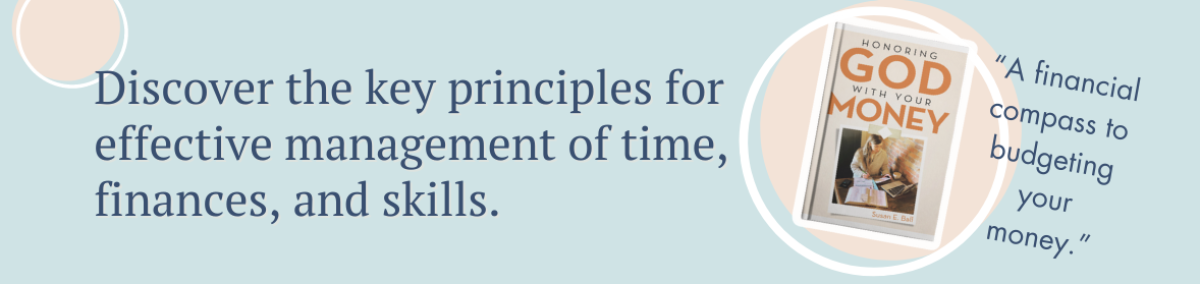
For other guidance on balancing your budget and managing your money, my book Honoring God with Your Money is an excellent resource. If you would like a free budget worksheet incorporating ideal spending guidelines, please email me at Susan.ball5@aol.com, and I will happily email them to you.


Trusting God for Your Finances

Are your resistant to the concept of tithing? Do you consider it a suggestion rather than a command from the Lord? Some people rationalize withholding their tithe because their bank accounts are empty at the end of the month. Others justify not tithing because they see it as God taking money away from them. Perhaps others plan to tithe when the company gives them a bonus or a raise, but those times arrive, and they still do not tithe.

Coins and the heading, The Truth about Tithing.

It is normal to be fearful when you have difficulty paying your bills and making ends meet, especially in this slower economy. Even if you typically can pay all your bills, you might worry you will not have enough extra cash to meet an unexpected expense for circumstances like extended sickness. Wishing for more money is not the solution. 

The solution is to put your trust in God and follow His command to tithe. It may sound counterintuitive that tithing can be the solution to financial difficulty. However, tithing, combined with sound financial management, is the solution.  

Tithing is an act of obedience. In Malachi 3:8, God chastised His people for failing to pay tithes. “Will a man rob God? Yet you have robbed Me! But you say, ‘In what way have we robbed You?’ In tithes and offerings.”  God expected the Israelites to bring in one-tenth of all their crops and livestock to support the priest. He still expects Christians to give one-tenth of their income to support the work of their local churches. The apostles and other early Christians demonstrated this by supporting the ministry of Paul and other teachers and apostles.

Tithing and giving when prompted by the Holy Spirit demonstrates trust in God. In the Sermon on the Mount, Jesus promised His followers that they did not need to worry about their needs because God would always be faithful to meet them (Matthew 6:25-35). In the Bible, God gives us many examples of people who gave sacrificially in obedience, and God met their needs. Two examples are Elijah and the widow in 1 Kings 17 and Elisha and the widow’s oil in 2 Kings 4.

God promises to bless those who are obedient in tithing. In Malachi 3:10, God promises to richly bless those who tithe. God challenges us to trust Him fully and allow Him to demonstrate that He will always give back to us more than we gave to Him.

“Bring all the tithes into the storehouse,

That there may be food in My house,

And try Me now in this,”

Says the Lord of hosts,

“If I will not open for you the windows of heaven

And pour out for you such blessing

That there will not be room enough to receive it.”

God does not want you to live in fear of being unable to care for your family and meet your basic needs. He has promised to care for those who place their trust in Him. He has also promised that you shall not be in need. One of the most famous passages of Scripture is Psalm 23:1, “The Lord is my shepherd, I shall not want.”

If the Lord is truly your shepherd, you are under His protection, and He will meet your needs. If He is not your shepherd, He desires to be. He loves you and wants to offer you the forgiveness of your sins, eternal life, and His care and provisions while you are on Earth.

In Psalm 34:8, David wrote, “Oh, taste and see that the Lord is good; blessed is the man that trusts in Him.” David was in the midst of a trial, yet he recognized that the Lord is always good. He trusted God in all circumstances, and God blessed David in very many ways. I challenge you to trust God with your finances and to demonstrate that trust by paying your tithes and giving as led by the Lord.

To learn how to accept God’s free gift of salvation, please click “Basics of Salvation” from the menu bar. If you want to learn more about managing your money in ways that honor God and reduce your stress, my book Honoring God with Your Money is a great resource.

Honoring God with Your Money

When you sit down to pay bills, does it create stress and anxiety for you? Do you feel guilty for not tithing, but you barely make ends meet? Is your first thought, if only I could make more money? If so, you are not alone. For most people, a lack of money does not cause their financial pressure. They do not budget their current salary or live within a budget, allowing their wants and desires to dictate their spending. However, when you see your earnings as a blessing from God, most of your stress turns into financial peace. The first step is recognizing that God has entrusted you with your income. Next is embracing the principles that He laid out in His word. If you consistently live outside of your means, you live in debt. God does not want us to live as debtors. 

Bible study on stewarding financial resources
Honoring God with Your Money

I read Dwight L. Moody’s book Pleasure and Profit in Bible Study several years ago. It inspired me to do a word search on what the Bible says about money which led to searches on riches, wealth, poverty, giving, charity, tithing, and greed. I realized that the Bible has much to say about money and finances and began to create teachings based on those guidelines so others could live in financial freedom.   

From these teachings, I created a Bible study, Honoring God with Your Money. Part One of this book is an in-depth study of what God’s word says to us on the subject of:

  • The role of money in our lives
  • Appropriate attitudes toward money
  • The foolishness of trusting in money
  • Tithing, offerings, and charitable donations
  • Business practices

Part Two applies the biblical teachings and budgeting principles and helps you create a budget for your family to achieve your financial goals. 

This Bible study is an excellent tool for young people about to graduate from high school or college, newly married couples, and anyone who struggles to manage their finances. Individuals, couples, or small groups can work through it. Also, I have developed teaching materials for instructors to use in small group settings. If you would like these materials, please email me at susan.ball5@aol.com, and I will happily email them to you. I do not charge for these materials. 
Recently, Deborah Morrison interviewed me for her YouTube channel, Greater is Jesus in Me. In the interview, we went through all the sections in the book and discussed the blessings of managing money according to godly principles. Deborah split the interview into two parts.

Part 1 of interview:  https://youtu.be/_3QFxywuzqo

Part 2 of interview:  https://youtu.be/euThkOk0Kr0

God intends for money to be a tool to help make your life easier. He does not intend for money to be a source of stress. As you go through this study, I pray that you will allow God to bless you with financial peace and empower you to use the financial resources that He entrusts to you to care for your family, help others, and honor God.

Save Money and Develop a New Mindset with a Financial Fast

If you’ve ever had surgery or bloodwork for your cholesterol levels, the test required you to fast for 8 hours or more. Many people also endeavor to fast for its health benefits to promote better digestion, weight loss, lowering cholesterol, and resetting appetite. Others may fast for spiritual reasons, like drawing closer to God for spiritual direction or increasing discipline.

Sack with bundles of cash falling out

However, eating is not the only item you can limit when fasting. I have “fasted” activities, such as crossword puzzles, computer games, and television, to gain more time to accomplish a goal or project. My time management fasts typically lasted until I achieved my goal or task.

A financial fast might be in order if you need to control your spending better. Whether you are just beginning to set up your budget or years into managing your money and want to reach a new goal, this plan might be the catalyst for your success. A total financial fast eliminates all unnecessary expenditures for a set period, whereas a partial fast eliminates specific spending categories. After you review your budget, decide which option works for you. During the period of the financial fast, you cut your spending. Fasting should increase your bank balance. However, you will likely experience other benefits.

Benefits of a Financial Fast:

One benefit is an increased awareness of how often you spend money on non-essentials. The ease of your purchases can hinder your realization of how much you spend. While shopping, a store offers multiple ways to pay for items. Pulling out a credit card or clicking the online “order button” distances the shopper from feeling their loss of money. Consider if you paid cash for every transaction. As the stack of bills shrinks in your hand, you connect the loss with the purchase. If you habitually charge $5 for breakfast and $10 for lunch every workday, you may not realize that those purchases add up to $330 each month (based on 22 workdays per month). The individual transactions are hardly worth noting when you examine your credit card bill, but the total makes a big dent in your bank balance. You will be surprised when you implement your fast. Those quick habits of taping your phone or swiping your credit card will lessen, and your bank account will grow.

A second benefit will be breaking bad habits and creating good ones. If you have been going through a drive-up for a coffee and breakfast sandwich, and now you skip that, you may begin to make coffee and breakfast at home. After a few weeks of this, making breakfast at home should be a regular habit, and going through the drive-up might become a once-in-while treat.

A third benefit is saving time. It takes time to get from your office to your car, drive to a restaurant, eat, and return to your office.   Packing a lunch takes much less time, and you can use that time savings to do something else, such as taking a walk, writing a letter, or engaging in a friendly conversation with a co-worker.

Finally, you are developing a new mindset of finding ways to enjoy life that do not require spending money. If you decide to fast spending money on recreation, you will work harder to seek free entertainment options. You will likely find many available to you and your family.

Action Plan for a Financial Fast:

  1. Decide on a goal for your financial fast. Possible goals might include:
    a. Paying off some debts
    b. Saving for a vacation
    c. Developing an appreciation of “free” activities and habits
    d. Demonstrating to your children that you have the self-control to delay a purchase until you have ended your spending fast.
  2. Set a time frame. Many financial experts recommend a 21-day fast, which is based on estimates that it takes 21 days to make or break a habit. Other experts recommend a period of intermittent financial fasting, such as fasting financially for one week out of every month. Your time period could be shorter or longer, depending on your goal and what spending category you will fast.
  3. Decide what you will fast. One option is to go on a strict fast, where you only pay bills and purchase groceries and medicine. Another option is a partial fast in which you forego spending for specific categories of items. For example, if buying shoes is a personal weakness, you might fast shoe purchases for an extended period. If you are saving to go on a cruise, you might give up dining out and recreational spending to have more money going toward your cruise budget.
  4. Plan for success. If you give up eating fast food for breakfast and lunch, ensure you have groceries to prepare those meals at home. Have motivational phrases and Scripture verses in your wallet, car, and computer to help you stay motivated. Celebrate your success without breaking your fast.
  5. Avoid temptations. If you are fasting clothing expenditures, avoid visiting your favorite apparel sites and stores. Throw away catalogs and delete marketing emails without reading them.

Recently, I participated in a 24-hour dietary fast at the request of a friend with a terminally-ill child. The purpose of the fast was to spend time in prayer for the child. I had no other motivation. Although I have been working to lose weight for a while, I did not fast with the expectation of losing weight. When the fast ended, however, I found that my appetite had been “reset.”  I have been able to eat less and feel satisfied, which has led to weight loss. A financial fast can provide the benefit of resetting your spending mindset, which will reap economic benefits for you long after you have ended your financial fast.

My Bible study, Honoring God with Your Money, is a great resource to help you understand how to manage your money better and achieve your financial goals. It is available on Amazon. If you would like to receive my quarterly newsletter with tips on managing your money, please complete this short form: Honoring God with Your Money (list-manage.com)

Feed the Hungry by Reducing Your Food Waste 

Can you relate to this phrase often told to a child 40 years ago at a dinner table? “You better clean your plate because there are starving children in Africa!” When I was young, my parents used to tell all 9 of us that phrase. It never made sense to me that cleaning my plate could impact whether other children were hungry. And, of course, if cleaning my plate results in me overeating, it will not benefit anyone and could harm me.  

Today, there are still hungry children. At least 1 in 6 children in the U. S. face food insecurity. Cleaning my plate still will not help those hungry children. On the other hand, if I reduce my food spending, I could donate money to one of the many organizations devoted to feeding the hungry.

Did you know the average American family throws away about $2,000 of food annually? In a society that feels the slowing down of the economy, it might feel like you have to pull back on your donations to non-profit organizations. However, if the average family could reduce waste and spend less, they could help feed hungry people. 

Consider challenging your family with these ideas for reducing waste and spending less on food expenditures: 

(1) eating smaller portions, 

(2) saving leftovers for second meals, 

(3) eliminating/reducing food waste by taking a bit more care in planning meals and using fresh food before the expiration date,

(4) allowing your children to participate in meal planning, shopping, and making to reduce the burden for you. 

These simple steps can help reduce food spending enough to make a difference in the lives of hungry Americans and others worldwide.

Here are some other motivational thoughts on helping you to reduce your spending on food and save to make donations:

For only $38 per month, you can sponsor a child through Feed the Children. Reducing your food waste by 23% would provide enough extra money to support a child. 

If you reduce your food waste by 30%, you will save $50 per month. A $50 donation to No Kid Hungry will provide up to 500 meals. 

A reduction of 15% would allow you to provide a gallon of milk for 15 families through Food for Others. For another 15% reduction, you could provide 20 families with a dozen eggs.

Volunteer at a local food bank when you turn in your donation. Your motivation increases when you see the impact it makes on the families in your community. 

Jesus encouraged us all to feed the hungry. “When the Son of Man comes in His glory, and all the holy angels with Him, then He will sit on the throne of His glory. All the nations will be gathered before Him, and He will separate them one from another, as a shepherd divides his sheep from the goats. And He will set the sheep on His right hand, but the goats on the left. Then the King will say to those on His right hand, ‘Come, you blessed of My Father, inherit the kingdom prepared for you from the foundation of the world: 35 for I was hungry and you gave Me food; I was thirsty and you gave Me drink; I was a stranger and you took Me in;  I was naked and you clothed Me; I was sick and you visited Me; I was in prison and you came to Me.'”  Matthew 25:31-36

If we all take steps to reduce our food wastes and expenditures, we can change make a meaningful difference in the lives of others and fulfill Jesus’s command to feed the hungry.

My book “Honoring God with Your Money” can provide you with many other ideas to reduce your expenses and manage your money. For other ideas on managing your money, please sign up for my quarterly newsletter: https://susaneball.us5.list-manage.com/subscribe?u=c4402ad22eed92a13b211a5ed&id=db5b79b8b5

Helping Your Child Establish Credit

When I graduated from high school, my parents gave me a sewing machine as my graduation gift.   The gift extended beyond the device, and my mother used this opportunity to help me establish credit and a good credit report. Sewing was a skill my mother taught me, and she knew that I enjoyed it. A few days after graduation, Mom and I went to the store and picked out a cabinet for the machine, which I would pay for myself. I completed a credit card application and put 20% down toward the cabinet purchase. A few days later, I received a Singer credit card in the mail. When the bill arrived, Mom had me write a check to pay the balance in full. So, at 18, I had a credit card with a record of promptly paying the debt in full.

My parents set a good example to use credit sparingly and to maintain an excellent credit record. In those days, gasoline companies and department stores issued most credit cards. They were used only in the store that issued the card. General-purpose credit cards, such as Visa and Discover, were rare in those days. I do not recall ever using the Singer credit card, but having it allowed me to apply for and receive a Sears credit card while in college. I used that card sparingly and promptly paid the balance in full upon receiving each bill. My mom invested in a gift that she knew would benefit my future.

When my sons began driving, I co-signed for a credit card for each of them. I wanted to ensure that they never got into a situation such as needing gas and not having any money. They had limits on how they could use the card. I could check the card online at any time, and my husband and I  expected them to pay their balances in full each month. If the bill was due and had not been paid, I transferred money from their savings account to pay the bill. We discussed their spending habits regularly. With a bit of guidance, they maintained excellent credit during college. When our first son to marry wanted to purchase a house, the mortgage lender was impressed that a twenty-two-year-old had a credit score in the high 700s.

A wonderful gift any parent can give their child is to help them establish good credit. Teaching the principles of financial integrity and maintaining good credit is critical to helping your children transition into adulthood.

Here are some guidelines to help parents get started on training their children to establish credit:

  1. Model responsible use of credit.
  2. Have family discussions on your budget regarding discretionary spending.
  3. Don’t assume your child has learned what they need to know about credit in school. Talk to your child about establishing and maintaining credit.
  4. Help your child to develop self-control. Early in their lives, teach them that you cannot afford to buy everything they want. Discuss with them the need to make choices and prioritize needs over wants.
  5. Demonstrate self-control by saving for larger, discretionary purchases. Share information with your child on how your savings are accumulating and how soon you will be able to make your purchase.
  6. Help your child develop a savings plan when they are young. Putting aside even a small amount each week or month can result in a tidy sum by the time they graduate high school. This money can be applied to college or their first car.
  7. Co-sign for a credit card for your child and discuss their spending habits each time the credit card bill comes. Discussions should be positive and affirm good decision-making. A good time to do this is when they start driving and going places without you.

Children do not instinctively know how to establish credit and maintain a good credit record. They must be taught, and it is your responsibility as their parent to instill good credit decision-making skills. Good credit will pay great dividends in your child’s future. “Train up a child in the way he should go, and when he is old, he will not depart from it.”  Proverbs 22:6

For more tips to help you manage your financial resources, please see my other blogs in the Finance tab. My book, Honoring God with Your Money, is full of guidelines to help you use money in a way that builds true wealth. Click here to sign up for my quarterly newsletter:  https://susaneball.us5.list-manage.com/subscribe?u=c4402ad22eed92a13b211a5ed&id=db5b79b8b5

Hope is Not a Plan

As a Christian, my hope is in the Lord, who holds my life in His hands. As a writer, I hope people buy my books and read my blogs. As the owner of short-term rental property, I hope that vacationers decide to stay at my home. But, as a small business consultant, I share with my clients the mantra, “Hope is not a plan.”

Hope is essential to taking risks and moving forward with new opportunities in your life. However, hope does not bring me readers or renters. I must take action to inform potential readers of my books and blogs and potential renters of my property. Those actions involve effort, such as marketing, advertising, and asking for reviews.

If you are trying to achieve a financial goal, hope will not help you to accomplish your goal. You need to have a plan:

  • If you want to purchase a new home or car, you need a plan to accumulate the down payment.
  • If you want to get out of debt, you need a plan to start paying off one debt while meeting the minimum obligations on your other debts.
  • If you would like to retire early, you need to start putting money into a retirement account at an early age and be consistent in making contributions.
  • If you want to improve your credit score, you need to obtain your credit report and assess what debts need to be paid off, what errors need to be corrected, and what steps you can take to reduce your total amount of debt.
  • If you want to start your own business, you must maintain a high credit score and set aside money to invest in your business.
  • If you want to start budgeting, you need to research and evaluate budgeting tools to determine which one you will actually use.

Key Factors of a Plan to Accomplish a Financial Goal:

  1. Live below your means. If you want to save money for any reason, or if you’re going to pay down debt, you must spend less than you make. This requires you to know what you spend and evaluate where to make cuts.
  2. Write down your goals. Studies show that writing down your goals significantly increases your chances of achieving them.
  3. Have an accountability partner. If you are married, you and your spouse should hold each other mutually accountable. If you are unmarried, ask a friend to be your accountability partner. Hold each other accountable by encouraging each other and reminding yourselves that money spent cannot be used to meet your goal.
  4. Celebrate milestones. Give yourself a pat on the back when you hit an intermediate milestone, such as paying off a debt or saving a certain amount of money. Milestone celebrations should be free or low-cost to keep you on track to achieve your goal.
  5. Make it easy to save. Set up payroll deductions for retirement or other savings so you never have access to the money. Download a budgeting tool that makes it easy for you to track your spending. Avoid “window shopping,” which increases your desire for items you do not really need.
  6. Keep your goal in front of you. Have a picture of your dream home or car on your refrigerator. Write your business plan and look around for possible locations. Develop a bucket list of all the fun things you will do in retirement.
  7. Evaluate your progress periodically, and if you have gotten off track, take action to correct your mistakes and get back on the right track.

Your plan does not have to be complicated to be effective. Start dreaming, set a goal, and develop a plan to reach that goal.

Setting and achieving financial goals helps you honor God in how you use and manage the financial resources He has entrusted to you. It also allows you to build treasure in Heaven. For more tips to help you manage your financial resources, please see my other blogs in the Finance tab. My book, Honoring God with Your Money, is full of guidelines to help you use money in a way that builds true wealth.

If you have never accepted Christ as your Savior, please consider accepting the free gift of salvation from your sins and eternal life in Heaven. It will pay dividends for all of eternity.

Minimizing the Costs of Credit Card Balances

Americans have a love affair with credit cards. They make life easier while also making it easier to overspend. Studies reveal that a purchaser will spend an average of 20% more on an item when using a credit card than when paying with cash.

Person using a laptop computer and holding a credit card.  Title is "Minimizing the Costs of Credit Card Balances."

Credit card usage peaked in the fourth quarter of 2008, as the nation entered a severe recession, with balances reaching a then-high of $866 billion. Credit card balances fell significantly over the next 5 years. As the economy recovered, however, the use of credit cards and credit card balances began to rise. Today, credit card balances are approaching the $1 trillion level. The average consumer carries a credit card balance of $7,279 (Lendingtree.com). Fifty-three percent of credit cards being actively used are not paid off in full each month. The average interest rate of these balances is 20.92%, and the average interest rate being offered to new borrowers is 23.65%. 

The good news is that most Americans make regular credit card payments, and only 2.25% of credit card balances are delinquent by 30 days or more.

The minimum credit card payment is typically about 2% of the balance. On the average balance of $7,279, the minimum payment would be $86. At that payment and an interest rate of 20.92%, it would take a borrower 28 years and 3 months to pay off the debt. The total interest paid would be $27,776. In this scenario, the $7,279 in debt would cost the borrower $35,055.

When a consumer (that’s you) begins to take an active role in their financial future, they can minimize the interest on credit card balances. Remember, interest is handing part of your hard-earned paycheck to someone loaning you money. If you are not paying off your credit card each month, you need to determine why you carry a balance. 

The steps below can help you make advances on getting a handle on your credit card debt: 

  1. Always pay at least the minimum balance on time.
  2. Set up automatic payments to ensure that payments are always made on time.
  3. Pay more than the minimum balance whenever possible.
  4. Consider the actual cost of debt before making large purchases on credit cards.
  5. If your balances are on multiple credit cards, prioritize paying off the card with the highest interest rate first.
  6. Live below your means so that you will have some money each month to put toward your credit card balances.
  7. Create a budget to live within your means. (Refer to my past posts on budgeting) 

To learn more about how to manage your money and pay off debt, please click the Finances categories tab to find many blogs on money management, budgeting, and stewardship. My book Honoring God with Your Money is a great tool for financial money management.

If you would like to receive my quarterly newsletter on managing your money, please complete the short form: newsletter signup.

9 Tips for Sticking to Your Budget

A few weeks ago, I shared tips on developing a personalized budget that works for you and your family. You can find that blog by clicking the following link. https://susaneball.blog/2023/03/30/how-to-create-a-personalized-budget-one-size-does-not-fit-all/

A reader wanted me to share some ideas on how to keep on track and stick with a budget. Often we desire to manage our finances and enthusiastically start the steps to wrangle in our spending but quickly lose the motivation and discipline. So, this post focuses on motivating yourself to follow the budget you developed to manage your finances better and achieve your goals.

What is Your Goal?

You should take the time to determine your goal(s). Simply saying that you want to save money is typically not incentive enough to save money. It is nebulous, and you will find that you can justify overspending when you have not determined a marker of how much to save and a date to accomplish this goal.   Setting specific financial objectives and developing a budget will take you one step closer to achieving success. Your plan will motivate you because every good spending decision brings you one step closer to your dream. Your goal should be unique to your life, and you might have multiple ones that you are working on simultaneously. If you have not thought about your financial plan(s), below is a list of some common ones:

  1. Pay off debt(s). 
  2. Reduce stress.
  3. Improve your credit.
  4. Save for a memorable vacation.
  5. Save a down payment for a house.
  6. Save for a new(er) car.
  7. Retire early.
  8. Invest in your retirement fund.
  9. Save for your children’s college expenses.
  10. Start your own business.

Keep Your Goal in Front of You

When my husband and I decided to buy a pizza franchise business, we knew we had to save money to invest in our company. We cut back on discretionary expenses, such as dining out. When we were tempted to go out to eat, we reminded each other that the money we saved by eating at home helped us to achieve our dream. To maintain our excitement about our future business venture, we worked on our business plan and discussed our business goals daily. We also sold possessions not needed in our new life so we could add to our investment fund. Sticking to our minimized budget and saving money was easy because we were excited about our new venture.

Celebrate Goal Milestones

Try to set intermediate goals and celebrate reaching them. It takes a long time to achieve many financial goals, such as paying off a large credit card debt or accumulating a down payment to purchase a home. The average home price is about $350,000, and the lender typically requires 6% as a down payment from the buyer. That means you will need to save $21,000 for the down payment. If you save $1,000 per month, it will take you nearly two years to put aside the down payment. To keep yourself from getting frustrated, set mid-goal milestones, such as saving multiples of $3,000, and celebrate hitting those marks. Your celebration needs to be modest and within your budget, such as having a reasonably-price dinner at a restaurant or purchasing an accessory for your future home. Also, you might make a chart to record your progress if you are visually motivated.

Focus Your Spending Attention on Discretionary Spending

Your mortgage or rent payment, car payment, and insurance premiums are set amounts each month. In the short run, you cannot change them. Of course, they are a significant portion of your budget and must be considered. However, it would be best to focus on areas of your budget where you have more flexibility. Consider saving money on utilities, telephone and internet services, food, clothes, recreation, and other miscellaneous spending.

Use a Bill Paying System to Make Bill Paying Easy

I have scheduled each regularly occurring, fixed payment bill to be paid using our bank’s bill-paying service. This system is great for paying the mortgage, HOA fee, car payment, and insurance premiums. Utility bills and other expenses that vary from month to month are delivered directly to the bank, making it fast and easy to pay them.

Set Regularly Times Each Week to Pay Bills

Setting a regular time to pay bills and balance your checkbook will reduce your financial stress. You can put bills out of your mind until it is time to deal with them. I balance my checkbook each Sunday morning before we go to church. Our church service starts later than a typical workday, and our Sunday morning routine is less hectic than our Saturday mornings. After breakfast, I pour a second cup of coffee and settle at the computer. It only takes a few minutes since there are only one week’s bills to pay and cleared checks to reconcile. 

Set Up Automatic Transfers to Savings

Once you have established your budget, you need one additional category added to your automatic transfers. This new category should be your savings. Once you determine that amount, set up an automatic transfer on the first of each month or the first payday. This is one less decision you must consider, and you are unlikely to be tempted to pull the money out of savings once it is there.

Make It a Family Effort

If you are married, it is important that you and your spouse work together to set your goals and achieve them.  If you have children, share your goal with them and build excitement.  This is a great learning opportunity for them, and will help them to understand why you are saying “No” to certain items they want you to purchase.  Set aside a time once a week or twice a month to assess where you are and hold yourselves accountable to one another.   As intermediate goals are met, have a family vote to decide on the reward, or take turns choosing the reward.

Recruit an Accountability Partner

If you are not married, you will want to recruit someone that you can review your spending with once or twice a month and who will encourage you to stick with your plan. Be careful not to sabotage your budget by asking your shopping buddy to be your accountability partner.  Perhaps you have a mentor at your work or church, or a parent, who has consistently demonstrated financial responsibility who would be willing to assist you.  Having an accountability partner greatly increases your chances of being successful in reaching your goal.

In summary, set goals, reward yourself for reaching your intermediate and long-term goals, and set up systems to make it easy to pay bills and live within your budget. The easier it is to monitor your spending, the more successful you will be in sticking with your budget.

To learn more about how to manage your money, please click the Finances categories tab to find many blogs on money management, budgeting, and stewardship. My book Honoring God with Your Money is a great tool for financial money management.

How to Create a Personalized Budget – “One-Size Does Not Fit All”

Do you find that you run low or out of money before the next paycheck arrives? Is your credit card full of charges that never fully get paid off, and you wish for a month with no unexpected expenses so that you can have a chance to get caught up? If you are not budgeting and planning your income, this is probably a familiar situation for you.

Budgeting Pie Chart

Many people try to create a budget a few times a year and some even stick to it, while many others find it difficult. Maybe you have even tried and found that you could not make it work. That’s because “ideal” budget percentages are based on the “average” person or family, and you are not “average.” You are a unique person, or family, with your own needs and priorities. You need to create a budget that works for you. Before we look at some tips to help you create a budget you can live with, let’s look at an ideal budget for an average household.

The median household income across America is currently $69,000. It consists of 2. 6 people—typically two adults and one child. The table below shows the “ideal” percentages that should be spent for each of the major spending categories, along with the annual and monthly amounts for each category.

Spending CategoriesPercentagesAnnual
Amount
Monthly
Amount
Housing (rent or mortgage, utilities, internet, homeowners/renters insurance, phone, cable)36%$24,840$2,070
Food (groceries and eating out)12%$8,280$690
Automobiles (car pymt, gas, insurance, maintenance and repairs12%$8,280$690
Medical (insurance and bills)5%$3,450$287.50
Clothing5%$3,450$287.50
Entertainment5%$3,450$287.50
Life Insurance5%$3,450$287.50
Savings5%$3,450$287.50
Debt Reduction5%$3,450$287.50
Miscellaneous10%$6,900$575

At first glance these numbers might look doable, and depending on where you live, maybe these are very realistic numbers.  However, where I live, it is hard to keep monthly housing costs to $2,070.  The average monthly rent for a one-bedroom apartment is $1,750.  That leaves $320 for utilities, internet, insurance, phone, and cable.  A careful consumer might be able to manage that.  However, an average family needs more than one bedroom, making it harder to stay within the budget for housing.  Automobile expenses are also challenging.  Currently, the average new car payment is $719, and the average payment for a used car is $527.  When you add in fuel, insurance, and repairs and maintenance, you will almost certainly exceed the $690 budgeted amount.

In order to create a budget that works for your household and one that you can stick with, you will have to make some difficult choices. 

Use these guidelines to help you make the decisions which are best for you and your family.

  1. Determine your needs based on the number of people in your family and your career.
    a. The more people in your family, the larger the home and vehicle you need.
    b. Each person requires food, clothing, and health care, so larger families need to allocate more money to those items.
    c. If your job requires professional or business attire, you will need to allocate more money for clothing.
    d. If you are required to drive your car for work, you will need a newer, reliable vehicle.
    e. Does your household require more than one vehicle for multiple drivers?
    f. Do you need to allocate money for childcare while you are working?
  2. Determine your priorities.
    a. Do you want each child to have their own bedroom, or can children share bedrooms?
    b. Do you want to have a short commute to work?
    c. Do you want to live in a specific community? Or a community with specific amenities?
    d. Is it important to you to have a new car every few years?
    e. Do you want your children to attend a specific school? Do you want them in a private school which will require you to pay tuition?
  3. Consider the alternatives.
    a. You may be able to afford a larger home if you are willing to commute farther to work.
    b. You may be able to live closer to work or in your preferred community, if you are willing to forgo a desired bedroom or other amenity, such as a den, garage, or extra bathroom.
    c. You may have access to safe, reliable public transportation, allowing you to forgo vehicle ownership.
    d. You may be able to continue to drive an older car by engaging in ride sharing to work and renting a car for longer trips.
    e. You can save money on food by packing lunches and cooking most meals at home.
    f. You can save money on recreation by taking advantage of free sources of entertainment and recreation.
    g. If you are single or a single parent, you could save money on housing by sharing a home or renting out a spare bedroom to a tenant.
    h. You may be able to telework full-time, or several days a week, which will reduce fuel expenses and perhaps childcare expenses.
  4. Use the “ideal” budget percentages to create a base budget. Use these budget numbers to help you see the areas in which you are overspending and underspending. Then, adjust your budget based on your current expenses and your needs.
  5. Refine your budget based on your priorities.
  6. If your expenses exceed your income, you must make additional adjustments. Consider the alternatives and make decisions based on which alternatives will best meet your needs and come closest to meeting your priorities

Creating a budget is not an easy task, but it is an important one.   It will allow you to meet the needs of your family and relieve much of the stress you are currently facing.

To learn more about how to honor God with your money and build treasure in Heaven, please click the Finances categories tab to find many blogs on money management, budgeting, and stewardship. My book Honoring God with Your Money is a great tool for financial money management.