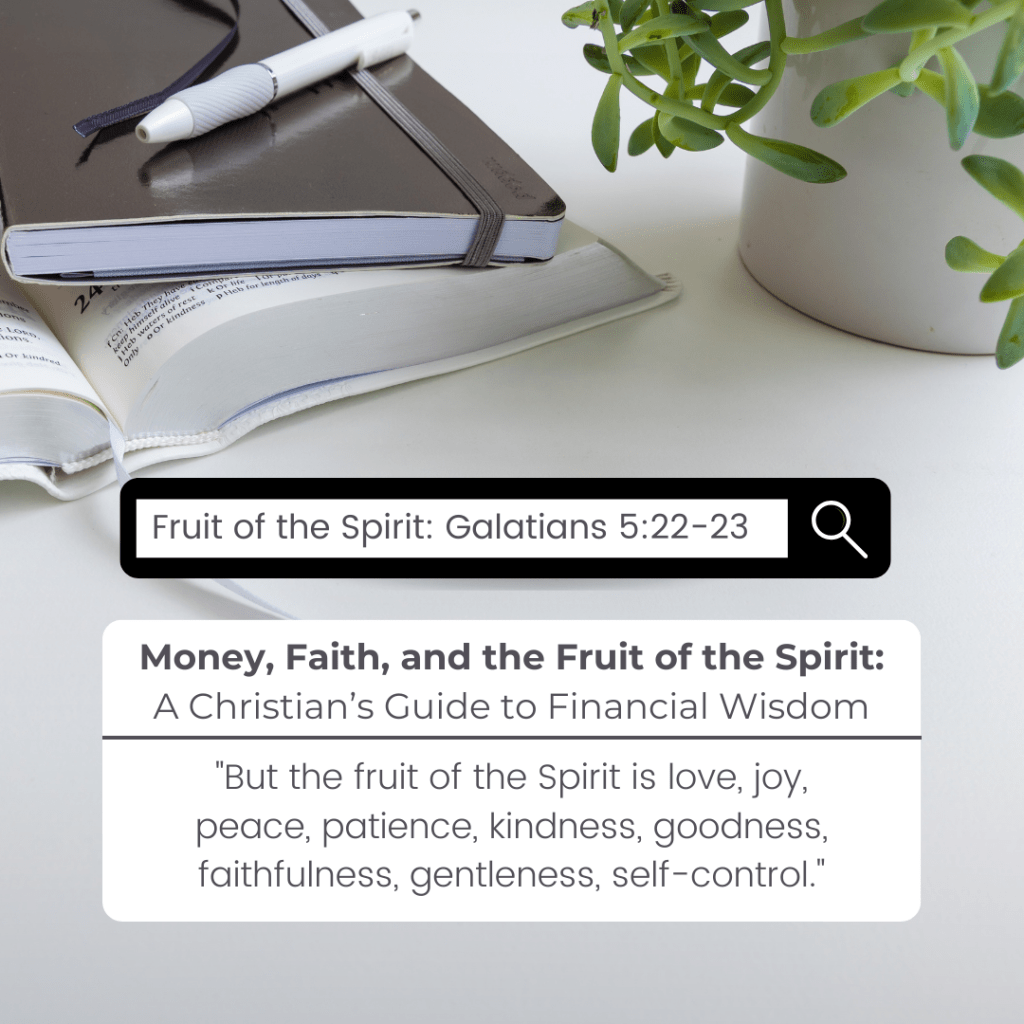
“But the fruit of the Spirit is love, joy, peace, patience, kindness, goodness, faithfulness, gentleness, self-control.” Galatians 5:22-23
As Christians, we’re called to grow closer to Jesus, allowing His life and teachings to shape every part of our lives—including how we handle money. The way we manage our finances can reflect Christ and influence those around us, especially in a world where many are struggling with financial stress.
Money is simply a tool—it helps us navigate life and conduct business—but it should never be the focus of our lives. Your worth is not determined by how much you have in the bank; it’s rooted in the truth that you were created by God, who loves you deeply. The way we handle money, however, should reflect God’s heart, shining His light in a world full of need.
In this blog, we’ll explore how the Fruit of the Spirit can guide us in our approach to money. Think of this post as an overview—a beginner’s guide or refresher on how these biblical qualities intersect with our financial lives. Over the coming weeks, I’ll dive deeper into each characteristic, offering more insights and practical tips for applying these principles in your finances. This series can serve as a personal study, a group discussion for Sunday school, or a home group study to help you grow in both your financial stewardship and your walk with Christ.
Love
When you accept Christ, God’s love fills your heart. In fact, He calls us to love Him with all that we are: “You shall love the Lord your God with all your heart, with all your soul, and with all your strength.” (Deuteronomy 6:5)
Desiring money isn’t sinful, but loving it can be. When we place too much emphasis on acquiring wealth, we risk letting it take God’s rightful place in our hearts. Jesus makes this clear in Matthew 6:24: “No one can serve two masters. Either you will hate the one and love the other, or you will be devoted to the one and despise the other. You cannot serve both God and money.”
When we love money more than God, it can lead to destructive behaviors like theft, fraud, or worse. As 1 Timothy 6:10 warns: “For the love of money is the root of all kinds of evil.”
How Love Shapes Our Financial Choices
Joy
We all want joy, but it’s different from happiness. Happiness is based on circumstances—it’s temporary, like the joy you feel when you receive good news. Joy, on the other hand, is deeper and more lasting. It comes from knowing our sins are forgiven and that we are part of God’s eternal family.
Romans 15:13 tells us, “May the God of hope fill you with all joy and peace as you trust in Him.” This kind of joy isn’t dependent on money or possessions.
While an unexpected windfall may bring a moment of happiness, it can’t provide the lasting joy that only comes from Christ. As Jesus reminds us in Luke 6:23–24, “Rejoice in that day and leap for joy, because great is your reward in heaven. For that is how their ancestors treated the prophets. But woe to you who are rich, for you have already received your comfort.”
Joy: Embracing Contentment Through Generosity
Peace
True peace comes from knowing we are secure in Christ. As Jesus said, “In this world, you will have trouble. But take heart! I have overcome the world” (John 16:33). No amount of money can provide that kind of peace.
Even the wealthiest people often feel insecure. Studies show that even multi-millionaires regularly feel that they need even more money to feel “secure.” King Solomon understood this when he wrote in Ecclesiastes 5:10: “Whoever loves money never has enough.”
True peace comes from trusting in God, not in wealth.
Peace: Letting Go of Financial Anxiety
Patience
Patience helps us avoid rushing into poor financial decisions. It allows wealth to grow over time and teaches us to wait before making big purchases until we can afford them. Without patience, we might impulsively invest in get-rich-quick schemes or fall into debt by buying things we can’t afford.
Proverbs 13:11 teaches, “Dishonest money dwindles away, but whoever gathers money little by little makes it grow.” And Proverbs 22:7 reminds us, “The rich rules over the poor, and the borrower is a servant to the lender.” Patience and self-control in money management are key.
Patience Transforms Our Financial Journey
Kindness
Kindness means treating others as family—especially those in need. As God’s people, we’re called to show kindness by helping those less fortunate, both with our resources and our time. True kindness eases others’ burdens and points them to Christ.
Job 6:14 says, “Anyone who withholds kindness from a friend forsakes the fear of the Almighty.” Jesus also taught that when we serve the least among us, we are serving Him (Matthew 25:31-46).
Isaiah 58:6-7 explains that true fasting is about meeting the needs of the poor and oppressed. “Is it not to share your bread with the hungry, and to bring the poor who are cast out into your house?”
Goodness
Goodness is about using what we have to fulfill God’s purpose, especially in helping others. James 4:17 tells us, “Anyone who knows the good he ought to do and doesn’t do it, sins.” When we fail to care for others, especially the poor, we miss an opportunity to show God’s love.
1 John 3:17-18 challenges us: “If anyone has material possessions and sees a brother or sister in need but has no pity on them, how can the love of God be in that person? Dear children, let us not love with words or speech but with actions and in truth.”
Proverbs 21:13 warns that if we ignore the cries of the poor, God may not answer us in our own time of need. “Whoever shuts their ears to the cry of the poor will also cry out and not be answered.”
How Practicing Goodness Can Transform Your Finances
Faithfulness
God is faithful to provide for us, and we are called to be faithful with what He has entrusted to us. This includes being faithful to give—whether through tithing or supporting others in need. Malachi 3:8-10 reminds us that failing to tithe is like robbing God, and that He will bless those who are faithful in their giving.
Jesus also promises rewards for those who use their resources wisely. In Luke 19:17, the faithful servant is told, “Well done, good servant; because you have been faithful in a very little, you shall have authority over ten cities.”
Gentleness
Gentleness compels us to help others without making them feel ashamed. It’s easy to judge those in financial trouble, but the Bible calls us to restore them gently. Galatians 6:1 reminds us, “If someone is caught in a sin, you who live by the Spirit should restore that person gently.”
As we help others, we must remember that our fortunes can change. Today, we may be the ones in a position to give, but tomorrow, we might need help ourselves (Proverbs 23:5). We should offer assistance discreetly and with humility, following the Golden Rule: “Do to others as you would have them do to you” (Luke 6:31).
Financial Help with a Gentle Heart
Self-Control
Self-control is essential for avoiding impulse spending and debt. It also applies to giving. While it’s important to be generous, we must be careful not to give beyond what we can afford, trusting that God will meet our needs (Philippians 4:19).
Jesus warned against giving to be seen by others. “When you give to the needy, do not let your left hand know what your right hand is doing” (Matthew 6:3). Self-control in giving, just like in spending, helps us maintain balance.
Proverbs 21:17 reminds us that “He who loves pleasure will become poor; whoever loves wine and oil will never be rich.” We must practice self-control in all areas of life to manage our resources well.
A Personal Bible Study on Money and the Fruit of the Spirit
As you reflect on the principles of money and the Fruit of the Spirit, I encourage you to take a moment to think about how each characteristic applies to your own financial life. The Fruit of the Spirit isn’t just a list of qualities to admire—it’s a call to live out the very nature of Christ in every area of life, including how we handle our finances.
Would you like to make this a personal study?
Consider printing out this blog and keeping it in your Bible as a reminder. You can use it for daily reflection or as a study guide with family or friends. Allow the Holy Spirit to reveal areas in your financial life where you can grow in love, joy, peace, patience, kindness, goodness, faithfulness, gentleness, and self-control. Ask God to give you wisdom as you apply these principles, and trust that as you do, He will bless your efforts and help you reflect His character in all you do.










 Susan's Reflections
You must be logged in to post a comment.