Remote Work Trends You Should Know

The way we work has changed dramatically in recent years. Remote work, once limited to a few industries, became mainstream during the COVID-19 pandemic. What started as a necessity has now evolved into an expectation for many employees. Flexibility in work location is often used as a bargaining chip to attract and retain talent, and new workplace trends have emerged as a result.

In this blog, we’ll look at three of the most talked-about trends—coffee badging, workcations, and digital nomadism—and what they mean for small business owners and managers.

Coffee Badging

Coffee badging is when employees make a brief appearance in the office—long enough to swipe their badge, grab a coffee, and connect with colleagues—before heading home to work remotely. While not every employee literally swipes in, the term has stuck to describe this trend.

In fact, I sometimes coffee badge myself on days I work remotely. I’ll come in for a staff meeting, chat for a few minutes afterward, and then return home where I can be more productive without office distractions.

The positives of coffee badging:

  • Creates opportunities for employees to connect in person, which can spark collaboration and problem-solving.
  • Breaks the isolation of remote work.
  • Helps employees maintain visibility and presence in the workplace without being tied to the office full-time.
  • Supports work-life balance while keeping connections intact.

The drawbacks of coffee badging:

  • Brief interactions may not be enough to build strong teams.
  • Employees who live far from the office may be excluded.
  • Some workers show up only to be seen, without contributing.

How leaders can make coffee badging effective:

  • Focus in-office meetings on activities that benefit from face-to-face interaction.
  • Use these times to recognize and encourage employees.
  • Ensure fully remote employees aren’t left out of opportunities or recognition.
  • Create a welcoming environment with coffee, snacks, and comfortable spaces.

Workcations

A “workcation” happens when employees travel to a vacation spot but continue working while they’re away. The appeal is obvious—new scenery, a chance to unwind after work hours, and often a boost in creativity. But without boundaries, workcations can blur the line between work and rest.

Tips to make workcations effective:

  • Employees should communicate clearly with their manager about work hours, especially if in a different time zone.
  • Reliable internet is a must—check this before booking.
  • Take at least a few true vacation days during the trip to fully recharge.
  • Plan around mandatory meetings and let travel companions know your schedule.

Digital Nomadism

Digital nomadism goes a step further: it’s not just a week away, but a lifestyle of traveling and working from anywhere. Enabled by the internet, this trend has grown significantly in the last 15 years. Today, many digital nomads are not just freelancers but full-time employees negotiating this flexibility with their companies.

Benefits:

  • Flexibility to live and work anywhere.
  • Exposure to new cultures and lifestyles.
  • Potential for improved work-life balance.

Challenges:

  • Navigating work permits and visa requirements.
  • Understanding tax and employment laws.
  • Coordinating across time zones with colleagues.
  • Protecting sensitive company data abroad.

Final Thoughts

Remote work has created both opportunities and challenges. Coffee badging, workcations, and digital nomadism are trends that reflect employees’ desire for flexibility and balance. As a small business owner, you don’t need to embrace every trend, but it is wise to understand them.

Take time to evaluate which positions in your company can be done effectively outside the office. Develop clear guidelines for remote work, and balance flexibility with accountability. Done right, offering remote options can help you attract and retain top talent who might not otherwise consider your business.

Spotting Fake Productivity: A Guide for Small Business Leaders

Do you have employees who work through lunch, stay late, and still can’t seem to finish their tasks? They may be “clock botching.”

Or perhaps you’ve noticed employees doing the bare minimum to get by—often referred to as “quiet quitting.” Others may appear busy but aren’t producing meaningful results, a behavior called “task masking.” In the most severe cases, employees may be “ghostworking”—pretending to work while putting their time toward other activities.

While these behaviors aren’t new, the terms that describe them have gained attention in recent years. As I researched these patterns, I was surprised by just how many ways employees can appear busy while avoiding meaningful productivity.

For business owners and managers, recognizing these behaviors is critical. They don’t just reduce productivity—they often point to deeper problems in the workplace. Low morale, burnout, poor time management, or unclear expectations can all contribute. Identifying and addressing these behaviors is the first step toward creating a healthier, more effective work environment.

Clock Botching

Clock botching happens when an employee is on the clock but not truly engaged in their work. They may look dedicated—staying late or attending every meeting—but their output tells a different story.

Signs of clock botching include:

  • Working long hours with little to show for it
  • Stretching simple tasks over an entire day
  • Lack of engagement during meetings

This behavior is often unintentional. Employees may struggle with time management, feel burned out, or lack a sense of purpose in their work. As a manager, your role is to recognize the pattern and help them re-engage.

That may mean:

  • Having honest conversations about what’s behind the decline in productivity
  • Offering paid time off if burnout is an issue
  • Providing training or tools to improve time management
  • Setting aside time to prioritize and break down tasks together

Small changes—like using time management apps or weekly check-ins—can help employees regain focus and deliver stronger results.

Quiet Quitting

Unlike clock botching, quiet quitting is intentional. Employees complete only what is required of them—no more, no less. They may disengage from office activities, social events, or collaborative opportunities.

Common causes include:

  • Burnout
  • Dissatisfaction with pay or lack of career growth
  • Poor management or unclear expectations
  • Desire for better work-life balance

If you notice quiet quitting, start with self-reflection. Ask yourself:

  • Am I offering clear opportunities for growth?
  • Are employees fairly compensated?
  • Do I respect their personal time and boundaries?

If improvements are needed, acknowledge this and commit to change. If, however, your workplace provides fair pay, opportunities, and balance, and the employee still disengages, it may be time for them to move on.

Task Masking

Task masking is when employees look busy but produce little value. This can include shuffling papers, carrying laptops around, sitting silently in video meetings, or endlessly scrolling through emails.

Often, task masking thrives in organizations that reward “looking busy” rather than achieving outcomes. Pressure to appear productive—sometimes intensified by fears of being replaced by AI or being forced back into the office—can push employees toward this behavior.

To combat task masking, leaders should:

  • Set clear, meaningful goals tied to the company’s mission
  • Reward results, not just hours worked
  • Support flexible or hybrid schedules where possible
  • Build trust and enthusiasm through purposeful work

When employees know their contributions matter, they’re more likely to stay engaged and productive.

Ghostworking

Ghostworking takes task masking a step further. Employees not only appear busy but actively fake productivity—sometimes while job hunting, updating resumes, or browsing online.

Examples include:

  • Keeping a report open on-screen while doing personal tasks
  • Scheduling fake meetings to avoid accountability
  • Pretending to make calls while engaging in personal conversations

Research suggests 58% of U.S. workers admit to ghostworking regularly.

Ghostworking often arises when employees feel undervalued, insecure about job stability, or unhappy but unwilling to quit until they find another role.

Leaders can reduce ghostworking by:

  • Recognizing and rewarding real accomplishments
  • Building stronger engagement and connection with employees
  • Reducing workplace distractions
  • Ensuring fair compensation

When employees feel valued and connected, they’re less likely to disengage or fake their efforts.

Final Thoughts

Behaviors like clock botching, quiet quitting, task masking, and ghostworking may look like productivity issues on the surface—but often they point to deeper challenges in the workplace. Low morale, lack of recognition, poor management practices, and burnout are frequently at the root.

As a business owner or manager, your role isn’t just to spot these behaviors, but to ask why they are happening and address the cause. Clear goals, fair compensation, meaningful recognition, and a supportive environment go a long way in preventing these productivity killers. When you create a workplace where employees feel valued, motivated, and connected to your mission, true productivity—not just the appearance of it—will follow

Workplace Trends Quiz

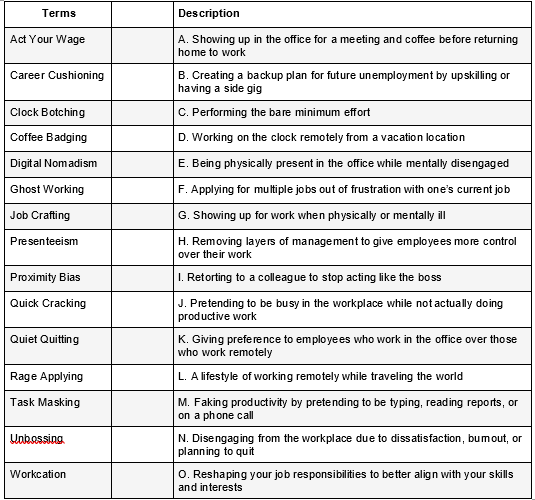
I recently came across the term “clock botching,” which was new to me. Upon researching the term, I learned that it was coined earlier this month to describe a new workplace trend. That led me to explore other terms—many of which describe behaviors that have emerged in recent years.

Test your knowledge! Match each workplace trend (left column) to the correct description (right column).

In the next few blogs, we will look at the factors that influenced these trends, the pros and cons of each, and how they impact your business.

Answer Key

  1. I — Act Your Wage
  2. B — Career Cushioning
  3. E — Clock Botching
  4. A — Coffee Badging
  5. L — Digital Nomadism
  6. M — Ghost Working
  7. O — Job Crafting
  8. G — Presenteeism
  9. K — Proximity Bias
  10. F — Quick Cracking
  11. C — Quiet Quitting
  12. F — Rage Applying
  13. J — Task Masking
  14. H — Unbossing
  15. D — Workcation

Leadership Mistakes: How to Turn Them Around

In recent blogs, we explored effective leadership approaches that help small business owners succeed. But many leaders still struggle to manage employees well. In fact, a study by Cake.com found that only 29% of employees trust their leaders, and just 20% believe they’re managed in a way that helps them work productively.

If you feel frustrated in your role as a leader, it may help to recognize which management styles are ineffective—and more importantly, how to correct them. Let’s look at four of the most common ineffective leadership styles and practical ways to overcome them.

Micromanagement

Micromanagers closely monitor every action their employees take. They resist delegating, and when they do, they often interfere with the work and demand constant updates. This creates an atmosphere where employees feel distrusted, fearful of mistakes, and discouraged from being creative. The result? Low morale, reduced productivity, and high turnover.

How to overcome micromanagement:

  • Acknowledge the behavior and identify the root cause. Is it fear of failure? Perfectionism? Lack of trust?
  • Start small by delegating low-risk tasks. Give clear expectations but avoid dictating every step.
  • Focus on goals and outcomes, not micromanaging the process.
  • Celebrate employee creativity and innovation.
  • Schedule regular check-ins rather than constant oversight.
  • Ask employees for feedback on how empowered they feel.
  • Invest in leadership development training—for yourself and your team.

Authoritarian Leadership

Authoritarian leaders make decisions alone, without input from their employees. While this style may feel efficient, it creates a fear-based culture, stifles creativity, and leaves employees disengaged.

How to shift away from authoritarian leadership:

  • Reflect on why you lead this way—often it’s driven by fear of failure or a need for control.
  • Invite feedback and listen to your employees’ concerns.
  • Delegate tasks and focus on results rather than process.
  • Adopt a coaching mindset: guide and encourage rather than command.
  • Encourage collaboration and shared decision-making.
  • Celebrate progress when you successfully empower employees.

Passive (Hands-Off) Leadership

At the opposite end of the spectrum, passive leaders avoid leading altogether. They focus only on their own tasks, leaving employees without direction or support. Conflicts go unresolved, decisions are delayed, and performance suffers.

How to become more engaged as a leader:

  • Acknowledge the avoidance. Remind yourself that you were chosen to lead because you are capable.
  • Ask your employees what they need from you and really listen.
  • Work with your team to set goals, priorities, and clear expectations.
  • Interact regularly and provide feedback—both praise and constructive guidance.
  • Gather information before making decisions rather than avoiding them.
  • Empower your team to make decisions and develop their skills.

Indecisive Leadership

Indecisive leaders procrastinate on decisions out of fear of mistakes. This creates confusion, frustrates employees, and causes missed opportunities for growth. Over time, employees lose confidence in their leader.

How to overcome indecisiveness:

  • Revisit why you started your business and define three priorities to guide your decisions.
  • Create a decision-making process (such as pros/cons lists or SWOT analysis).
  • Set deadlines to avoid procrastination.
  • Delegate decision-making where appropriate to reduce your burden.
  • Build confidence by making smaller, low-risk decisions first.
  • Accept that mistakes are part of leadership—learn from them and move forward.

Final Thoughts

As you can see, many of the corrective steps apply to more than one ineffective leadership style. Each plan of corrective action involves building relationships and trust with your employees. Whether you are a small business owner or a team leader within a company, your employees are your greatest assets. Treat your employees with respect and build their confidence so that they will partner with you to accomplish the goals of your company.

This blog concludes our leadership series, where we’ve explored both effective and ineffective leadership styles. Over the past several weeks, we’ve looked at transformational, servant, and coaching leadership—styles that inspire, guide, and empower employees. We’ve also examined the challenges of leading different generations in the workplace. Now, by addressing ineffective patterns such as micromanagement, authoritarianism, passivity, and indecision, you have a full picture of what to avoid and what to strive toward. Strong leadership is not about perfection—it’s about growth, self-awareness, and a commitment to creating a culture where both you and your employees can thrive.

Serve First:  The Leadership Style That Boosts Profits

In the last few blogs, we’ve explored six effective leadership styles: servant, transformational, results-driven, hands-on, adaptive, and coaching.

While no single style works best for every employee, servant leadership consistently ranked highest across most generations of workers. Beyond boosting morale and engagement, servant leadership can also improve the bottom line. A 2023 study found that business owners who shifted to a servant leadership approach saw an increase in profits.

What Makes a Servant Leader?

Servant leaders stand out by:

  • Allowing employees to share their feelings and suggestions
  • Listening to feedback from employees, customers, and stakeholders
  • Admitting mistakes and acknowledging they don’t have all the answers
  • Recognizing the contributions of others
  • Leading with authenticity
  • Committing to personal growth and improvement
  • Building a culture of trust and safety

Jesus modeled this style of leadership, reminding His disciples:

Whoever wants to become great among you must be your servant, and whoever wants to be first must be slave of all. For even the Son of Man did not come to be served, but to serve.”               — Mark 10:43–45

How Servant Leadership Benefits Businesses

Servant leadership doesn’t just feel good—it produces tangible results that can strengthen and grow a business:

1. Greater Employee Engagement

  • Employees feel valued, connected, and empowered in their roles
  • Engaged employees are more likely to stay, reducing costly turnover
  • Lower turnover = reduced hiring/training expenses = higher profits

2. Stronger Customer Relationships

  • Servant leaders prioritize customer needs and resolve issues quickly
  • Genuine care builds loyalty and trust
  • Better service and stronger relationships = repeat customers = higher revenues

3. More Innovation and Adaptability

  • Employees feel safe suggesting improvements and new ideas
  • A culture of trust encourages flexibility and openness to change
  • Increased efficiency and adaptability = happier customers = higher profits

4. Ethical Business Practices

  • Servant leaders model integrity in all dealings
  • Customers, employees, and partners are more likely to trust the business
  • Strong partnerships and customer loyalty = sustainable growth

5. Inspires Employees with a Sense of Purpose

  • Employees who believe in the mission bring passion and energy to their work
  • Purpose-driven employees are more productive and efficient
  • Greater productivity = lower costs = stronger profitability

Final Thoughts

Practicing servant leadership fosters a culture of trust, respect, and collaboration. These qualities not only make the workplace more positive but also contribute to long-term profitability.

The apostle Paul captured this spirit well:

Do nothing out of selfish ambition or vain conceit. Rather, in humility value others above yourselves, not looking to your own interests but each of you to the interests of the others.” — Philippians 2:3–4 (NIV)

When business owners choose to serve first, both people and profits thrive.

Leading Across Generations: How to Motivate and Manage a Multigenerational Team

If your business has more than a handful of employees, chances are you’re managing people from multiple generations. While many members of the Silent Generation and Baby Boomers are past traditional retirement age, about 16% of Americans aged 65+ are still working—some by choice, others by necessity. Older workers now make up around 12% of the workforce.

Millennials, on the other hand, represent the largest generational group, accounting for over one-third of today’s workforce. The rest is fairly evenly split between Gen X and Gen Z.

Each generation brings different values, communication preferences, and expectations to the workplace. If you want to lead your team effectively, you’ll need to adopt leadership styles that connect with and motivate individuals across these generational divides.

Let’s start with a quick overview of each generation in today’s workforce.

Generational Snapshot

Traditionalists (Silent Generation)
Born 1928–1945
Having lived through the Great Depression and World War II, Traditionalists value discipline, loyalty, and hard work. They prefer structured environments, respect hierarchy, and are most comfortable with formal communication. Only about 5% are still in the workforce, but their presence is slowly growing, especially in consulting or part-time roles.

Baby Boomers
Born 1946–1964
Many Boomers are nearing or already past retirement age, yet many continue working—often in leadership or consulting roles. Boomers are resourceful and competitive, value job security, and prefer in-person communication or phone calls over digital tools.

Generation X
Born 1965–1980
Gen Xers are often in leadership or upper management roles. They’re independent, tech-savvy, and appreciate a strong work-life balance. They prefer autonomy and clear performance expectations and tend to communicate via email or phone.

Millennials
Born 1981–1996
Millennials are rising leaders in business and bring a collaborative, purpose-driven approach to work. They embrace flexibility, value frequent feedback, and gravitate toward tech-enabled communication like video chat, messaging, and email.

Generation Z
Born 1997–2012
The youngest members of the workforce, Gen Zers are digital natives who expect fast, transparent communication and flexible, inclusive work environments. They value mentorship, purpose, and adaptability.

Leading Across Generations

Let’s take a look at how each generation responds to different leadership styles. Understanding these preferences can help you tailor your approach for stronger engagement and performance.

Traditionalists

  • Prefer clear goals and structured direction
  • Value stability and loyalty
  • Respond best to servant, results-oriented, and hands-on leadership
  • Prefer formal communication—written memos or face-to-face conversations

Baby Boomers

  • Competitive and committed, with a strong work ethic
  • Thrive on recognition and purpose
  • Prefer phone calls and face-to-face meetings
  • Respond best to servant, results-oriented, and hands-on leadership

Generation X

  • Independent and results-driven
  • Prefer autonomy, but want clear performance metrics
  • Communicate through email and phone
  • Respond well to results-oriented, adaptive, and hands-on leadership

Millennials

  • Value collaboration, flexibility, and meaningful work
  • Appreciate frequent feedback and transparency
  • Communicate via email, text, and video
  • Respond well to transformational, servant, and coaching leadership styles

Generation Z

  • Digital natives who expect quick communication and adaptability
  • Value diversity, mentorship, and growth
  • Communicate via instant messaging, video, and social apps
  • Respond well to coaching, transformational, and adaptive leadership

Leadership Style Effectiveness by Generation

6 = Most Effective | 1 = Least Effective

This chart shows how different generations respond to various leadership styles. As you can see, no single style works best for everyone—and generational stereotypes don’t tell the whole story. Individuals within a generation may have very different preferences and personalities.

How to Lead a Multigenerational Team

Here are some practical strategies to manage generational differences while maintaining a strong team culture:

1. Get to know your employees as individuals.
Use simple assessments or surveys to learn how each person prefers to communicate, be led, and receive feedback.

2. Blend leadership styles.
You don’t have to stick to one approach. Be hands-on with those who need guidance, and give more autonomy to those who thrive independently.

3. Diversify your communication methods.
Use email, text, video, and face-to-face conversations strategically. For important messages, follow up through more than one channel.

4. Encourage feedback.
Invite employees to share their preferences and ideas for improvement. This creates a culture of openness and mutual respect.

Final Thoughts

Leading across generations can feel complex—but it’s also an opportunity. When you adapt your leadership to meet your team where they are, you build trust, improve retention, and unlock greater performance.

Start small. Listen well. And don’t be afraid. Your employees—and your business—will thank you for it.

Effective Leadership Styles: Which One Fits You Best?

As a business owner, your leadership style sets the tone for your company culture, employee morale, and ultimately your success. Some leaders lean toward an authoritarian approach—my way or the highway—while others avoid leading altogether, trying instead to be everyone’s friend. Neither of these extremes typically result in strong or sustainable leadership.

In this blog, we’ll take a look at six effective leadership styles that can help you build a healthier business and a stronger team.

Servant Leaders: Leading with Empathy

Servant leaders put the needs of others ahead of their own. A defining trait of this leadership style is the intentional consideration of how business decisions affect employees. Policies are designed to improve—not complicate—the lives of those who work for them.

A small business owner who embraces servant leadership strives to grow both the company and the people within it. He works to balance the needs of the business with the family lives of his employees, cultivating loyalty and a strong team culture.

Servant leaders are characterized by:

  • Empathy and understanding
  • Selflessness in decision-making
  • A focus on empowering employees

Transformational Leaders: Inspiring Growth and Innovation

A transformational leader seeks to improve and evolve the business. This often includes changing the workplace culture, streamlining processes, or introducing innovation. These leaders share their vision with their team and motivate them to work toward it.

A small business owner with a transformational mindset listens to employees and values their input. He encourages adaptability and embraces change as a path to improvement.

Transformational leaders are characterized by:

  • A compelling vision for the future
  • Motivation and inspiration
  • A willingness to lead through change

Hands-On Leaders: Leading by Example

Hands-on leaders work closely with their employees and understand the day-to-day operations of the business. This leadership style is especially common (and often necessary) in the early stages of a company.

A hands-on owner models a strong work ethic and sets the standard for professionalism, service, and dedication.

Hands-on leaders are characterized by:

  • Deep operational knowledge
  • High involvement in daily tasks
  • Strong modeling of company values

Results-Oriented Leaders: Focused on the Bottom Line

Results-oriented leaders are driven by clear goals—such as hitting sales targets or maintaining profit margins. These leaders value data, use measurable benchmarks to evaluate performance, and hold employees accountable.

They are highly effective at creating systems that lead to tangible success. Everyone on the team knows what is expected and how they contribute to the bigger picture.

Results-oriented leaders are characterized by:

  • Clear performance goals and expectations
  • Regular feedback and evaluation
  • Recognition of high achievers

Adaptive Leaders: Thriving Through Change

Adaptive leaders are flexible and responsive to shifting business environments. They stay informed about industry trends, pivot when needed, and encourage feedback from employees.

An adaptive leader views change not as a disruption but as an opportunity for innovation. He learns from failures and stays focused on long-term goals.

Adaptive leaders are characterized by:

  • Responsiveness to change and feedback
  • Strategic decision-making
  • A willingness to evolve with the market

Coaching Leaders: Mentoring for Growth

A coaching leader sees employees not just as workers but as people with potential. This leadership style focuses on developing individual strengths and long-term growth.

A business owner who leads this way invests time in understanding his team. He provides thoughtful feedback, encourages problem-solving, and builds strong relationships based on trust.

Coaching leaders are characterized by:

  • Prioritizing employee development
  • Constructive, two-way feedback
  • Trust-building and mentoring

Which Style Fits You?

Each of these leadership styles can be effective—but not every style will feel natural to every business owner. If you’re naturally task-oriented, you may gravitate toward being a results-oriented leader. If you’re more people-focused, servant, coaching, transformational, or hands-on leadership may feel more authentic. Adaptive leaders often strike a balance between both.

Want help identifying your natural leadership strengths? Try one of these free personality assessments:

Each test takes about ten minutes and can provide valuable insight to help you lead more confidently and effectively.

Coming up next: In my next blog, we’ll discuss how different generations of employees respond to different leadership styles—and how you can adjust your approach to lead them well.

Who’s in Charge When You’re Away?: Identifying a Trusted Leader

In my last blog, I shared how important it is to develop one or more employees who can manage the business while you’re away. Whether you call them a lead employee, acting manager, or person in charge, choosing the right person matters.

When you’re away from the business, you want someone who will represent you well—someone you trust to protect and even enhance the reputation you’ve worked hard to build. That’s why I want to walk you through what I’ve learned over the years about identifying potential leaders in your workplace.

The best lead employees are reliable, trustworthy, knowledgeable, and respectful. These are the people who will give you peace of mind when you take time off—whether it’s for a vacation, family need, or just a day to recharge.

What to Look for in a Lead Employee

Someone Who Is Reliable

When you’re not around, you need someone who consistently follows through and doesn’t require reminders. A reliable employee:

  • Is on time and dependable
  • Gives notice when they need to change their schedule
  • Follows your policies and procedures
  • Completes tasks correctly and on time
  • Can be trusted with tasks like ordering supplies or making bank deposits
  • Keeps their commitments and doesn’t make excuses

Someone You Can Trust

You need someone who will do the right thing—even when no one’s watching. A trustworthy employee:

  • Works well without constant oversight
  • Is honest and transparent
  • Makes decisions with integrity
  • Admits mistakes and works to correct them
  • Respects your business and protects its value
  • Puts the company’s best interests first when you’re not there

Someone Who Knows the Business

A qualified leader understands how the business works and how you want things done. A knowledgeable employee:

  • Understands day-to-day operations
  • Supports your business goals and works to achieve them
  • Can confidently explain products and services to customers
  • Exercises good judgment in difficult or unusual situations
  • Anticipates how you would respond and acts accordingly
  • Brings you thoughtful ideas for improvement

Someone Who Is Respectful

Your lead employee should treat others with professionalism and kindness. A respectful employee:

  • Shows courtesy to customers and coworkers
  • Listens well and communicates clearly
  • Considers all perspectives before making decisions
  • Offers praise in public and correction in private
  • Maintains composure when tensions rise
  • Recognizes and appreciates their team members

Leadership Benefits Everyone

If you select and train the right people, you’ll be able to step away from your business knowing it’s in capable hands. Not only will you enjoy peace of mind and time to rest, but your lead employees will grow in their own confidence, responsibility, and job satisfaction.

Paul reminds us in Scripture,
Now it is required that those who have been given a trust must prove faithful.”1 Corinthians 4:2 (NIV)

Developing trustworthy leaders within your business is one of the best investments you can make—not just for your time off, but for the future of your company.

Stepping Away from a Small Business Without Losing Control: How to Develop a Trusted Team Leader

Recent surveys show that many employees today are not interested in stepping into management roles. Instead, they prefer positions where they can contribute as individuals without supervising others. For larger firms—where multiple layers of management are essential—this creates a challenge. In response, many of these organizations are developing alternative career paths to retain talent and allow for growth without forcing people into unwanted leadership roles.

As a small business owner, you might think this trend doesn’t apply to you—especially if you currently wear all the management hats. But if you have employees, it’s vital to develop at least one who can step into a leadership role in your absence. Imagine spending a week at the beach, completely unplugged, while a capable, trusted team member handles the day-to-day responsibilities of your business.

So, how do you encourage and prepare someone to be your go-to leader?

Understand Why Employees May Avoid Management

Especially among younger workers, there is often hesitancy to move into management. Common concerns include:

  • Increased stress
  • Longer working hours
  • Interference with family or personal life
  • Strained relationships with co-workers

Understanding these concerns allows you to build a leadership development plan that reassures potential leaders and sets them up for success.

Steps to Develop a Lead Employee

Here’s a practical approach to cultivating leadership in your business:

1. Reframe the Role

  • Use the title leader instead of manager to make the role feel more approachable.
  • Emphasize that the goal is to help the business run smoothly when you’re away—not to burden the employee with unnecessary stress.

2. Define Responsibilities

  • Make a clear list of tasks the employee will be expected to handle in your absence.
  • Outline which decisions they can make independently and which ones require your input.
  • Create easy-to-follow checklists and protocols for recurring responsibilities.
  • Provide a contact file with supplier, client, employee, and emergency information.

3. Begin Delegating Gradually

Start by assigning small tasks and increasing responsibility over time. These might include:

  • Opening or closing the business
  • Handling customer questions or complaints
  • Responding to employee needs or schedule changes
  • Ordering supplies
  • Making bank deposits

4. Try a Trial Run

Choose a day to delegate full authority to your lead employee while you remain on-site.

  • Step back and allow them to make decisions.
  • If other employees approach you, direct them to the lead.
  • Provide feedback afterward and evaluate what went well and what needs refining.

5. Create a Vacation Handbook”

Prepare your employee with a written guide that includes:

  • Task checklists and contact lists
  • Necessary passwords and system access
  • Emergency protocols and clear instructions on when to contact you

6. Take a Short Break First

Before your big vacation, take a day off and let the lead employee manage independently.

  • Review the experience together.
  • Answer questions that came up.
  • Clarify anything that was unclear.

7. Schedule and Take Your Vacation

Once your lead is ready, take that well-deserved time off. Trust the process, and trust your employee.

If Your Business Has Extended Hours…

If your business is open more than eight hours a day or more than five days a week, consider developing two or three lead employees. That way, they can rotate shifts and avoid burnout—ensuring full coverage without exhausting your team.

Benefits for You and Your Business

Following these steps prepares your lead employee to handle daily operations with confidence. When employees feel equipped and supported, their stress decreases and their performance improves. For you, it means peace of mind and the freedom to step away when needed—whether it’s for a vacation, family event, or simply a much-needed break.

Leadership doesn’t have to be about titles—it’s about trust, preparation, and partnership.

A Guide for Small Business Owners: Finding Peace Without Losing Your Drive

A friend commented recently that one of his children had been so content as a young man, he worried it might keep him from achieving all that God intended for him in life.

Contentment—being at peace and satisfied with one’s station—is a valuable quality. People who are content tend to experience lower stress levels and a deeper appreciation for daily life. The apostle Paul modeled this beautifully, writing:

“I have learned in whatever state I am, to be content.”
Philippians 4:11 (KJV)

But while contentment is healthy, it can become a drawback if it leads to complacency. A person who is too content may neglect personal development, avoid pursuing opportunities, or settle for less than their best. For a small business owner, this might mean missing out on ways to better serve customers, grow the business, or create jobs.

Conversely, unchecked ambition can be equally harmful. The Bible warns against selfish ambition:

For where you have envy and selfish ambition, there you find disorder and every evil practice.
James 3:16 (NIV)

The key is finding a healthy balance—striving to improve your business while maintaining contentment in the journey and integrity in your methods.

How to Balance Contentment and Ambition in Your Business

If you’re a small business owner, it’s important to regularly evaluate your goals, values, and ambitions to ensure they align with your faith, lifestyle, and vision. Here’s a practical process to help you balance ambition with contentment:

1. Reflect on Your Personal and Business Goals

Before you can decide how much to grow your business, be clear about what you want from it. Consider:

  • Do you want to work as a solopreneur, generating income through your own skills without managing employees?
  • Does your business idea require more labor than you can handle alone?
  • Do you want to create jobs and provide reliable income for others?
  • How many hours per week are you willing to work?
  • What type of schedule would you like to maintain?

Example:
If you value evenings and weekends off, a manufacturing or professional service business might suit you better than a restaurant, retail shop, or entertainment business.

2. Define Your Financial Needs

Understand how much income you need to meet your personal and family obligations. Your financial goals will shape your business structure:

  • As a solopreneur, your income depends solely on your labor and the rates you charge.
  • As an employer, your income potential grows with employee productivity and overall business revenue.

3. Develop a Business Plan That Reflects Your Priorities

Once your goals are clear, develop a plan that honors those objectives.

  • Choose your legal structure.
  • Launch your marketing strategy.
  • Build your customer base through personal connections and word-of-mouth.

Remember: The startup phase is typically slow—be patient as customers become aware of your business.

4. Regularly Assess Your Growth and Contentment

Periodically evaluate whether you’re satisfied with your business’s size, revenue, and operations.

Questions to consider:

  • Are you content with your current workload and income?
    • Has demand exceeded your capacity? If so, would you prefer to turn away work or hire help and grow your business?
  • Would expanding your hours, services, or product lines serve your goals—or cause unnecessary stress?
  • Is maintaining your current size better aligned with your personal and family priorities?

There’s no wrong answer—what matters is that your decisions reflect thoughtful, prayerful discernment.

5. Avoid Complacency While Maintaining Contentment

Even if you’re satisfied with your business size, remain proactive:

  • Monitor industry trends and customer preferences.
  • Stay current with new technologies that improve efficiency.
  • Review your offerings to meet evolving customer needs.
  • Keep your physical space welcoming and well-maintained.
  • Stay compliant with legal and regulatory changes.
  • Invest in employee development through training and advancement opportunities.

Final Thoughts

Business ownership can bring both financial rewards and personal fulfillment when managed wisely. But it can also lead to stress and dissatisfaction if you chase goals that don’t align with your values or allow others to pressure you into expanding beyond your comfort zone.

Strive to operate a business that honors your definition of success, serves others well, and allows you to live with contentment and integrity. In doing so, you’ll find a healthy, God-honoring balance between ambition and peace.

📢 Id love to hear from you!

How have you balanced contentment and ambition in your business? What decisions helped you stay true to your values while pursuing growth? Share your thoughts in the comments!